Nuclear Safety Inspector: Pay, Training & Daily Duties
Imagine having a job where “having a meltdown” isn’t just a metaphor for a stressful Monday, it’s exactly what you’re there to prevent. That is the high-stakes reality of a Nuclear Safety Inspector.
Right now, every single operating nuclear power plant in the United States has at least two NRC resident inspectors on-site, watching operations around the clock.
If standing between a massive reactor and a potential safety failure sounds like the ultimate purpose-driven career, you’re spot on. It’s a role that requires a sharp eye, a calm head, and a genuine passion for public safety.
In this guide, we’re going behind the concrete walls to explore everything you need to know about joining the field.
We’ll break down the salary expectations, the rigorous qualifications required, and what a “normal” (if there is such a thing) workday actually looks like.
What Is a Nuclear Safety Inspector?
A nuclear safety inspector ensures facilities follow federal regulations and safety protocols to prevent incidents. While roles like health physics technicians or security officers focus on specific tasks like radiation monitoring or physical defense, the safety inspector provides high-level regulatory oversight of the entire facility’s safety posture.
Core Inspector Roles
Where Nuclear Safety Inspectors Work?
The range of workplaces for nuclear safety inspectors goes well beyond the typical power plant. Here’s where you’ll find them:
- Nuclear Power Plants remain the most common workplace, both for operating reactors and facilities under construction. The U.S. currently operates 93 commercial nuclear reactors across 54 plant sites, and each one has resident inspectors on-site.
- Government regulatory bodies like the U.S. Nuclear Regulatory Commission (NRC), the Department of Energy (DOE), and international organizations such as the International Atomic Energy Agency (IAEA) employ a significant number of inspectors in both field and headquarters roles.
- Nuclear Fuel Cycle Facilities including enrichment plants, fuel fabrication facilities, and conversion operations all require regular safety inspections.
- Nuclear Waste Storage and Disposal Sites such as independent spent fuel storage installations (ISFSIs) need inspectors to verify safe handling and containment of radioactive materials.
- Research Reactors and National Laboratories operate under their own set of safety requirements and are subject to inspection.
- Decommissioning Projects are growing in number as older reactors reach end-of-life, creating a steady need for inspectors who can oversee safe dismantlement.
- Defense and Military Nuclear Installations under the DOE and the National Nuclear Security Administration (NNSA) maintain their own inspection programs for weapons-related facilities and naval reactor operations.
Why Does This Role Matters More Than Ever?
The nuclear safety inspector role has never been more critical than it is right now. The U.S. Department of Energy projects that the nuclear energy sector will require over 375,000 skilled workers by 2050 to sustain ongoing operations and support next-generation reactor deployment.
Meanwhile, the existing workforce is aging rapidly. According to the DOE’s 2024 U.S. Energy & Employment Report, 60% of nuclear workers are between ages 30 and 54, and the sector has 23% fewer workers under 30 compared to the broader energy workforce.
The rise of Small Modular Reactors (SMRs), advanced reactor designs, and growing global interest in nuclear energy as a clean power source means regulatory oversight will need to scale right alongside the technology. More reactors mean more inspectors, period.
Employers across the nuclear sector are already feeling the squeeze. According to the DOE’s 2025 U.S. Energy & Employment Report, 63% of nuclear manufacturing employers reported that hiring was “very difficult,” and over 80% of employers across all nuclear subsectors said they experienced at least some hiring difficulty. For qualified professionals, this means significant opportunity.
Missing the Right Nuclear Expertise?
We close the gap. From specialised engineering talent to leadership roles, TRX International connects the best in the sector. As a specialized nuclear recruitment agency, TRX understands the qualifications, clearances, and career paths that matter in this space.
What Does a Nuclear Safety Inspector Do?
The day-to-day work of a nuclear safety inspector covers a broad range of responsibilities. It’s a role that requires both deep technical knowledge and strong interpersonal skills, because you’re not just reviewing paperwork. You’re evaluating people, processes, and systems under real operating conditions.
Regulatory Compliance and Enforcement
At its core, this job is about ensuring that nuclear facilities operate within the boundaries set by federal regulations. Inspectors review and audit safety documentation, technical specifications, operating procedures, and corrective action programs.
When violations are found, inspectors have the authority to issue citations, document findings, and require licensees to take corrective action. In serious cases, enforcement actions can escalate to civil penalties or even orders to shut down operations.
Facility Inspections and Audits
Inspections come in several forms. Routine scheduled inspections follow the NRC’s baseline inspection program, which outlines specific areas to evaluate on a regular cycle.
Unannounced and reactive inspections happen when events or concerns trigger a closer look. And special inspections are launched in response to significant operational events, safety system failures, or other elevated concerns.
During these inspections, you’ll conduct walkdowns of plant systems, observe maintenance activities, watch operators during evolutions, and compare what you see against what the facility’s procedures and regulations require.
Radiation Protection and Monitoring
Inspectors evaluate a facility’s radiation protection program to verify that workers and the public are being adequately protected. This includes reviewing radiation exposure records, checking dosimetry programs, verifying contamination controls, and assessing how well the facility implements its ALARA (As Low As Reasonably Achievable) program.
ALARA is a regulatory principle that requires licensees to make every reasonable effort to keep radiation doses as far below regulatory limits as practical.
Emergency Preparedness Evaluation
Nuclear facilities must maintain robust emergency plans, and inspectors are responsible for evaluating those plans and the drills that test them. This involves observing emergency exercises, assessing communication protocols, evaluating evacuation procedures, and verifying that emergency equipment is maintained and ready. Inspectors may also participate in graded exercises alongside FEMA evaluators.
Documentation, Reporting, and Communication
Every inspection produces a written record. Inspectors write detailed inspection reports that document their findings, observations, and conclusions. These reports are shared with plant management and made publicly available through the NRC’s ADAMS (Agencywide Documents Access and Management System) database. In some cases, inspectors may be called upon to present findings in public meetings or regulatory hearings.
Safety Culture Assessment
One of the more nuanced parts of the job involves evaluating the overall safety culture at a facility. This isn’t something you can measure with a radiation detector. It requires observation, interviews with plant personnel at every level, and an understanding of organizational behavior.
Inspectors look for signs that safety is genuinely prioritized in decision-making, that workers feel comfortable raising concerns, and that management is responsive to safety issues.
What a Typical Day Looks Like for a Nuclear Safety Inspector?
One of the most common questions from people considering this career is: “What does a normal day actually look like?” The honest answer is that no two days are exactly alike. But there is a general rhythm to the work, especially for resident inspectors stationed at a nuclear plant.
Morning: Briefings and Preparation
Most days start early. A resident inspector typically begins by reviewing the plant’s overnight status, including any alarms, equipment issues, or operational changes that occurred during the night shift. If the plant had any reportable events or unusual conditions, those get flagged immediately.
Next comes the daily briefing. Depending on the facility, this could be a formal meeting with plant management or a quick check-in with the operations team to understand the day’s planned activities. This is where you’ll identify your focus areas for the day.
Maybe there’s a safety system test scheduled, or a maintenance crew is performing work on a critical component. Those activities become your inspection targets.
Midday: Field Inspections and Observations
This is where the real work happens. You’ll spend time walking down plant areas, which could include the control room, containment building, auxiliary buildings, diesel generator rooms, switchgear areas, or the spent fuel pool. You’re observing work in progress, checking that procedures are being followed, looking for material condition issues, and verifying that safety barriers are intact.
You’ll also conduct interviews with operators, technicians, engineers, and supervisors. These conversations help you understand how decisions are being made and whether the facility’s safety culture is healthy.
You might ask an operator to walk you through their response to a hypothetical scenario, or you might ask a maintenance technician to explain the steps they’re taking and why.
Afternoon: Analysis, Reporting, and Follow-Up
After your field time, you’ll return to your office (which for a resident inspector is typically located right at the plant site) to document your observations. This involves cross-referencing what you saw against regulatory requirements, technical specifications, and the facility’s own procedures.
If you’ve identified a potential finding, you’ll begin the process of characterizing its significance and determining whether it rises to the level of a documented violation.
You’ll also conduct debrief meetings with site personnel to share preliminary observations and discuss any concerns.
Communication is a critical part of the role, as you need to clearly articulate technical issues to people who may have a different perspective on the same situation.
The Reality: No Two Days Are the Same
While the above describes a typical day, the job can shift quickly. Emergency callouts can happen at any time. If there’s a significant event at the plant, like a reactor trip or a safety system actuation, inspectors respond immediately to evaluate the cause and the plant’s response.
Regional and specialist inspectors often travel extensively, sometimes spending weeks at different facilities. During refueling outages, which happen roughly every 18 to 24 months at each plant, the pace intensifies significantly. Outages involve massive amounts of maintenance, testing, and modification work condensed into a few weeks, and inspectors ramp up their oversight accordingly.
Looking for Qualified Nuclear Professionals?
TRX International specializes in nuclear and energy sector recruitment. Reach out to our team and let us help you make the right connection.
Nuclear Safety Inspector Salary and Compensation
Let’s talk about what this career pays, because the compensation is one of the strongest arguments for pursuing it.
Average Salary Ranges
Compensation varies based on experience, employer type, and location, but the numbers are strong across the board.
- Entry-Level Positions: Those just starting their careers in nuclear safety inspection can expect salaries in the range of $65,000 to $85,000, depending on education and prior experience. For federal positions at the NRC, entry-level inspectors typically start at the GS-11 or GS-12 level.
- Mid-Career Professionals: With five to ten years of experience, nuclear safety inspectors commonly earn between $90,000 and $130,000 annually. At the NRC, this corresponds to the GS-13 and GS-14 pay grades, which include locality pay adjustments that can significantly boost total compensation.
- Senior-Level and Lead Inspectors: Senior inspectors, team leads, and branch chiefs can earn between $130,000 and $190,000 or more. According to Glassdoor, the average total compensation for nuclear inspectors is approximately $146,092 per year, with top earners reaching up to $248,000.
These figures are notably higher than many other inspection and safety roles. For context, general safety inspectors earn a median of about $86,700, while nuclear safety roles consistently command a premium due to the specialized knowledge and clearance requirements involved.
Salary Differences Across Employer Types
- Federal Government (NRC, DOE, DOD): Federal positions offer structured pay through the General Schedule (GS) system, with NRC resident inspectors receiving special salary schedules that include enhanced pay. Locality pay adjustments vary, but inspectors in high-cost areas like Washington, D.C., California, and the Northeast can see total compensation well above base rates.
- Private Sector and Utility Companies: Major nuclear operators like Constellation Energy, Duke Energy, Southern Company, and EDF often offer competitive packages that include base salary, annual bonuses, and performance incentives. Private sector compensation can exceed federal pay, especially at the senior level.
- Consulting and Contractor Roles: Independent consultants and contractors working in nuclear safety can command hourly rates ranging from $75 to $150+, particularly during outage seasons or for specialized assessments.
- International Opportunities: Organizations like the IAEA, along with international new-build projects in countries expanding their nuclear programs, offer roles with competitive pay plus additional benefits like housing allowances and tax advantages.
Benefits Beyond Base Salary
Federal nuclear safety inspectors enjoy one of the most comprehensive benefits packages available. This includes the Federal Employees Retirement System (FERS), Thrift Savings Plan (TSP) with employer matching, and a full suite of health, dental, and vision insurance options.
Private sector positions often come with their own advantages, including relocation packages, outage premiums, company-matched 401(k) plans, and continuing education reimbursement.
Across the board, nuclear safety inspection offers something that many careers cannot: exceptional job stability. Nuclear plants operate for decades, regulatory oversight is legally mandated, and the skills you develop are in persistent demand.
What Influences Your Pay?
Several factors affect where you fall within these salary ranges. Geographic location plays a major role, as cost-of-living adjustments and locality pay can vary significantly from state to state.
Holding an active security clearance, whether L or Q level through the DOE or NRC access authorization, adds value. Specialized certifications, advanced degrees, and prior experience as a licensed reactor operator (RO or SRO) all push compensation higher.
How to Become a Nuclear Safety Inspector?
Getting into this career isn’t something that happens overnight. It takes a specific combination of education, hands-on experience, and formal qualifications. But for the right candidate, the path is well-defined and achievable.
Education Requirements

Minimum Educational Background
Most nuclear safety inspector positions require at least a bachelor’s degree in a relevant technical field. The most common and competitive degrees include nuclear engineering, health physics, mechanical engineering, electrical engineering, physics, chemistry, or another physical science. The NRC and other federal agencies typically list these fields in their minimum qualification standards.
If your degree is in a closely related discipline, you may still qualify, but a strong foundation in radiation science, reactor systems, and thermodynamics will serve you best.
When Advanced Degrees Help?
A master’s degree or PhD isn’t required for most inspector positions, but it can accelerate your career progression and open doors to specialized roles. Advanced degrees in nuclear engineering, health physics, or risk assessment are especially valuable for positions involving probabilistic risk assessment (PRA), safety analysis, or regulatory policy development. If you’re targeting a career in nuclear regulatory research or senior advisory roles, an advanced degree is a significant advantage.
Experience Requirements

Nuclear Industry Experience
Education alone won’t get you into the inspector’s chair. Most positions require between three and seven years of hands-on experience in the nuclear industry. This could come from roles in reactor operations, nuclear engineering, radiation protection, maintenance supervision, or quality assurance at a licensed nuclear facility.
One of the strongest backgrounds you can bring is experience as a licensed reactor operator (RO) or senior reactor operator (SRO). Licensed operators have deep familiarity with plant systems, emergency procedures, and the regulatory framework, all of which translate directly into inspection competence.
Military Nuclear Experience
The U.S. Navy’s Nuclear Propulsion Program is one of the most well-respected pipelines into civilian nuclear careers, and nuclear safety inspection is no exception. Navy nuclear-trained personnel, including reactor operators, engineering laboratory technicians, and nuclear-trained officers, bring rigorous operational experience and a strong safety discipline that regulatory agencies and utility companies value highly.
Certifications and Licenses
NRC Inspector Qualifications
For those working directly as NRC inspectors, the agency has a formal training and qualification program outlined in Inspection Manual Chapter (IMC) 1245. This program includes two levels of qualification.
The Basic Level involves individual study activities, formal classroom training at the NRC’s Technical Training Center, and on-the-job training under the supervision of qualified inspectors.
Activities include facility familiarization tours, control room observations, documenting inspection findings, and understanding the NRC’s reactor oversight process. Basic-level qualification allows inspectors to perform limited-scope inspection activities under supervision.
The Proficiency Level builds on the basic level with advanced technical training and a qualification board examination. This board evaluates whether the inspector has the integrated knowledge and skills to conduct inspections independently. The NRC expects new inspectors to achieve full qualification within approximately two years.
Health Physics and Radiation Protection Certifications
Several industry certifications strengthen your qualifications and make you a more competitive candidate:
The Certified Health Physicist (CHP) credential, offered through the American Board of Health Physics, is the gold standard for radiation protection professionals. It requires a combination of education, experience, and passing a two-part examination.
The National Registry of Radiation Protection Technologists (NRRPT) certification is another respected credential, particularly for professionals whose work focuses on applied radiation protection.
Other Valuable Certifications
Depending on your specific focus area, additional certifications can add value. These include ASQ certifications like the Certified Quality Auditor (CQA) or Certified Quality Engineer (CQE), OSHA safety certifications, and credentials related to ISO 19443 or NQA-1 quality program standards.
Security Clearance and Background Checks
Nuclear safety inspection positions almost universally require some level of security screening. Federal positions with the NRC require NRC access authorization, while DOE-related positions may require an L or Q clearance depending on the level of access to classified or sensitive information.
The background investigation process examines criminal history, financial records, foreign contacts, substance use, and personal conduct. It’s thorough and can take several months to complete. Once granted, clearances require periodic reinvestigation and continuous monitoring.
Essential Skills and Competencies
Technical Skills
Successful inspectors bring a strong technical toolkit. This includes deep knowledge of reactor systems and nuclear safety principles, proficiency with radiation detection and measurement instruments, understanding of probabilistic risk assessment, and working familiarity with regulatory codes including 10 CFR Parts 20, 50, 52, and 73, as well as IAEA Safety Standards.
Professional and Interpersonal Skills
The technical side is only half the equation. Nuclear safety inspectors also need sharp analytical and critical thinking abilities, clear written and verbal communication skills, and the ability to remain objective and professionally assertive when delivering findings that plant management may not want to hear.
Conflict resolution skills matter here. You’ll regularly find yourself in situations where your assessment of a safety issue differs from the licensee’s perspective, and you need to handle those conversations with both firmness and professionalism.
Career Path and Growth Opportunities
Entry Points into Nuclear Safety Inspection
There’s no single path into this career, but the most common entry routes include transitioning from nuclear plant operations or engineering, joining through government recruitment programs like the NRC’s Resident Inspector Development Program (RIDP), or moving from military nuclear service into civilian inspection roles.
The NRC’s RIDP is specifically designed to develop new inspectors. Selectees receive formal classroom training, developmental assignments, and structured on-the-job training, with the expectation that they’ll achieve full qualification within two years and then serve as resident inspectors at assigned plant sites.
Career Progression
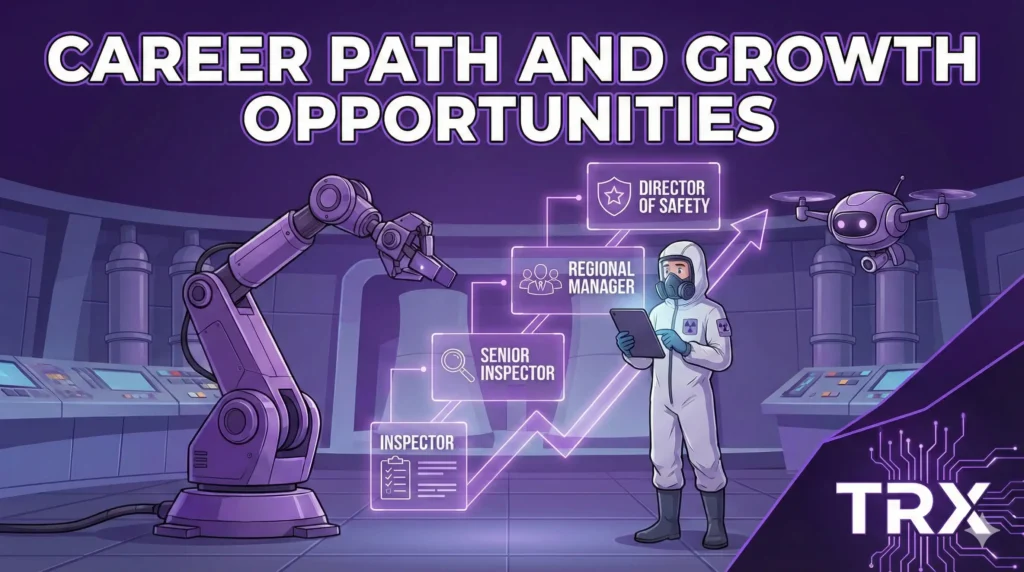
The career ladder for nuclear safety inspectors is well-structured, especially within the federal system:
- Junior / Trainee Inspector: You’ll start under supervision, learning the inspection process and building your technical foundation. Federal positions typically begin at the GS-11 or GS-12 level.
- Qualified Inspector: After completing the full qualification process, you’ll conduct independent inspections across a range of technical areas. This is the GS-13 level at the NRC.
- Senior Inspector / Team Lead: With additional experience and demonstrated expertise, you’ll take on leadership of inspection teams, mentor newer inspectors, and handle the most complex or sensitive assignments. This corresponds to GS-14 roles.
- Branch Chief or Regional Management: Moving into management means overseeing inspection programs, setting priorities, and managing staff. These are GS-15 and Senior Executive Service (SES) positions.
Lateral Moves and Specializations
One of the strengths of this career is the range of directions you can take it. Specialist tracks include security inspection, emergency preparedness, fire protection, cybersecurity, and safeguards. You can also transition into nuclear safety consulting, work for international organizations like the IAEA, or move into regulatory affairs, licensing, and nuclear safety policy.
The Future Outlook
The outlook for nuclear safety inspectors is exceptionally strong. The DOE reports that the nuclear workforce grew by 5.7% from 2024 to 2025 and employers anticipate a 9.2% increase in nuclear construction employment. The U.S. nuclear workforce is expected to nearly triple by 2050, and the IAEA has forecast a need for more than four million nuclear professionals globally to support the projected expansion of nuclear capacity.
Three of the top five highest-paying careers in electric power generation are in nuclear energy, with nuclear engineers earning a median of $127,520, reactor operators at $122,610, and nuclear technicians at $104,240 according to the DOE’s 2025 USEER report. Nuclear safety inspection careers fall comfortably within this top tier.
Frequently Asked Questions About Nuclear Safety Inspector Jobs
Is being a nuclear safety inspector a good career?
Yes! Becoming a Nuclear Safety Inspector offers high pay, unmatched job security, and the deep satisfaction of protecting public health while working in a high-stakes, essential industry.
How long does it take to become a nuclear safety inspector?
Expect roughly nine to thirteen years. This includes a four-year technical degree, several years of industry experience, and two years of specialized NRC qualification training before flying solo.
What is the difference between a nuclear safety inspector and a nuclear security officer?
Inspectors ensure mechanical systems and procedures meet safety regulations to prevent leaks. Security officers focus on physical protection, access control, and defending the facility against external threats.
Do nuclear safety inspectors get exposed to radiation?
While inspectors enter areas with radiation, exposure is strictly monitored via wearable dosimetry. Levels are kept “as low as reasonably achievable,” far below federal safety limits for workers.
Can I become a nuclear safety inspector with military experience?
Absolutely. Veterans, especially from the Navy Nuclear Propulsion Program, are highly sought after for their technical discipline, rigorous training, and “safety-first” mindset in high-pressure environments.
Are nuclear safety inspector jobs in demand?
Definitely. With a massive wave of retirements and federal goals to triple nuclear capacity by 2050, the demand for skilled safety oversight has never been higher.
What federal agencies hire nuclear safety inspectors?
The U.S. Nuclear Regulatory Commission (NRC) is the primary employer, but the DOE, NNSA, and Department of Defense also hire inspectors to oversee national labs and military operations.
Can nuclear safety inspectors work internationally?
Yes! Opportunities exist with the IAEA in Vienna or through global firms like Westinghouse. Experienced inspectors are often recruited to help develop regulatory frameworks for emerging nuclear nations.
How TRX International Can Help You Land a Nuclear Safety Inspector Role?
The nuclear industry is not like other job markets. It has unique qualification standards, security clearance requirements, and a relatively small pool of employers with very specific needs. Working with a generalist recruiter who doesn’t understand the difference between an SRO license and a CHP certification can cost you time and opportunities.
TRX International exists specifically for the nuclear and energy sector. As a specialized recruitment agency and human resource provider, TRX has the industry relationships, technical knowledge, and placement expertise to match qualified professionals with the right roles. Whether you’re a seasoned inspector looking for your next challenge or an operations professional ready to transition into a safety inspection career, TRX can help you get there faster.