Clean Energy vs Nuclear: Where Are the Most Jobs in 2026?
If you’ve been paying any attention to the global energy conversation over the past couple of years, you’ve probably noticed something: the debate isn’t really “clean energy vs nuclear” anymore. It’s more like “clean energy and nuclear, and how on earth do we find enough people to make it all work?”
That’s the question I keep coming back to. The headlines are full of record solar installations, offshore wind milestones, and a genuine nuclear renaissance. But behind every panel bolted to a roof and every reactor humming to life, there’s a workforce story that doesn’t always get the spotlight it deserves.
In 2024, the United States alone supported more than 4 million climate-related jobs, according to the U.S. Department of Energy’s annual employment report. Clean energy job creation outpaced fossil fuel hiring and grew at a rate more than three times the national average.
Meanwhile, the nuclear energy sector directly employs over 100,000 people in the U.S., with secondary and supply-chain jobs pushing that number well past 350,000, and projections suggest the industry will need hundreds of thousands more by 2035.
Here’s my honest take: Both sectors are screaming for talent. But they’re screaming in very different ways, for very different skill sets, and through very different megaphones. Let me break it down.
Clean Energy vs Nuclear Energy: Quick Side-by-Side
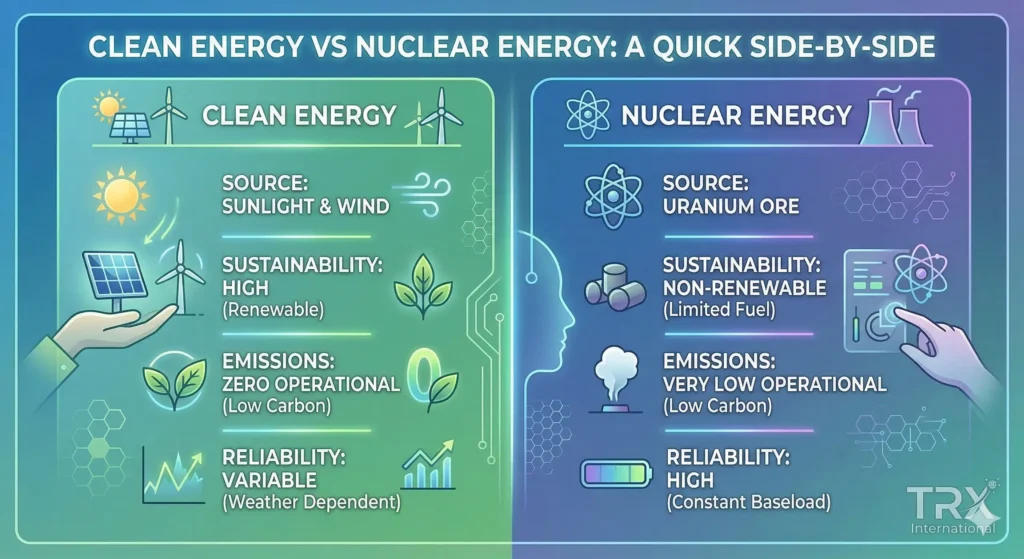
Alright, let’s put these two side by side for a moment, because I think it helps to see the contrast clearly. Clean energy and nuclear energy are both critical to the world’s decarbonisation goals, but they play very different roles in the job market. Clean energy, particularly solar, wind, and energy efficiency, generates a massive volume of jobs. It’s accessible, fast-growing, and spread across a wide range of skill levels.
Nuclear, on the other hand, creates fewer positions in absolute numbers but punches well above its weight in terms of pay, stability, and long-term career value. Think of it this way: clean energy is the broad river, nuclear is the deep well. Both give you water, but the experience of drawing from each is fundamentally different.
| Factor | Clean Energy | Nuclear Energy |
|---|---|---|
| Total U.S. Jobs | 4 million+ (climate-related) | 100,000+ direct; 350,000+ with supply chain |
| Fastest-Growing Roles | Solar installers, wind techs | SMR engineers, fusion researchers |
| Median Pay | Moderate; varies by trade | 52% above power generation average |
| Job Duration | Often project-based | Multi-decade plant lifecycles |
| Entry Barriers | Lower; trade certifications common | Higher; regulatory, clearance, specialist degrees |
| Recruitment Challenge | Volume hiring at scale | Sourcing rare, highly specialised talent |
| Career Stability | Growing but project-dependent | Exceptionally stable; 80-year plant lifespans |
The takeaway? If you want volume and accessibility, clean energy has you covered. If you want premium compensation, exceptional stability, and the chance to work on technologies shaping the next century, nuclear is where the smart money is heading.
The Clean Energy Job Industry View: Growth, Gaps, and Where the Opportunities Are
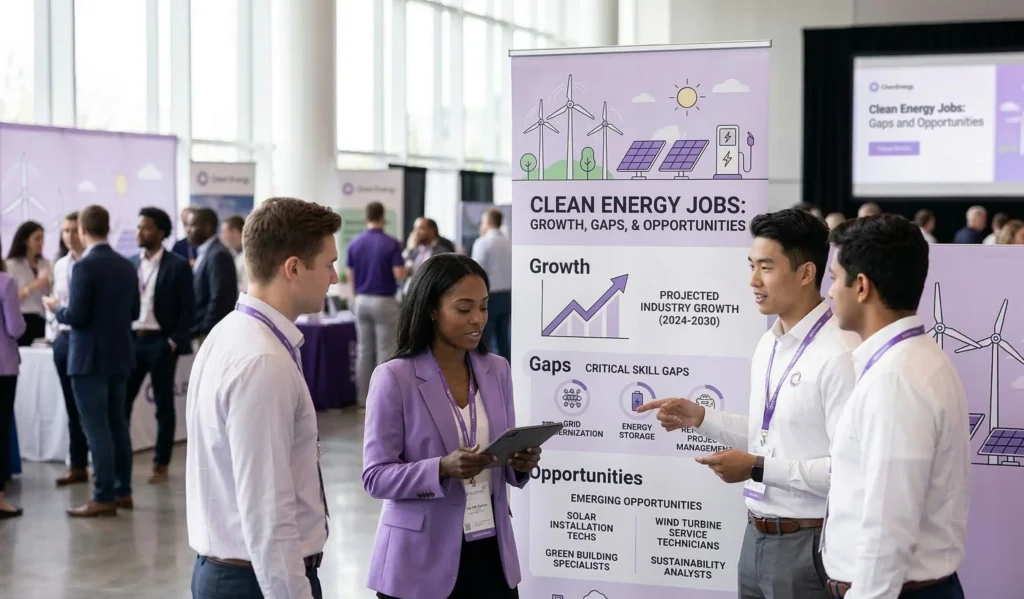
Let’s start with the broader clean energy picture, because the numbers are genuinely impressive. The clean energy economy in the United States spans energy efficiency, renewable power generation, electric vehicles, grid modernisation, battery storage, and clean transportation. Together, these sectors have been on a relentless upward trajectory.
Renewable Energy: Solar and Wind Lead the Charge
Solar and wind remain the twin engines of renewable energy employment. In 2024, the renewable energy sector supported roughly 596,000 jobs in the U.S., with solar accounting for about 370,600 positions and wind for around 133,000.
The Bureau of Labor Statistics continues to rank wind turbine service technicians and solar photovoltaic installers as the two fastest-growing occupations in the country, and that’s been the case for three consecutive years now.
Globally, the picture is even more striking. The IEA’s World Energy Employment 2025 report puts total global energy sector employment at 76 million people, with clean energy and renewables representing the fastest-growing share. The power sector has now overtaken fuel supply as the single largest energy employer worldwide.
I find this stat fascinating: For every 100 jobs in the U.S. economy, more than 6 are now in clean energy. That’s not a niche anymore. That’s a structural shift.
Energy Efficiency: The Quiet Giant
When people think “clean energy jobs,” they tend to picture someone in a hard hat on a wind turbine or wiring solar panels on a rooftop. But the single largest category of climate-related employment in the United States is actually energy efficiency, and it’s not even close. Nearly 2.4 million Americans worked in energy efficiency in 2024, covering everything from designing energy-efficient HVAC systems and manufacturing LED lighting to retrofitting commercial buildings and installing smart thermostats.
Stop Searching, Start Getting Found
Join TRX International’s Nuclear Talent Database and put your profile in front of the world’s leading nuclear employers, before roles even hit the job boards.
California leads the pack with over 312,000 energy efficiency jobs, followed by Texas, New York, and Florida. Every sub-category within this sector has experienced growth since 2021, making it one of the most consistent sources of employment in the entire energy economy.
Grid Modernisation and Battery Storage: The Emerging Frontier
Clean energy storage and grid technology supported around 160,000 jobs in 2024, with a growth rate of 4.3%. Battery storage added the most new positions, while pumped hydro storage saw the highest percentage growth at 7.6%. Texas and California dominate this space, reflecting both their massive energy grids and ambitious state-level targets.
This is where things get particularly interesting for job seekers and recruiters alike. Grid modernisation is fundamentally a cross-disciplinary field, you need electrical engineers alongside software developers, data analysts working with linemen, and project managers who understand both utility-scale infrastructure and emerging digital platforms.
The Skills Gap: A Growing Challenge
Here’s the part that doesn’t always make the headlines. Despite all this growth, the clean energy sector is running into a significant workforce bottleneck. Solar panels are going up faster than trained technicians can install them. Wind farms are being commissioned in regions where qualified maintenance engineers are scarce. Grid modernisation projects are stalling, not because of a lack of funding, but because of a lack of skilled workers.
In Europe, Germany has doubled its green jobs since 2019 but continues to face acute staffing shortages in electrical engineering, grid integration, and heat pump installation. Spain and the Netherlands are actively recruiting internationally to fill gaps in their offshore wind programmes. In North America, renewable energy investment fell by 36% in the first half of 2025 compared to the previous year, driven partly by policy uncertainty, but the underlying demand for talent hasn’t slowed down.
This is the paradox of the clean energy boom: The demand for workers is outstripping the supply of workers who are ready, trained, and credentialled. And that gap isn’t closing as fast as anyone would like.
The Nuclear Energy Jobs Story in 2026: A Renaissance That Needs Thousands of New Professionals
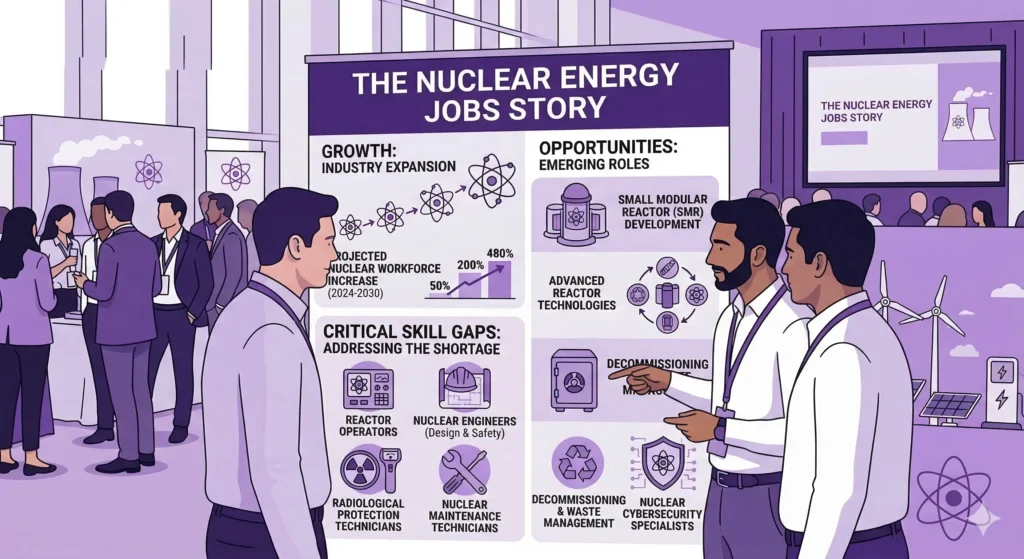
Now let’s talk about nuclear, because this is where the story gets really compelling from a recruitment standpoint.
Nuclear energy is experiencing what many analysts are calling a genuine renaissance. The IAEA has upgraded its projections for nuclear’s role in the global energy mix for the fourth consecutive year. In 2025, nuclear power generation reached an all-time high, driven by new reactors in China and India, restarts in Japan, and improvements across the French fleet. Industry reports project an annual growth rate of nearly 3% through 2026 and beyond.
But here’s the workforce reality that underpins all of this optimism: the IAEA forecasts that nuclear capacity needs to more than double, and potentially triple, by 2050. To get there, the industry will need more than four million professionals globally.
Four million. Let that sink in for a moment. We’re not talking about a modest staffing bump. We’re talking about building an entirely new generation of nuclear professionals from scratch.
The High-Paying, High-Stability Advantage
One thing that consistently sets nuclear apart in the jobs conversation is compensation. According to the Nuclear Energy Institute, the median hourly wage for nuclear generation workers is 52% higher than the median across all electric power generation types. BLS data shows the median annual salary for nuclear engineers at $127,520, second only to petroleum engineering among engineering disciplines.
A single large nuclear power plant typically employs 500 to 800 workers, and with plants now licensed to operate for 80 years or more, these aren’t short-term gigs. They’re multi-generational career foundations. IAEA research has found that nuclear power generates about 25% more employment per unit of electricity than wind power, and those jobs pay roughly a third more than comparable positions in the renewables sector.
During peak construction of a large reactor, a project can employ up to 4,500 workers. Even smaller modular reactor (SMR) units, which are designed for a more streamlined build process, require 150 to 250 permanent staff each, many of them in engineering, operations, maintenance, and skilled trades earning six-figure salaries.
Small Modular Reactors: The Game-Changer for Nuclear Recruitment
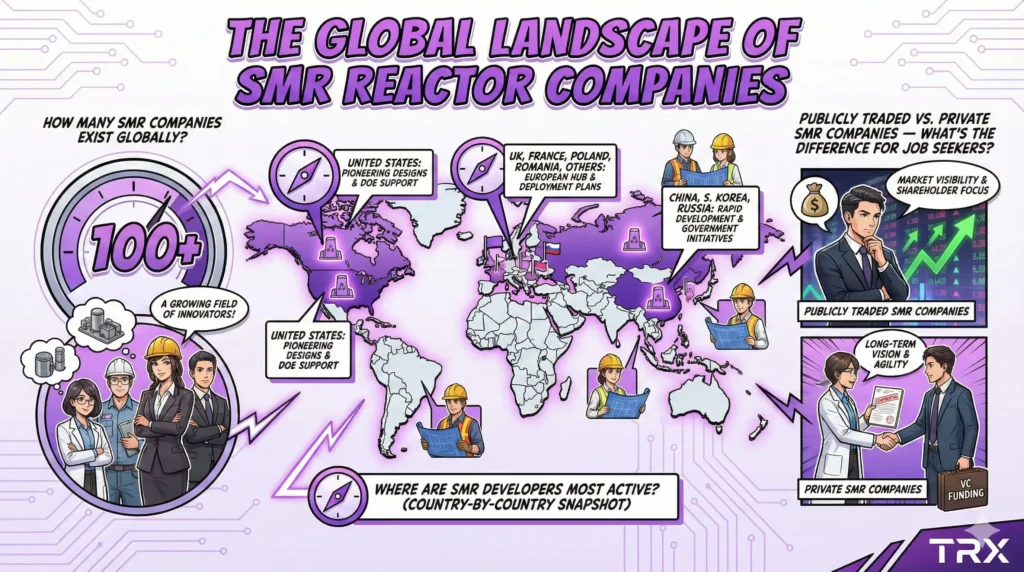
If there’s one technology reshaping the nuclear jobs landscape more than any other right now, it’s SMRs. The OECD Nuclear Energy Agency’s 2025 SMR Dashboard identifies 127 distinct SMR technologies globally, with 74 actively advancing through design and regulatory stages. SMR Companies like TerraPower, NuScale, Kairos Power, and X-energy are leading the charge, backed by billions in government funding and private investment.
The workforce implications are enormous. TerraPower’s reactor project in Wyoming is expected to create more than 250 jobs, many at six-figure salaries. The Tennessee Valley Authority’s project at Clinch River is projected to bring over 300 positions. X-energy’s Texas project anticipates around 100 permanent roles once operational.
And these are just individual projects. Studies suggest that deploying a single SMR could generate sales of $1 billion and support up to 7,000 jobs across the supply chain. Multiply that across dozens of planned deployments worldwide, and you begin to see the scale of the recruitment challenge, and opportunity, ahead.
The Ageing Workforce and the Talent Pipeline Problem
Perhaps the most urgent issue facing nuclear recruitment in 2026 is the generational gap. According to the 2024 U.S. Energy and Employment Report, 17% of nuclear industry workers are over the age of 55, while 60% are between 30 and 54. Meanwhile, the number of students graduating with bachelor’s degrees in nuclear engineering fell by 25% between 2012 and 2022. The class of 2022 produced only 454 graduates in the field.
The Department of Energy estimates that the U.S. nuclear workforce needs to grow from roughly 68,000 direct employees to more than 200,000 to meet demand from new builds, SMR deployments, plant life extensions, and decommissioning projects. That’s nearly a tripling of the current workforce within the next decade.
I’ll be blunt: You don’t solve a talent gap like that by posting a few job ads on LinkedIn. You solve it through specialised recruitment, deep industry networks, and strategic workforce partnerships. This is exactly where agencies like TRX International become indispensable.
Fusion: The Long-Term Opportunity
While fission drives today’s nuclear employment, fusion is quickly emerging as a significant source of future jobs. Fusion startups are scaling rapidly and attracting recruits from adjacent fields like IT, computer science, and advanced manufacturing. Although commercial fusion is still on the horizon, the research and development phase alone is generating demand for plasma physicists, materials scientists, superconducting magnet engineers, and a host of other highly specialised roles.
Advanced technologies like these are drawing from outside the traditional nuclear talent pool, and that cross-pollination requires recruiters who understand both the technical requirements and the cultural transition involved. It’s not enough to find a great engineer; you need to find a great engineer who can operate within nuclear governance, safety protocols, and regulatory frameworks.
Build Your Nuclear Dream Team
Every unfilled role is a missed deadline. Top nuclear talent is scarce and getting scarcer. TRX International sources pre-vetted specialists globally so your projects stay on schedule and fully compliant.
So, Where Are the Most Jobs: Clean Energy or Nuclear?
The honest answer? Both. But they’re different kinds of jobs, with different career trajectories, different compensation structures, and different recruitment challenges.
In terms of pure volume, the broader clean energy sector, especially energy efficiency, solar, and wind, supports a larger total workforce. More than 4 million climate-related jobs exist in the U.S. alone, compared to roughly 100,000 direct nuclear positions (and 350,000+ when you include secondary employment). But volume isn’t the only metric that matters.
Nuclear jobs tend to be higher-paying, longer-lasting, and more concentrated in specialised roles that are extremely difficult to fill. The median nuclear energy worker earns significantly more than the median renewable energy worker. Nuclear plants operate for decades, providing stability that project-based solar and wind installations often can’t match. And the regulatory, safety, and technical barriers to entry create a talent market where demand dramatically outstrips supply.
For employers, this means nuclear recruitment requires a fundamentally different approach. You’re not just competing for candidates against other energy companies, you’re competing against every technology company, defence contractor, and research institution that values the same skill sets. The margin for error in hiring is razor-thin in an industry where compliance, safety culture, and technical precision are non-negotiable.
Here’s my honest read on it: if you’re a job seeker, both sectors offer extraordinary opportunities in 2026. But if you want the highest earning potential, the deepest job security, and the chance to work on technologies that will define the next half-century of energy production, nuclear is the place to be. And if you’re an employer looking to build or expand a nuclear team, the time to start is yesterday.
Finding the Right Talent
Whether you’re a utility planning an SMR deployment, a research facility staffing a fusion programme, or a professional looking to transition into nuclear energy, the challenge is the same: how do you connect the right people with the right opportunities in an industry where precision matters more than almost anywhere else?
This is precisely the problem that TRX International was built to solve. As one of the world’s leading nuclear recruitment agencies, TRX International specialises exclusively in the nuclear sector, from new build and decommissioning projects to advanced reactor technologies, regulatory compliance, and nuclear medicine. Their deep industry knowledge, global talent network, and specialised tools like the Nuclear Talent Database mean they don’t just fill positions; they build workforces that are ready for nuclear delivery environments.
Looking to hire nuclear professionals or explore nuclear career opportunities?
TRX International connects world-class talent with critical roles across the global nuclear industry. Visit trx-international.com or get in touch with the team to start the conversation.
In a sector where a mis-hire isn’t just expensive but potentially dangerous, working with a specialist who understands the regulatory landscape, the technical language, and the career trajectories that generic recruiters simply can’t match makes a measurable difference. Whether you need to recruit nuclear engineers, hire nuclear safety specialists, or source talent for emerging SMR and fusion projects, having a dedicated partner in your corner changes the equation entirely.
What this means for Job Seekers in 2026?
If you’re considering a career in energy, there’s never been a better time. The clean energy economy is expanding rapidly, offering a wide range of entry points from hands-on installation work to highly technical engineering and management roles. Solar and wind will continue to generate volume employment, while grid modernisation and battery storage are creating exciting new cross-disciplinary positions.
On the nuclear side, the opportunities are fewer in absolute number but dramatically higher in value. Nuclear salaries consistently outpace every other segment of the clean energy sector. The career paths are longer, more stable, and increasingly diverse, spanning traditional fission operations, cutting-edge SMR development, nuclear fusion research, nuclear medicine, and digital reactor systems.
For professionals with backgrounds in engineering, physics, skilled trades, IT, project management, or healthcare, nuclear energy offers a compelling proposition: meaningful work at the frontier of technology, competitive pay, and the kind of long-term job security that’s increasingly rare in today’s economy.
One piece of advice I’d give anyone considering a move into nuclear: don’t try to navigate the process alone. The hiring ecosystem is complex, the compliance requirements are strict, and the opportunities are often unadvertised. Working with a specialist recruiter like TRX International gives you access to roles, guidance, and industry insight that you simply won’t find anywhere else.
Frequently Asked Questions
What types of clean energy jobs are growing the fastest in 2026?
Solar installers, wind turbine technicians, battery storage specialists, and grid modernisation roles are expanding fastest. Energy efficiency remains the largest clean energy employer overall.
How does nuclear energy compare to other clean energy sectors in terms of job quality and pay?
Nuclear offers the highest pay in clean energy, with median salaries around $127,520 for engineers. Jobs are longer-term, more stable, and pay roughly 50% above average.
What skills are most in demand for nuclear energy careers right now?
Nuclear engineers, radiation protection specialists, project managers, skilled tradespeople, and SMR/fusion researchers are highly sought after. IT and digital reactor skills are also rising.
Is it realistic to transition into a nuclear career from another industry?
Yes. Professionals from defence, aerospace, oil and gas, and IT transition successfully. A specialist recruiter like TRX International helps map transferable skills effectively.
Why is it so difficult to recruit for nuclear positions compared to other clean energy roles?
Strict regulatory requirements, security clearances, and a limited specialist talent pool make nuclear hiring uniquely challenging. Dedicated agencies like TRX International bridge that gap.
How can employers build a strong nuclear talent pipeline for the future?
Invest in STEM education, veteran engagement, and apprenticeship programmes. Partner with specialist recruiters like TRX International to access pre-vetted candidates ahead of demand.
The Bottom Line
The clean energy and nuclear sectors are not in competition for relevance, they’re both essential pillars of the global energy transition. But when it comes to jobs, the stories they tell are different in meaningful ways. Clean energy offers breadth and volume. Nuclear offers depth, stability, and some of the highest-quality employment anywhere in the economy.
For job seekers, the message is clear: invest in your skills, understand the landscape, and don’t be afraid to explore nuclear as a career path. For employers, the message is equally clear: the talent war in nuclear is real, it’s intensifying, and the organisations that partner with specialist recruiters will be the ones that win it.