Energy Attorney Jobs: Hire Smarter, Apply Confidently
The global energy sector is in the middle of its biggest transformation since the Industrial Revolution. Trillions of dollars are moving from fossil fuels toward renewables, nuclear, hydrogen, and smart grid technologies. Governments are rewriting rulebooks. Companies are restructuring their entire business models. And somewhere in the middle of all this complexity, holding the legal fabric together, is the energy attorney.
Energy attorney jobs sit at one of the most exciting intersections in the modern legal profession: environmental law, corporate transactions, regulatory compliance, and public policy all rolled into one specialisation. It is a career path that was once considered a quiet corner of the legal world. Not anymore.
Whether you are a law graduate plotting your first specialisation, a mid-career solicitor thinking about a pivot, or a legal recruiter trying to fill a seat in a fast-scaling energy company, this guide covers everything you need to know about energy attorney jobs, what they involve, what they pay, where they are heading, and how to find the right one.
What Is an Energy Attorney?
An energy attorney is a lawyer who specialises in the legal, regulatory, and commercial dimensions of the energy industry. This covers a broad spectrum, from advising a wind farm developer on land rights to helping a nuclear power company navigate a licensing renewal with the regulator.
The role sits across several areas of law simultaneously. On any given week, an energy attorney might be reviewing a power purchase agreement (PPA), advising on environmental impact assessments, liaising with a government agency over a grid connection dispute, or structuring the acquisition of a solar portfolio.
What makes this role genuinely unique is that it demands both deep legal expertise and a working understanding of the energy sector itself, its technology, its economics, and its politics. A good energy attorney does not just understand what the law says; they understand what it means for a project that will generate power for a million homes.
Energy attorneys work across law firms, in-house legal teams, government bodies, and independent regulatory authorities. Each setting brings a different flavour to the job, but the common thread is complexity, and the appetite to make sense of it.
Why Energy Attorney Jobs are Booming Right Now?
The demand for energy lawyers has risen sharply in recent years, and the drivers behind that demand are structural, not cyclical. This is not a short-term hiring blip. It is a multi-decade build-out of new legal infrastructure to match a new energy system.
A few headline numbers put this into perspective. Global clean energy investment crossed $1.8 trillion in 2023, according to the International Energy Agency, for the first time exceeding spending on fossil fuels. The US Inflation Reduction Act (IRA) alone allocated $369 billion for clean energy incentives, triggering a wave of project development, M&A activity, and regulatory filings that all require legal counsel.
In fifteen years of placing legal talent across the nuclear and energy sectors, I’ve never seen demand move this fast. The pipeline of projects is real, the investment is committed, and companies are scrambling to build legal teams that simply don’t exist yet at the scale they need.
Here is a snapshot of the key market forces currently driving demand for energy attorney jobs:
| Driver | What It Means | Legal Impact |
|---|---|---|
| IRA 2022 (US) | $369B in clean energy investment incentives | Surge in tax credit deals, project finance |
| EU Green Deal | Net-zero target by 2050, 55% by 2030 | Cross-border energy regulatory work |
| Nuclear Revival | 30+ countries commit to tripling capacity by 2050 | NRC licensing, reactor contracts, safety compliance |
| Offshore Wind Expansion | Global capacity to reach 380 GW by 2032 | Seabed rights, maritime law, grid agreements |
| Carbon Markets | Global carbon credit market hit $909B in 2023 | Carbon trading law, offset verification |
Add to this picture the growing complexity of energy markets, cross-border power trading, energy storage disputes, carbon credit litigation, offshore wind permitting battles, and you have a legal landscape that requires not just more lawyers, but more specialised lawyers.
The nuclear sector deserves particular mention here. After years of stagnation following Fukushima, nuclear is staging a genuine comeback. Small modular reactors (SMRs) are attracting billions in investment.
Countries from the UK to South Korea to Poland are signing nuclear agreements. This renaissance is generating a specific category of energy attorney work, NRC licensing, reactor site agreements, nuclear safety compliance, decommissioning contracts, that requires a rare blend of technical and legal fluency.
Build Your Nuclear Dream Team
Every unfilled role is a missed deadline. Top nuclear talent is scarce and getting scarcer. TRX International sources pre-vetted specialists globally so your projects stay on schedule and fully compliant.
Types of Energy Attorney Jobs
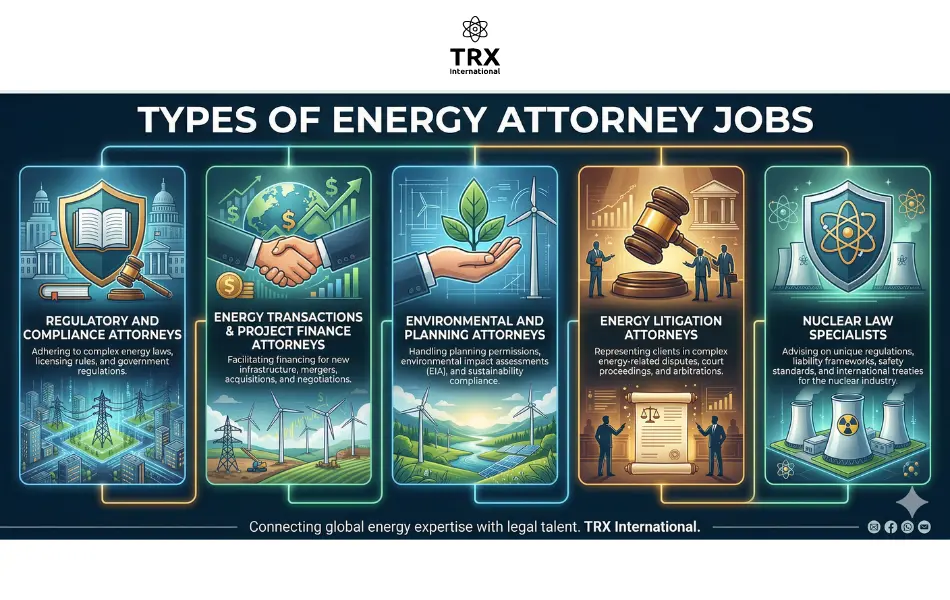
Energy law is not a monolith. Under the broad umbrella of ‘energy attorney,’ there are several distinct specialisations, each with its own focus, skill demands, and career trajectory.
1. Regulatory and Compliance Attorneys
These are the lawyers who live inside the rulebook. They advise clients on compliance with energy regulations at national and international levels, from FERC filings in the US to Ofgem requirements in the UK to EU taxonomy regulations.
Regulatory attorneys often work closely with government bodies, utilities, and grid operators. They represent clients in regulatory proceedings, respond to enforcement actions, and help companies build compliance programmes that keep them on the right side of rapidly evolving rules.
2. Energy Transactions and Project Finance Attorneys
If regulatory law is about rules, transaction law is about deals. Energy transactions attorneys handle the legal architecture of major deals, power purchase agreements, M&A of renewable portfolios, project finance for new generating assets, joint venture structuring, and asset sales.
This is a high-volume, high-stakes environment. A single offshore wind transaction can involve dozens of agreements, multiple jurisdictions, and teams of lawyers on both sides. Attention to detail and commercial awareness are non-negotiable here.
3. Environmental and Planning Attorneys
Every new energy project, from a solar farm in the Midlands to a hydrogen production plant in Texas, needs to navigate environmental law. These attorneys handle environmental impact assessments, planning permissions, ecological mitigation requirements, and challenges from third parties opposed to a project.
The overlap between environmental law and energy law is growing, particularly as carbon emissions become a legal liability in a way they were not a decade ago.
4. Energy Litigation Attorneys
Disputes happen. Contracts fail, licences get challenged, pricing disagreements turn adversarial. Energy litigation attorneys handle these disputes in court, arbitration, and regulatory tribunals.
This is one of the most technically demanding forms of energy law because it requires not only legal expertise but the ability to explain complex technical and commercial matters to judges or arbitrators who may have limited industry background.
5. Nuclear Law Specialists
Nuclear law sits within energy law but deserves its own category. The regulatory environment for nuclear energy is unlike any other, governed by a dense web of national and international frameworks including the Nuclear Non-Proliferation Treaty, IAEA guidelines, and country-specific nuclear regulatory bodies.
Nuclear law candidates are the hardest profiles to find in the entire energy legal market. The regulatory knowledge alone takes years to build. When a client calls me for a nuclear licensing attorney, I’m not searching a job board, I’m calling people I’ve known for a decade.
Nuclear attorneys advise on reactor licensing, radioactive waste management agreements, nuclear site security, decommissioning liability, and international fuel cycle contracts. Given the resurgence of nuclear energy globally, this is one of the fastest-growing sub-categories of energy attorney jobs right now.
Key Skills and Qualifications for Energy Attorney Jobs
Energy law is a specialisation, not an entry point. Most energy attorneys come into the field after qualifying in a related area, corporate law, environmental law, regulatory practice, or public law, and then transition into energy as they develop sector-specific expertise.
That said, there are clear foundations that employers and recruiters consistently look for:
For nuclear-specific roles, understanding of nuclear safety regulation, radiation protection law, and the IAEA safeguards system is often required or strongly preferred.
Increasingly, employers are also looking for lawyers who understand climate and carbon law, how carbon pricing regimes work, what emissions trading schemes require, and how net-zero obligations translate into contractual and regulatory duties.
Looking to hire nuclear professionals or explore nuclear career opportunities?
TRX International connects world-class talent with critical roles across the global nuclear industry. Visit trx-international.com or get in touch with the team to start the conversation.
What Does an Energy Attorney Actually Do Day-to-Day?
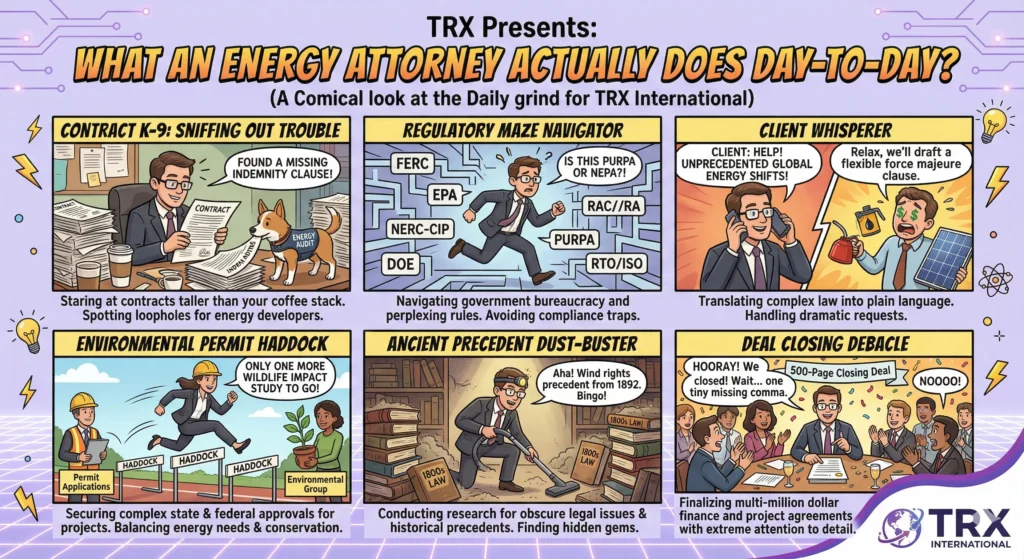
Job titles in legal hiring can be deceptive. The day-to-day reality of energy attorney jobs varies enormously depending on whether you sit in a law firm, an in-house team, or a government agency. Here is what typical workdays look like across each setting:
In a Law Firm
Your work is client-driven and deal-led. You might be advising a renewable energy developer on the legal structure of a new wind farm one morning and reviewing a gas supply contract for an oil major in the afternoon. Deadlines are tight, client relationships matter, and billing targets are real.
Senior associates and partners in energy practice groups at top-tier firms can have genuinely significant transaction portfolios, running multi-hundred-million-pound deals, managing junior teams, and building long-term client relationships.
In an In-House Legal Team
In-house energy attorneys tend to have broader ownership of their issues, you are not just the external advisor, you are the decision-maker within the legal function. You are embedded in the business, sitting alongside commercial, engineering, and finance teams.
In-house roles often offer a better view of the full lifecycle of an energy project, from early-stage development through construction, operations, and eventual decommissioning or sale.
In Government or a Regulatory Body
This is where energy law meets public policy. Government energy lawyers advise ministries, shape legislation, and handle enforcement. Regulatory body lawyers police the rules, investigate breaches, and represent the public interest in proceedings.
These roles tend to offer strong work-life balance and intellectual rigour, though compensation is typically lower than private practice. Many energy lawyers move between the public and private sectors across their careers, and the cross-over experience is genuinely valued.
Energy Attorney Salary: What Can You Earn?
Compensation for energy attorney jobs is strong, and growing. As demand for qualified energy lawyers outpaces supply, employers are increasingly willing to pay a premium for candidates with the right mix of legal expertise and sector knowledge.
The table below provides a realistic snapshot of salary ranges across different levels and geographies. Note that in-house roles typically offer strong total compensation packages including bonuses, pension, and benefits that can close the gap with private practice.
| Role / Level | Location | Avg. Annual Salary | Sector |
|---|---|---|---|
| Junior Energy Attorney (0–3 yrs) | US | $85,000 – $130,000 | Law Firm / Utility |
| Mid-Level Energy Attorney (3–7 yrs) | US | $140,000 – $220,000 | Renewables / O&G |
| Senior / Partner-Track (7+ yrs) | US | $250,000 – $450,000+ | BigLaw / In-House |
| In-House Counsel Nuclear | UK / EU | £90,000 – £160,000 | Nuclear / Utility |
| Energy Regulatory Counsel | US (DC) | $160,000 – $280,000 | Government / Consulting |
| Energy Transactions Counsel | Global | $180,000 – $350,000 | M&A / Project Finance |
Salary expectations in this space have shifted noticeably in the last two years. Candidates with cross-sector experience; say, someone who has worked on both oil and gas transactions and renewables project finance; are commanding premiums that would have surprised people in 2021.
Beyond base salary, many energy law roles, particularly in project finance and M&A, come with deal bonuses, performance-related pay, and equity in the case of some in-house positions at scale-up energy companies.
The nuclear and advanced energy sectors are particularly competitive at the moment. Companies and law firms with nuclear practices are actively competing for a small pool of qualified candidates, which is pushing compensation upward across the board.
Where Do Energy Attorneys Work?
Energy attorney jobs are distributed across a diverse ecosystem of employers. Understanding where the opportunities sit, and what each employer type offers, is important for anyone considering or progressing in this career.
Geographically, the highest concentrations of energy attorney jobs are in Washington DC, Houston, London, Brussels, and the Gulf region, though remote and hybrid working has broadened the geographic spread of many roles significantly.
Emerging Specialisations in Energy Law
The energy transition is not just creating more of the same legal work, it is generating entirely new categories of energy law that barely existed a few years ago. Lawyers who position themselves at these emerging frontiers are likely to be in exceptionally strong demand over the next decade.
Hydrogen Law
Green hydrogen is one of the most hotly discussed technologies in the energy transition. It has no established regulatory framework in most countries, which means the legal infrastructure is being built in real time. Attorneys working on hydrogen projects are navigating everything from production licensing to pipeline access agreements to safety regulation, often with no existing precedent to guide them.
Carbon Trading and Climate Liability
As carbon markets expand and climate litigation accelerates, energy attorneys are increasingly being asked to advise on emission trading scheme compliance, voluntary carbon credit transactions, and climate-related disclosure obligations. A handful of landmark climate liability cases are now working their way through courts globally, and specialist energy litigators are at the forefront.
Energy Storage and Grid Law
Battery storage, pumped hydro, and grid-scale storage are booming. But existing energy law frameworks were not designed with storage in mind, and the regulatory gaps are creating both problems and opportunities. Attorneys who understand how storage assets interact with grid codes, balancing mechanisms, and capacity markets are increasingly sought after.
SMR and Advanced Nuclear Law
Small modular reactors are at the frontier of energy innovation. The legal work here is genuinely novel, advising on new reactor licensing pathways, technology transfer agreements, SMR site selection, and the international frameworks governing advanced reactor export. This is a small but growing niche within nuclear law, and the lawyers shaping it now are likely to define it for years to come.
How to Land Energy Attorney Jobs?
Breaking into energy law requires a deliberate approach. Unlike some legal specialisms, it is not a straight line from law school to job offer, it requires building both legal expertise and sector credibility simultaneously.
Step 1: Build a Strong Legal Foundation
Energy law is not a first job specialism in most cases. Start by building depth in a relevant practice area, corporate transactions, regulatory law, environmental law, or commercial litigation. The stronger your foundational legal skills, the easier the sector pivot will be.
Step 2: Develop Sector Knowledge
Read industry publications. Follow energy policy developments. Understand how the grid works, what a PPA involves, and what the regulatory bodies in your jurisdiction do. Employers are not looking for engineers, but they are looking for lawyers who can hold their own in a room with them.
Step 3: Target the Right Opportunities
Energy law opportunities vary significantly in what they offer. A seat in the energy practice group of a major law firm gives you deal exposure and training structure. An in-house role at a renewable developer gives you ownership and business proximity. Choose the type of role that matches where you want to take your career.
Step 4: Work With a Specialist Recruiter
In a niche field like this, generalist job boards only take you so far. Specialist energy recruitment agencies have access to roles that are never publicly advertised and relationships with hiring managers who trust their judgement on candidate fit. This matters in a sector where who you know can matter as much as what you know.
The best energy law roles rarely go public. I’d estimate that a third of the senior placements I make in a given year are never advertised anywhere. They come from a phone call between me and a hiring manager who trusts that I already know who the right person is.
How TRX International Supports Your Energy Law Career?
TRX International has spent years building deep expertise in specialist recruitment for the nuclear and energy sectors. We operate where technical depth and legal precision intersect, and we understand that finding the right energy attorney, or the right energy law role, requires more than a keyword search.
Whether you are an employer looking to grow your legal team or a legal professional ready for your next challenge, TRX International offers a recruitment experience tailored to the specific demands of this market.
| For Candidates | For Employers |
|---|---|
| Access to exclusive energy law vacancies | Pre-screened, sector-qualified legal talent |
| CV and application coaching | Custom talent search across nuclear, renewables, O&G |
| Interview and negotiation support | Contingency and retained search options |
| Career progression guidance | Market salary benchmarking |
| Confidential job search handling | Fast-track placement for urgent mandates |
For Candidates: Find the Right Energy Attorney Job
Navigating energy attorney jobs on your own is possible, but it is not efficient. Many of the most attractive roles in this sector are filled through professional networks and specialist recruiters before they ever appear on a public job board.
TRX International works with candidates at all levels, from recently qualified lawyers making their first move into energy, to senior in-house counsel looking for a step up or a sector change. We take the time to understand your experience, your ambitions, and what matters to you in a role, not just your CV.
We are particularly strong in nuclear and advanced energy legal roles, where the candidate pool is small and the matching process requires genuine sector knowledge to get right. Our consultants understand what a nuclear licensing team needs from its legal counsel. That means better matches, and faster placements.
A candidate who understands how a nuclear power purchase agreement works is not the same as one who has just read about it. We spend a lot of time understanding what our candidates actually know, not just what’s written on their CV. That distinction is exactly what our clients pay us to make.
For Employers: Build a Legal Team That Moves With the Market
The legal talent market in energy is tight. Demand for qualified energy attorneys is rising while supply remains constrained. In this environment, employers who work with specialist recruiters get ahead of the market, and those who rely solely on direct advertising often find themselves in extended hiring processes with disappointing shortlists.
TRX International brings a pre-qualified network of energy law professionals across the nuclear, renewables, oil and gas, and utilities sectors. We operate across the UK, Europe, North America, and internationally, which means we can source talent for roles that require both jurisdiction-specific legal knowledge and sector expertise.
We also provide salary benchmarking support, so you go to market with a package that is genuinely competitive, not one that is six months behind the curve.
Stop Searching, Start Getting Found
Join TRX International’s Nuclear Talent Database and put your profile in front of the world’s leading nuclear employers, before roles even hit the job boards.
The Future of Energy Attorney Jobs
The trajectory for energy attorney jobs is unambiguously positive. The forces driving demand, decarbonisation, energy security, new technology deployment, and regulatory evolution, are not going away. If anything, they are intensifying.
The legal profession is also catching up with the sector. More law schools are offering dedicated energy law programmes. More firms are investing in energy practice groups. More in-house teams at energy companies are building out their legal capabilities. The infrastructure for a mature, recognised energy law specialism is being built, and those who plant their flag now will be the senior practitioners of the next generation.
Artificial intelligence is also beginning to reshape energy legal work, not to replace lawyers, but to automate the lower-complexity tasks (contract review, regulatory monitoring, document analysis) and free attorneys to focus on the high-value advisory, strategic, and negotiation work that genuinely requires human judgement.
The lawyers entering energy law today are going to be the people writing the contracts that define how the world generates power for the next fifty years. That’s not hyperbole, that’s just what the energy transition actually means at a legal level. It’s a remarkable time to be in this specialism.
For lawyers willing to invest in sector knowledge and stay close to where the energy sector is heading, the opportunity in energy attorney jobs over the next decade is significant. This is a career path that is growing in scope, in prestige, and in compensation, and it is doing so at exactly the moment the world most needs the legal frameworks to make the energy transition work.
Frequently Asked Questions
What does an energy attorney specialise in?
Energy attorneys handle legal work in regulatory compliance, energy transactions, environmental law, and project development within the energy sector.
Do I need an engineering background?
No, but sector literacy matters. Understanding energy markets, technologies, and regulation is expected alongside legal expertise.
What is the average salary for energy attorneys?
Salaries range from $85,000 for juniors to $450,000+ for senior partners or experienced in-house counsel at top energy firms.
Is nuclear law a separate specialism?
Yes. Nuclear law involves NRC licensing, nuclear safety regulation, and international frameworks, distinct from general energy law practice.
Are energy attorney jobs available internationally?
Absolutely. Major hubs include Washington DC, London, Houston, Brussels, and the Gulf. Many roles now support hybrid or remote arrangements.
How can TRX International help me find energy law roles?
TRX International specialises in nuclear and energy sector recruitment, offering access to exclusive vacancies, candidate coaching, and employer benchmarking support.
Final Thoughts
Energy attorney jobs represent one of the most dynamic and consequential specialisations available to legal professionals today. The work is complex, the stakes are high, and the demand for qualified talent is outpacing supply in almost every sub-sector.
Whether you are advising on a landmark offshore wind transaction, helping a nuclear operator navigate a licence renewal, or structuring carbon credit agreements that will define how companies manage climate liability, energy law puts you at the centre of decisions that matter.
If you are ready to explore where energy attorney jobs could take your career, or if you are an employer looking to strengthen your legal team, TRX International is the partner you want in your corner. Reach out to our specialist team and let us make the connection that moves things forward.