
What Is Neutronics? The Nuclear Engineering Specialty Powering Reactor Design
Nuclear energy is back in a big way.
With over 60 new reactors under construction globally and a wave of Small Modular Reactor (SMR) projects moving from blueprints to build phase, the nuclear industry is hiring at a scale not seen in decades.
Right at the centre of all that activity is a discipline called neutronics.
If you are exploring a career in nuclear engineering and keep seeing this word come up in job listings, this article will tell you exactly what it means and why it matters.
What Is Neutronics?
At its core, neutronics is the study of how neutrons behave inside a nuclear reactor. It covers everything from how neutrons are produced during fission, to how they travel through materials, interact with atomic nuclei, and sustain the chain reactions that generate heat and electricity. It sits firmly within the broader field of nuclear engineering, but it is one of the most specialised and technically demanding corners of it.
Here is a simple way to think about it. A nuclear reactor is essentially a very precisely controlled chain reaction. Neutrons are what keep that chain reaction going. Neutronics is the engineering discipline that makes sure those neutrons are doing exactly what they are supposed to do, at the right rate, in the right places, safely and consistently.
That is why neutronics is often called the backbone of reactor design. You cannot design a reactor core, assess its safety, plan its fuel cycle, or get it licensed without rigorous neutronics analysis underpinning every decision. It touches everything.
Neutronics vs. Nuclear Physics: What Is the Difference?
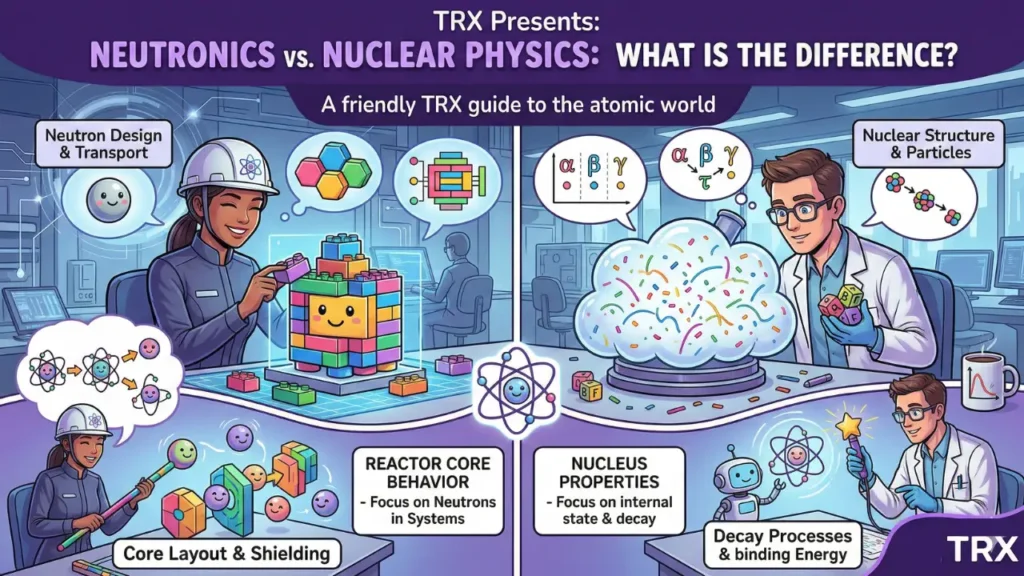
This is a question that comes up a lot, especially among physics graduates who are considering moving into the nuclear industry.
Nuclear physics is the foundational science. It explains why atoms behave the way they do at the subatomic level, what happens when a neutron strikes a uranium nucleus, and what the underlying laws governing these interactions look like. It is largely theoretical, and it is the domain of scientists working to understand the fundamental nature of matter.
Neutronics is what happens when you take that science and put it to work in the real world.
A neutronics engineer is not asking “why does this nuclear interaction occur?” They are asking “given that this interaction occurs, how do I design a reactor core that performs reliably, stays within safe operating limits, and meets regulatory requirements?” That shift, from curiosity-driven science to problem-driven engineering, is the key distinction.
In practice, this means neutronics professionals spend their time running computational simulations, interpreting results, validating models against experimental data, and feeding their findings into broader design and safety teams. The physics knowledge is absolutely essential, but it is the foundation you build on, not the end goal.
For physics graduates considering a move into nuclear engineering, neutronics is often the most natural and rewarding transition point because the domain knowledge transfers well, while the day-to-day work is grounded in practical engineering challenges.
Missing the Right Nuclear Expertise?
We close the gap. From specialised engineering talent to leadership roles, TRX International connects the best in the sector. As a specialized nuclear recruitment agency, TRX understands the qualifications, clearances, and career paths that matter in this space.
How Neutronics Works?
If you have never studied nuclear engineering, some of the terminology around neutronics can feel a bit intimidating at first. But the underlying ideas are actually quite logical once you break them down. You do not need a physics background to follow this. Think of this as a quick orientation, the kind of plain-English explanation that will make everything else in this field start to click.
What Is a Neutron and Why Does It Matter?
A neutron is a tiny particle found in the nucleus of an atom. On its own, it sounds fairly unremarkable. But in the context of a nuclear reactor, it is everything.
When a neutron collides with a heavy atom like uranium-235, it can cause that nucleus to split apart. That splitting is called fission, and it releases an enormous amount of energy plus two or three more neutrons. Those new neutrons go on to split more uranium atoms, which release more neutrons, which split more atoms. That self-sustaining sequence is a chain reaction, and controlling it is the entire point of reactor design.
Key Principles in Neutronics
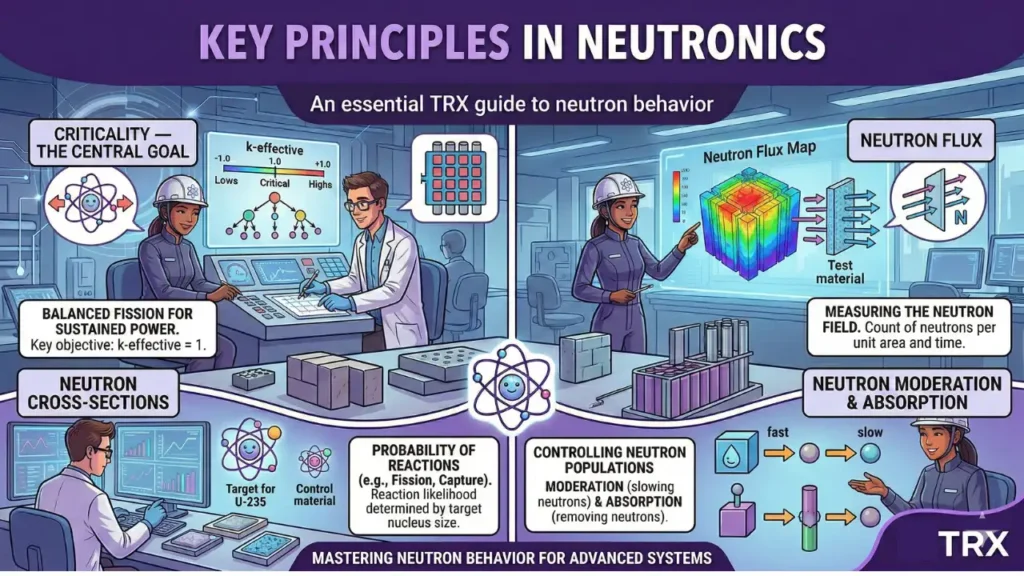
There are four concepts that form the foundation of almost everything in neutronics. Get comfortable with these and you will have a solid grip on what neutronics engineers are actually working on.
Neutron flux is essentially a measure of neutron intensity inside the reactor. It tells engineers how many neutrons are passing through a given area at any point in time. High flux means more fission reactions are happening. Engineers monitor flux continuously because it directly reflects how much power the reactor is generating and where that power is being produced within the core.
Neutron cross-sections describe the probability that a neutron will interact with a particular material. Some materials are very likely to absorb neutrons, others scatter them, and others let them pass through almost entirely. These probabilities vary depending on the speed of the neutron and the material it encounters. Cross-section data sits at the heart of every neutronics calculation because it determines how the entire neutron population behaves.
Criticality is arguably the most important concept in reactor neutronics. A reactor is said to be critical when every fission event produces exactly one neutron that goes on to trigger another fission. Not two, not zero, exactly one. That state of balance is what keeps a reactor running at a steady power level. Going above critical means power increases, going below means it decreases. Managing criticality safely and precisely is the central engineering challenge that neutronics exists to solve.
Neutron moderation and absorption are the two main levers engineers use to control reactor behaviour. Moderators, typically water or graphite, slow neutrons down so they are more likely to cause fission. Absorbers, like the boron-containing control rods you may have heard of, capture neutrons to reduce reaction rates. Adjusting these elements is how operators control power output and shut a reactor down safely.
The Neutron Lifecycle in a Reactor
Every neutron in a reactor follows a lifecycle. It is born during fission, travels outward through the reactor core, and is either slowed by a moderator, absorbed by a material, or causes another fission event. On average, a neutron’s entire life inside a reactor lasts only a fraction of a second.
Neutronics engineers model this lifecycle in extraordinary detail using simulation software, tracking how neutron populations evolve over time and space within the reactor. That modelling tells them how the core will behave during normal operation, during fuel burnup over months of use, and during accident scenarios. It is how engineers know, before a reactor is ever built, exactly how it will perform. That predictive power is what makes neutronics so central to everything.
What Does a Neutronics Engineer Actually Do?
So far we have covered the science. Now let us talk about what this actually looks like as a job. Because if you are exploring neutronics jobs or thinking about whether this could be the right career path for you, the theory is only half the picture. The other half is understanding what a neutronics engineer does on a Tuesday afternoon.
Day-to-Day Responsibilities
The honest answer is that no two days are exactly the same, and that is a big part of why people who work in this field tend to love it. That said, there are some core activities that make up the bulk of the work.
A significant chunk of the role involves running neutronics simulations and computational models. You are essentially building a virtual version of a reactor core and testing how it behaves under different conditions. This is detailed, methodical work that requires both technical precision and a solid understanding of the underlying physics.
Alongside that, neutronics engineers spend a lot of time analysing reactor core designs, checking that they meet safety requirements, performance targets, and regulatory standards. If something in the design does not look right, it is the neutronics team that flags it and works out what needs to change.
Fuel management is another regular feature of the role. Nuclear reactors do not run on a single load of fuel forever. Fuel gets used up over time and needs to be partially replaced in a carefully planned sequence. Neutronics engineers support that process by calculating how fuel is depleting, how the core’s behaviour is shifting, and what the optimal reload strategy looks like.
You will also spend meaningful time collaborating with other engineering disciplines. Thermal-hydraulics engineers, structural engineers, materials specialists, they all rely on neutronics outputs to do their own work. So being able to communicate clearly across teams is genuinely important in this role, not just a nice-to-have.
And then there is documentation. Writing clear, accurate technical reports and safety case documentation is a core part of the job. In a regulated industry like nuclear, the written record of your analysis is just as important as the analysis itself.
How a Nuclear Recruitment Specialist Can Help You Land a Neutronics Role?
Here is something worth knowing early in your job search. Most neutronics roles are never publicly advertised.
Yes, try to recall how many times have you come across a job posting in this domain?
This is a specialist field, and a large portion of hiring happens through professional networks and recruitment agencies before a position ever reaches a general job board.
Working with a nuclear-specialist recruiter gives you access to that hidden market. A recruiter who genuinely understands nuclear engineering can accurately represent your profile, match you to roles that suit your background and goals, and give you honest advice on where you stand in the current market. That is a very different experience from uploading your CV to a general platform and waiting.
TRX International specialises in nuclear industry recruitment, with established connections across utilities, SMR developers, national laboratories, consultancies, and defence programs. Their team understands what neutronics hiring managers are actually looking for, which means you get targeted guidance and access to opportunities that would otherwise be out of reach.
Browse current neutronics and reactor physics jobs or register your profile with the TRX International nuclear engineering team today.
Neutronics Analysis: The Bread and Butter of the Role
If there is one thing that defines the neutronics engineer’s working life, it is analysis. Specifically, neutronics analysis, which is the process of using computational models to predict and evaluate reactor behaviour in rigorous, quantifiable detail.
In practice, this breaks down into a few distinct types of work.
Shielding analysis involves calculating how radiation propagates through the materials surrounding the reactor core and ensuring that exposure levels for workers, the public, and the environment remain within safe limits. It is exacting work, because the consequences of getting it wrong are serious.
Criticality safety is about confirming that nuclear material cannot accidentally reach a critical state outside of controlled, intended conditions. This applies not just to operating reactors but to fuel storage facilities, transport scenarios, and reprocessing environments. It is one of the most important safety disciplines in the entire nuclear industry.
Core physics calculations cover the broader modelling of how a reactor core behaves over its operational lifetime. Power distribution, reactivity coefficients, shutdown margins, burnup behaviour, all of this feeds into the core physics picture. These calculations directly influence major design decisions and are central to any reactor licensing submission.
The results of neutronics analysis do not just sit in a report somewhere. They actively shape decisions. If the analysis shows that a proposed design change would push the reactor outside its safe operating envelope, that finding feeds directly back into the design process. Neutronics engineers are not just number crunchers. They are an integral part of how reactor designs get refined, approved, and built.
Tools and Software Used in Neutronics
Here is something worth knowing early if you are targeting neutronics jobs: the tools matter. Employers hiring in this space will almost always ask about your experience with specific codes, so it is worth knowing what they are and what they do.
MCNP (Monte Carlo N-Particle Transport Code) is the industry standard. It uses statistical methods to simulate how neutrons travel and interact through complex three-dimensional geometries. If you only learn one code, make it this one.
Serpent is a Monte Carlo code that has grown significantly in popularity, particularly among SMR developers and research institutions. It is efficient, well-documented, and increasingly used for core design work.
SCALE is a comprehensive analysis suite developed by Oak Ridge National Laboratory, widely used for criticality safety assessments and shielding analysis. You will encounter it frequently in regulatory and consultancy environments.
OpenMC is an open-source Monte Carlo code that has become the go-to tool for students and early-career engineers looking to build practical simulation experience before entering the workforce. If you are still studying, start here.
CASMO and SIMULATE are deterministic codes used extensively by commercial utilities for fuel cycle analysis and core design. If you are heading toward a role with a power plant operator, familiarity with these tools is a real advantage.
Beyond the codes themselves, computational proficiency in Python, MATLAB, or Fortran is increasingly expected. Most modern neutronics workflows involve scripting and automation, so the ability to write clean, functional code to process simulation outputs is genuinely useful and often listed as a requirement rather than a bonus in job descriptions.
Looking for Qualified Nuclear Professionals?
TRX International specializes in nuclear and energy sector recruitment. Reach out to our team and let us help you make the right connection.
Where Is Neutronics Applied?
One of the things that makes neutronics such a compelling specialty to build a career in is how broadly it applies. This is not a skill set tied to one type of employer or one corner of the industry. Neutronics expertise is needed across a surprisingly wide range of sectors, and that diversity translates directly into more career options for you.
Commercial Nuclear Power Plants
The most established home for reactor neutronics is commercial power generation. Light Water Reactors, which include Pressurised Water Reactors (PWR) and Boiling Water Reactors (BWR), account for the vast majority of operating nuclear capacity worldwide.
Neutronics engineers working with utilities focus heavily on fuel cycle management, reload planning, and ongoing safety case support. It is steady, substantive work with a long track record, and for many engineers it is where their neutronics career begins.
Advanced and Next-Generation Reactors
This is where the real excitement is right now. Small Modular Reactors are moving from concept to construction across the UK, US, Canada, and several other markets, and every single one of those designs requires extensive neutronics work before it can be licensed or operated.
Beyond SMRs, fast reactors, molten salt reactors, and high-temperature gas-cooled reactors each present their own unique neutronics challenges. These are genuinely novel engineering problems, and the engineers who can tackle them are among the most sought-after in the industry at the moment.
Beyond Power Generation
The application of neutronics extends well beyond electricity generation, and this is something a lot of people entering the field do not initially realise.
Naval nuclear propulsion programs, including submarines and surface vessels, rely heavily on neutronics expertise for reactor design and safety assessment. National laboratories run research reactors that require continuous neutronics analysis to support scientific programs. Medical isotope production facilities need criticality safety engineers to ensure safe handling of fissile materials throughout the production process.
And then there is nuclear fusion, which is rapidly moving from a long-term ambition to a near-term engineering challenge. Neutronics plays a growing role here too, particularly in understanding how high-energy neutrons produced during fusion reactions interact with and degrade surrounding materials over time. For engineers who want to be at the frontier of energy technology, this is a space worth watching closely.
Neutronics Jobs: What Career Opportunities Exist in This Field?
Let us get into the part that most of you are really here for. The career landscape for neutronics professionals is genuinely strong right now, and if you have the right background or are building toward it, there are more routes in than you might expect.
Common Job Titles in Neutronics
Job titles in this space are not always consistent across employers, so do not get too hung up on the exact wording. The roles below all draw on core neutronics skills, just applied in slightly different contexts:
- Neutronics Engineer
- Reactor Physics Engineer
- Nuclear Core Design Engineer
- Criticality Safety Engineer
- Computational Nuclear Engineer
- Senior / Lead Neutronics Analyst
You will often find the same underlying work described differently depending on the organisation. A national laboratory might advertise for a Reactor Physics Scientist, while a commercial SMR developer posts the same type of role as a Neutronics Engineer. Read the job description carefully rather than filtering purely by title.
Who Hires Neutronics Professionals?
The short answer is: more organisations than most people realise.
Here is a breakdown of the main employer types actively recruiting in this space:
Nuclear utilities and power plant operators are the most traditional employers, offering stable long-term roles centred on operational reactor support and fuel cycle management.
SMR developers including NuScale, Rolls-Royce SMR, X-energy, and Kairos Power are hiring aggressively right now. These companies need neutronics engineers to support reactor design, licensing submissions, and safety case development, often years before their reactors are operational.
National laboratories such as INL, ORNL, and ANL in the US, and NNL in the UK, offer research-oriented neutronics roles that often sit at the cutting edge of reactor physics.
Nuclear consultancies and engineering firms provide neutronics services across multiple clients and project types, which can offer excellent breadth of experience early in your career.
Defence contractors and government agencies hire neutronics engineers for naval propulsion programs and classified nuclear work. These roles typically require security clearance but often come with premium compensation.
Regulatory bodies including the NRC in the US and ONR in the UK employ neutronics specialists to review and assess reactor safety cases submitted by developers and operators.
Entry-Level vs. Senior Neutronics Roles: What to Expect?
Starting out, you can expect to spend most of your time supporting calculations, running simulations under the guidance of more senior engineers, and building familiarity with the codes and methodologies the team uses. It is a learning-heavy phase, and that is entirely normal in a field this specialised.
As you accumulate experience, typically from around three to five years in, you start taking ownership of specific analyses, contributing to safety reports, and acting as a technical point of contact for other engineering disciplines. The work becomes less guided and more independent.
At the senior and principal level, the role shifts again. You are defining analysis methodologies, reviewing junior work for quality and accuracy, leading technical streams on major projects, and often interfacing directly with regulators or clients. Some senior engineers move into management, others stay deep in the technical track. Both paths have a clear future in this field.
Neutronics Salary: What Can You Earn?
Neutronics commands strong salaries relative to many other engineering disciplines, and that reflects the depth of specialist knowledge required. Here are realistic reference points based on current market conditions:
- Entry-level (0 to 3 years): $70,000 to $95,000 in the US; £35,000 to £50,000 in the UK
- Mid-level (3 to 8 years): $95,000 to $130,000 in the US; £50,000 to £70,000 in the UK
- Senior / Principal level (8+ years): $130,000 to $170,000+ in the US; £70,000 to £100,000+ in the UK
A few factors can push those numbers higher. Roles requiring active security clearance, particularly in defence and government programs, tend to attract a premium. Location matters too, with positions in high cost-of-living areas or at well-funded national laboratories often sitting at the upper end of the range.
SMR developers are also offering competitive packages right now as they compete hard for a limited pool of experienced talent.
How to Break Into Neutronics? Roadmap for New Candidates
Getting your first neutronics role is probably the hardest step. After that, the career tends to build on itself fairly naturally. Here is a practical look at how people actually get started.
Starting Out: Graduate Schemes and Entry Pathways
If you are still studying or recently graduated, structured graduate programmes are one of the cleanest entry points available. In the UK, organisations like NNL, EDF Energy, and Rolls-Royce run graduate schemes that offer rotations across nuclear engineering disciplines, including reactor physics and neutronics. In the US, the Department of Energy sponsors fellowships and internships at national laboratories like INL and ORNL that are specifically designed to funnel early-career engineers into the sector.
On the university side, institutions with dedicated nuclear engineering programmes, such as MIT, University of Michigan, Penn State, and Imperial College London, tend to have direct industry connections that make the transition into employment more straightforward.
Internships and industrial placements are worth every effort to secure. Even a short placement with a nuclear operator, consultancy, or laboratory gives you something concrete to point to, and in a field where employers are cautious about hiring people with zero industry exposure, that experience carries real weight.
Building Your Neutronics Portfolio
If formal placements are not immediately available to you, there are still practical ways to build relevant experience.
Start with OpenMC. It is free, open-source, well-documented, and widely respected in the neutronics community. Working through simulation projects on your own time and being able to discuss that work in an interview tells an employer something meaningful about your initiative and your technical foundation.
Your academic work matters more than you might think. A thesis focused on criticality analysis, neutron transport, or reactor core modelling is genuinely valued by hiring teams. If you have contributed to a research publication or presented at a conference in the reactor physics space, make sure those achievements are prominently listed on your CV.
Any involvement with research reactor programmes at your university or through a laboratory collaboration is also worth pursuing and highlighting. Hands-on exposure to real nuclear systems, even in an academic context, sets you apart from candidates who have only worked with theory.
Transitioning from a Related Field
Already working in physics, aerospace, or mechanical engineering and considering a move into neutronics? It is a more achievable transition than many people assume.
The transferable elements are stronger than you might expect. Computational skills, experience with simulation tools, and a grounding in applied physics all translate well. What you typically need to add is domain-specific nuclear knowledge and familiarity with the relevant codes.
Professional development courses are the most practical way to bridge that gap. The American Nuclear Society (ANS) offers training programmes and short courses aimed specifically at engineers entering the nuclear field. In the UK, the Nuclear Institute and the NNL Academy both run development programmes worth exploring. These courses will not replace a nuclear engineering degree, but they signal commitment to the transition and help you get up to speed on the fundamentals that employers expect you to know.
Common Queries Related to Neutronics
Is a nuclear engineering degree required to work in neutronics?
Not always. Physics, applied mathematics, and mechanical engineering degrees are all recognised entry points, especially when paired with relevant computational skills.
Can you work in neutronics without security clearance?
Yes. Many neutronics roles in utilities, SMR companies, and consultancies do not require clearance. Defence and government roles are the main exceptions.
How long does it take to become a senior neutronics engineer?
Most engineers reach senior level after eight or more years, though strong computational skills and relevant experience can accelerate that progression noticeably.
Is neutronics only relevant to fission reactors?
No. Neutronics expertise is increasingly applied in fusion energy research, particularly in understanding how neutron bombardment affects reactor materials over time.
What is the best code to learn first for neutronics?
MCNP is the industry standard and the most requested skill in neutronics job postings. OpenMC is a practical free alternative for building early experience.
Are neutronics jobs available outside the United States and United Kingdom?
Yes. Canada, France, South Korea, and several other countries with active nuclear programs regularly hire neutronics professionals across both public and private sectors.
Conclusion
Neutronics is one of those specialties where the demand is real, the work is genuinely interesting, and the career rewards are strong. With the global nuclear sector expanding and SMR projects picking up pace, qualified neutronics professionals are needed now more than ever. If you are considering this path, the opportunity is there.
When you are ready to make your move, having the right people in your corner matters. TRX International works exclusively in nuclear industry recruitment and has the connections and technical understanding to match you with the right role, faster.
Start your search today.