What Is the NRC? What It Does, Why It Matters & Careers Inside It?
How do you power one in five American homes while ensuring absolute safety?
That is the monumental challenge managed by the Nuclear Regulatory Commission (NRC). As the nation’s primary nuclear watchdog, the NRC serves as the ultimate gatekeeper for public health and environmental security.
From experienced specialists to those entering the nuclear workforce, knowing the NRC’s regulatory structure is critical.
Let’s break down how this regulator operates and why its mission is more critical today than ever before.
What does NRC stand for?
NRC stands for Nuclear Regulatory Commission. It is the independent federal agency responsible for overseeing civilian nuclear energy in the United States. The word “civilian” is important. The NRC does not regulate nuclear weapons or military reactors. That responsibility falls under the Department of Defense and the Department of Energy. The NRC focuses exclusively on making sure that commercial, research, and medical uses of nuclear materials are safe for people and the environment.
If you have typed “what does NRC stand for” or “what does NRC mean” into a search engine, you may have come across multiple results. In Canada, NRC refers to the National Research Council. In other fields, the acronym carries different meanings.
What Is the Nuclear Regulatory Commission?
The Nuclear Regulatory Commission is an independent agency of the U.S. federal government. “Independent” means it does not sit under a cabinet department and is not directly controlled by the executive branch’s day-to-day priorities. It was designed from the start to be a neutral, objective watchdog for the nuclear industry.
The NRC’s primary mission is protecting public health, safety, and the environment in connection with the civilian use of nuclear energy and materials. It achieves that mission through licensing, inspection, enforcement, and rulemaking. Think of it as the referee in the nuclear energy game, making sure all players follow established rules.
NRC vs. DOE: What Is the Difference?
People often confuse the NRC with the Department of Energy (DOE). Here is a clear way to think about it: the DOE focuses on energy policy, nuclear weapons programs, and energy research and development. The NRC focuses exclusively on regulating civilian nuclear safety. They are two separate entities with distinct mandates and different cultures.
The table below summarizes the key differences:
| NRC | DOE | |
|---|---|---|
| Full Name | Nuclear Regulatory Commission | Department of Energy |
| Type | Independent federal agency | Cabinet-level department |
| Primary Focus | Civilian nuclear safety regulation | Energy policy, weapons, R&D |
| Regulates Nuclear Weapons? | No | Yes (jointly with DOD) |
| Created | 1975 (via Energy Reorganization Act of 1974) | 1977 |
The History and Origins of the NRC
Let’s have a look over the how, why, and key milestones of NRC.
How was the NRC Created?
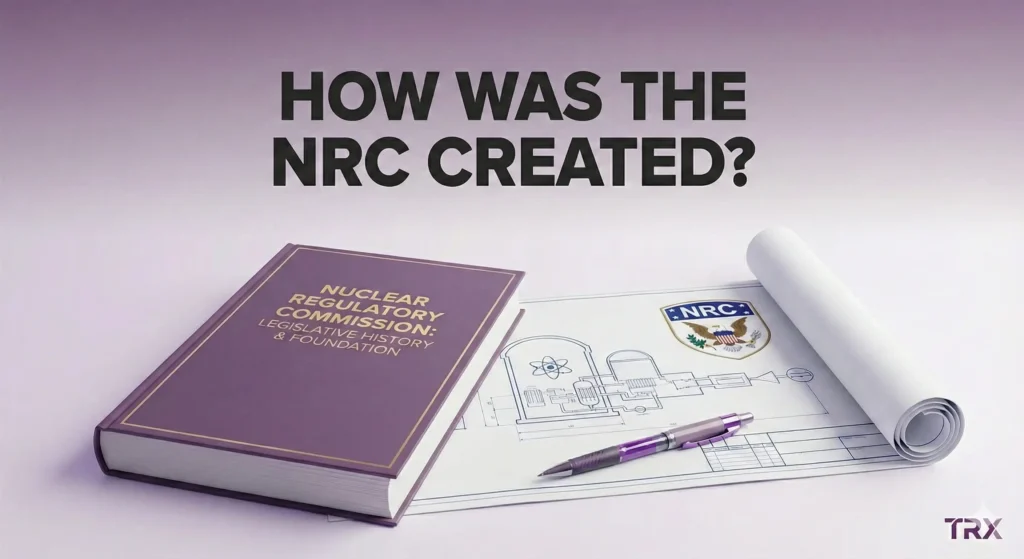
The Nuclear Regulatory Commission was established through the Energy Reorganization Act of 1974 and officially began operations on January 19, 1975. Before that, nuclear regulation in the U.S. was handled by the Atomic Energy Commission (AEC), which had a structural conflict built right into its mandate: it was simultaneously tasked with promoting nuclear energy and regulating it. That dual role made it difficult for the AEC to take truly independent safety positions.
Congress resolved the problem by splitting the AEC into two bodies. The NRC took on all regulatory functions. The Energy Research and Development Administration, which later evolved into the Department of Energy, took over the development and promotional side.
Why Was a Separate Regulatory Body Needed?
Throughout the 1960s and early 1970s, the U.S. civilian nuclear industry was growing fast. More power plants were being built, radioactive materials were being used more widely in hospitals and research labs, and public concern about nuclear safety was rising alongside that expansion. The AEC’s dual role undermined public confidence and made a tough regulatory stance nearly impossible to sustain.
Creating the NRC as a standalone regulatory body brought credibility, independence, and a sharpened focus on public safety, which was exactly what the industry and the public needed.
Missing the Right Nuclear Expertise?
We close the gap. From specialised engineering talent to leadership roles, TRX International connects the best in the sector.
Key Milestones in NRC History
A handful of events have fundamentally shaped how the NRC operates today.
The Three Mile Island accident in 1979 was a turning point. A partial meltdown at a Pennsylvania reactor exposed serious gaps in emergency preparedness and operator training. The NRC responded with sweeping reforms: stricter operator training standards, overhauled emergency planning requirements, and more rigorous inspection protocols.
The Chernobyl disaster in 1986 occurred in the Soviet Union, but it sent shockwaves through every nuclear regulatory body in the world. The NRC used it as an opportunity to reassess U.S. reactor safety standards and deepen international regulatory cooperation.
After the September 11, 2001 attacks, the NRC undertook a comprehensive overhaul of physical security requirements for nuclear facilities. New rules around force protection, access control, and insider threat mitigation were implemented across the board.
The Fukushima Daiichi disaster in Japan in 2011 prompted another serious round of reflection. The NRC established a task force to review U.S. reactor safety and ultimately implemented dozens of new requirements focused on flooding, seismic preparedness, and backup power systems.
Today, the NRC is developing licensing frameworks for small modular reactors (SMRs) and advanced reactor technologies, reflecting the nuclear industry’s shift toward next-generation energy solutions.
What Does the NRC Do? Functions and Responsibilities

Think of the NRC as the ultimate safety bouncer. Before a facility even thinks about powering up, it has to pass some seriously rigorous checks. The NRC reviews every blueprint and safety plan to ensure the public stays protected.
Licensing Nuclear Facilities
The licensing in the nuclear energy vertical primarily includes the power reactor licensing, research and test licensing, and Nuclear materials licensing; let’s a more in depth overview across them.
Power Reactor Licensing
One of the NRC’s most prominent functions is licensing nuclear power plants. Before a single construction crew arrives on site, the developer must work through the NRC’s licensing process. This includes applying for an Early Site Permit (ESP), which evaluates whether a specific location is suitable for a reactor, and a Combined License (COL), which authorizes both construction and operation.
The process is rigorous. The NRC reviews detailed safety analysis reports, environmental impact statements, and security plans before issuing any approvals. This is not a formality; it is a substantive technical and safety review.
Research and Test Reactor Licensing
Beyond commercial power plants, the NRC also licenses research and test reactors, often found at universities, national laboratories, and medical isotope production facilities. These reactors operate under different requirements than commercial plants but are still subject to meaningful NRC oversight.
Nuclear Materials Licensing
Radioactive materials are used every day in hospitals, industrial facilities, and research institutions. The NRC licenses these uses through its materials program. However, not every state depends directly on the NRC for this oversight.
Through the Agreement States program, 39 states have entered agreements with the NRC allowing them to exercise regulatory authority over certain nuclear materials within their borders, all under NRC-consistent standards.
Oversight and Inspection
The Reactor Oversight Process (ROP)
The NRC does not simply issue licenses and step aside. It continuously monitors the performance of operating nuclear power plants through the Reactor Oversight Process (ROP). This includes scheduled and unannounced inspections, performance indicator tracking, and a structured action matrix that determines the NRC’s response based on how well or poorly a plant is performing.
Plants that fall below performance thresholds receive increased NRC attention, additional inspections, or formal enforcement action. The ROP keeps every operating reactor under consistent, objective scrutiny.
Materials and Waste Inspections
The NRC also inspects the many facilities outside the power sector that handle nuclear materials, including hospitals, universities, and industrial users. Spent fuel storage at both operating and decommissioned nuclear sites is another area of active oversight, covering dry cask storage and spent fuel pools alike.
Security Inspections
Nuclear security is not theoretical. The NRC conducts force-on-force drills at nuclear facilities, putting security teams through simulated attack scenarios to test their ability to defend against real threats. Cybersecurity is an increasingly important focus as digital systems become more prevalent in plant operations, and the NRC actively inspects in this area as well.
Regulations and Rulemaking
The NRC’s regulatory authority is exercised through a detailed body of rules found in Title 10 of the Code of Federal Regulations (10 CFR). These regulations cover radiation protection, emergency preparedness, physical security, environmental impact, quality assurance, and much more.
Developing new regulations is a transparent public process. The NRC proposes rules, accepts public comment, and revises accordingly. This openness is one of the qualities that sets the NRC apart from many regulatory bodies and contributes to its credibility with the public.
Incident Response and Enforcement
The NRC operates a 24/7 Operations Center at its headquarters in Rockville, Maryland. This center monitors nuclear facilities across the country around the clock. When an incident occurs, the NRC can deploy response teams, issue emergency orders, and coordinate with the Federal Emergency Management Agency (FEMA) and state agencies.
When licensees break the rules, the NRC has a full range of enforcement tools: notices of violation, civil monetary penalties, orders to modify or suspend operations, and in serious cases, license revocation. The enforcement process is structured, documented, and public, which adds another layer of accountability.
Research and Development Oversight
The NRC funds and oversees safety-focused research at several national laboratories, including Argonne, Sandia, Oak Ridge, and Pacific Northwest National Laboratory. This research directly informs the NRC’s regulatory decisions and helps the agency anticipate new safety challenges before they become incidents.
International Cooperation
Nuclear safety is a global issue. The NRC works closely with the International Atomic Energy Agency (IAEA) and maintains bilateral regulatory cooperation agreements with dozens of countries. U.S. nuclear safety standards have influenced regulatory frameworks worldwide, giving the NRC a reach that extends well beyond American borders.
How Is the NRC Structured?

If you are curious on how this nuclear commission is structured, here are a few things you can look at, and its really exciting to see how this huge commission is structured.
The Five-Member Commission
The NRC is led by five commissioners, each appointed by the President and confirmed by the Senate. They serve staggered five-year terms, a structure designed to ensure continuity of leadership across changes in administration. The President designates one commissioner as Chair, who serves as the principal executive officer and public spokesperson for the agency.
The NRC’s Four Regional Offices
The NRC maintains four regional offices that carry out inspections and enforcement activities across the country:
- Region I, in King of Prussia, Pennsylvania, covers the Northeast.
- Region II, in Atlanta, Georgia, covers the Southeast.
- Region III, in Lisle, Illinois, covers the Midwest.
- Region IV, in Arlington, Texas, covers the South and West.
Each region maintains inspection teams that maintain close, ongoing relationships with licensees in their territory. Regional presence means hands-on oversight rather than remote monitoring alone.
NRC Headquarters
The NRC’s main offices are in Rockville, Maryland. Key offices operating from headquarters include the Office of Nuclear Reactor Regulation (NRR), which oversees power reactor licensing and performance; the Office of Nuclear Material Safety and Safeguards (NMSS); the Office of Nuclear Security and Incident Response (NSIR); and the Office of Research (RES). Each plays a distinct role in fulfilling the NRC’s overall mission.
NRC Budget and Workforce
The NRC operates primarily on a fee-recovery model. Roughly 90% of its operating budget is funded through fees charged to licensees, meaning the nuclear industry largely funds its own regulatory oversight. The agency employs approximately 3,000 full-time staff members spanning nuclear engineering, health physics, legal, cybersecurity, emergency preparedness, and administrative functions.
Why the NRC Matters?
Protecting Public Health and Environmental Safety
At its foundation, the NRC exists to make sure that the benefits of nuclear energy do not come at the cost of public health or environmental quality. It enforces strict radiation exposure limits for workers and the public, requires thorough environmental reviews for major licensing actions, and ensures that emergency preparedness plans are realistic and regularly tested.
The consistency of NRC oversight is one of the reasons U.S. nuclear plants rank among the safest and best-operated in the world. That track record does not happen by accident; it is the product of continuous regulatory pressure and attention.
Maintaining Public Trust in Nuclear Energy
Public trust in nuclear energy has always been fragile, and rightly so. People want assurance that someone credible is watching over these facilities. Strong, independent regulation is a major reason why public opinion around nuclear energy has shifted more positively in recent years. When people see a rigorous, transparent regulatory process in action, they are more willing to accept nuclear energy as part of a clean power future.
The NRC’s public meeting culture, open comment periods, and accessible inspection records all contribute to that trust. Transparency is not just a value at the NRC; it is a deliberate strategic choice.
Enabling the Future of Nuclear Energy
The nuclear industry is evolving fast. Small modular reactors, advanced reactor designs like molten salt and gas-cooled concepts, and microreactors are moving from research and development into actual licensing discussions. The NRC is actively developing new regulatory frameworks to accommodate these technologies.
The Part 53 rulemaking effort is a significant example. It aims to create a modern, technology-inclusive licensing pathway that moves beyond the frameworks written for large light-water reactors in the 1970s. Without clear regulatory paths, advanced nuclear technologies stall. The NRC’s work here is opening those paths.
NRC’s Influence on Nuclear Industry Employment
Here is something often overlooked: NRC regulations directly shape how many nuclear professionals are needed, what qualifications they must hold, and what specific roles must exist within a licensed facility.
Staffing requirements embedded in NRC regulations create consistent, sustained demand for licensed reactor operators, health physicists, quality assurance engineers, radiation protection technicians, and dozens of other specialized roles.
For job seekers and HR professionals in the nuclear sector, understanding the NRC is not just general knowledge. It is practical intelligence about where the jobs are, what credentials they require, and what compliance obligations employers must meet.
Looking for Qualified Nuclear Professionals?
TRX International specializes in nuclear and energy sector recruitment. Reach out to our team and let us help you make the right connection.
Careers at the NRC and in NRC-Regulated Fields
If you’re into big science and even bigger responsibilities, the NRC is where it’s at. You’ll be on the front lines of nuclear safety, ensuring plants operate without a hitch. It’s meaningful work where technical expertise meets public service.
Working Directly at the NRC
Who Does the NRC Hire?
The NRC recruits a wide range of professionals. Nuclear engineers and reactor physicists form the technical backbone of the agency, but the NRC also employs health physicists, materials scientists, cybersecurity specialists, emergency preparedness coordinators, environmental scientists, attorneys, policy analysts, and IT professionals.
If you have a technical, legal, or policy background and an interest in nuclear energy or public safety, there is likely a role at the NRC that fits your profile.
NRC Employment Benefits and Culture
Working for the NRC comes with federal government benefits, including competitive pay, robust health and retirement packages, and strong job security. The agency also has a genuine culture of professional development. Employees are encouraged to deepen their expertise across multiple regulatory areas, and the NRC provides structured training programs to support that growth.
For early-career professionals, the NRC offers student internship and fellowship programs. The agency’s Historically Black Colleges and Universities (HBCU) and Minority Serving Institutions grant programs bring diverse talent pipelines into the regulatory workforce, reflecting a commitment to building an inclusive team.
How to Apply for NRC Jobs?
NRC positions are posted on USAJobs.gov, the federal government’s official hiring platform. Most roles require U.S. citizenship, and some positions require a security clearance. Applications stand out when candidates can demonstrate familiarity with nuclear safety concepts, relevant regulatory frameworks, and 10 CFR provisions applicable to the role they are pursuing.
Careers in NRC-Regulated Industries
Nuclear Power Plant Roles Shaped by NRC Requirements
The NRC does not just employ people directly; its regulations define entire job categories across the broader nuclear industry. Senior Reactor Operators (SROs), for example, must be individually licensed by the NRC. This is not an internal company certification; it requires passing NRC-administered examinations and meeting strict experience requirements. The NRC issues those licenses directly.
Other plant roles heavily shaped by NRC requirements include:
- Radiation Protection Technicians, who monitor and control radiation exposure at nuclear facilities under NRC radiation protection standards.
- Nuclear Quality Assurance Engineers, who ensure that plant components and processes meet NRC-mandated quality standards under 10 CFR Part 50 Appendix B.
- Nuclear Security Officers, who must meet NRC-defined physical protection requirements at commercial nuclear facilities.
- Outage Management Professionals, who plan and execute the complex logistics of reactor shutdowns under strict NRC scheduling and safety requirements.
Nuclear Materials and Medical Sector Roles
NRC oversight extends well beyond the power sector. In hospitals, research institutions, and industrial facilities, several roles exist specifically because of NRC and Agreement State licensing requirements:
- Radiation Safety Officers (RSOs) are required at every NRC-licensed facility to administer and oversee the radiation safety program.
- Nuclear Medicine Technologists work under NRC-regulated protocols for handling the radioactive isotopes used in diagnostic and therapeutic procedures.
- Radioactive Waste Management Specialists handle, package, store, and arrange for disposal of nuclear materials under strict NRC waste management guidelines.
Consulting and Support Roles Around NRC Compliance
A significant portion of the nuclear professional workforce works in consulting or compliance support, helping facilities maintain their regulatory standing, prepare licensing applications, or respond to NRC inspection findings. Common roles in this space include:
- NRC Licensing Consultants, who guide utilities and developers through new reactor licensing, license renewal, or license amendment processes.
- Regulatory Affairs Specialists, who track NRC rulemaking developments and translate their implications for plant operations.
- Nuclear Safety Analysts, who perform probabilistic risk assessments and safety case reviews that feed into both NRC submissions and internal decision-making.
- Document Control and Records Management Specialists, who maintain the extensive documentation that NRC-licensed operations require.
Skills and Qualifications the NRC and Nuclear Industry Value
Whether you are aiming for a role at the NRC itself or within an NRC-regulated facility, certain qualifications consistently matter. A degree in nuclear engineering, health physics, or a related discipline like mechanical or electrical engineering forms a strong foundation for most technical roles.
For operator roles, NRC licensing is a firm requirement, not a preference. For many positions across the sector, a U.S. security clearance adds substantial value. And across most roles, familiarity with 10 CFR regulations, particularly 10 CFR Part 50 for power reactors or 10 CFR Part 30 for radioactive materials users, is a meaningful differentiator when applying.
Soft skills are equally important. Attention to detail, strong written communication for regulatory documentation, and the ability to function effectively within structured procedural environments are qualities that both the NRC and private-sector nuclear employers consistently look for.
How TRX International Supports Nuclear Career Seekers and Employers?
TRX International specializes in recruitment and human resource solutions for the nuclear and energy sector. With deep industry knowledge and a practical understanding of NRC regulatory requirements, TRX helps match qualified professionals with the right opportunities, whether at nuclear power plants, national laboratories, consulting firms, or energy companies operating in regulated environments.
For employers, TRX helps identify candidates who bring not only the right technical credentials but also a working understanding of the regulatory context they will operate in. In an industry where compliance is built into every job description, that distinction matters.
Frequently Asked Questions About the NRC
What does NRC stand for?
NRC stands for Nuclear Regulatory Commission, the independent U.S. federal agency responsible for overseeing civilian nuclear energy and radioactive materials.
What does the NRC do?
The NRC licenses nuclear facilities, conducts safety and security inspections, develops and enforces regulations, responds to nuclear incidents around the clock, and oversees radioactive materials used in medicine, research, and industry. Its core mission is to protect public health, safety, and the environment.
Is the NRC part of the Department of Energy?
No. The NRC is an independent regulatory agency, fully separate from the Department of Energy. The DOE handles energy policy, nuclear weapons programs, and energy development initiatives. The NRC focuses solely on civilian nuclear safety oversight.
How does the NRC affect nuclear industry jobs?
NRC regulations define required staffing levels, mandatory qualifications, and role-specific certifications across nuclear facilities. Those requirements directly generate and sustain demand for a wide range of specialized nuclear professionals, from licensed reactor operators to radiation safety officers.
What is the difference between the NRC and the IAEA?
The NRC is a U.S. federal agency with jurisdiction over domestic civilian nuclear activities. The IAEA is an intergovernmental organization under the United Nations that sets international nuclear safety standards and promotes global cooperation. The two bodies work together, but they operate independently with distinct authorities.
Does the NRC regulate nuclear weapons?
No. Nuclear weapons fall under the jurisdiction of the Department of Defense and the Department of Energy. The NRC’s authority is limited to civilian nuclear applications.
What are NRC Agreement States?
Agreement States are states that have entered formal agreements with the NRC to assume regulatory authority over certain radioactive materials within their borders. There are currently 39 Agreement States. Each operates under standards that are compatible with and at least as stringent as NRC requirements.
How does the NRC respond to nuclear accidents?
The NRC operates a staffed Operations Center 24 hours a day, seven days a week. In a significant incident, the NRC can dispatch Incident Response Teams to the affected site, issue emergency orders, and coordinate closely with FEMA, state emergency management agencies, and other federal partners to protect the public.
Final Thoughts
The NRC is not just a regulatory checkbox that nuclear facilities have to deal with. It is the framework that makes civilian nuclear energy possible in the United States.
Without credible, independent oversight, public trust in nuclear energy would be far harder to earn and maintain. With it, nuclear energy can play the substantial role it is increasingly being asked to fill in a cleaner, more reliable energy grid.
TRX International is a specialist recruitment and HR solutions provider for the nuclear and energy sector. From searching for top nuclear talent to looking for your next career move in an NRC-regulated environment, our team is ready to help.
Contact TRX International today and take the next step.