SMR Reactor Companies: Who’s Building the Future & Who’s Hiring?
Nuclear energy is back, and this time, it’s thinking smaller. Small Modular Reactors are no longer a distant concept; they’re being built, funded, and staffed right now.
If you’re exploring a career in the nuclear sector, understanding who the major SMR reactor companies are is your smartest first move. From well-funded US startups to government-backed UK giants, this guide breaks down who the key players are, where they’re headed, and most importantly, who’s actively hiring.
Rise of SMR Reactor Companies
Over the past decade, SMR reactor companies have gone from niche research projects to some of the most well-funded and talked-about ventures in the energy sector. These companies are developing next-generation nuclear reactors that are smaller, cheaper, and faster to build than traditional nuclear plants.
With billions in government grants and private investment flowing in, the sector is growing fast. For job seekers, this growth translates directly into opportunity, making it one of the most exciting spaces to build a long-term career in energy right now.
What Are SMR Reactors?
SMR stands for Small Modular Reactor. In simple terms, these are nuclear reactors that are significantly smaller than conventional ones, designed to be built in factories and assembled on-site. They produce up to 300 megawatts of electricity, making them flexible enough to power anything from a remote community to a mid-sized city. Think of them as nuclear energy, but smarter and more adaptable.
How SMRs Differ From Traditional Nuclear Reactors?
Traditional nuclear reactors are massive infrastructure projects. They take decades to plan, billions to build, and require large, specific sites with extensive grid infrastructure. While they generate enormous amounts of power, their sheer scale makes them difficult and expensive to deploy, especially in regions with growing but not yet large-scale energy demands.
SMRs flip that model on its head. Their compact size means shorter construction timelines, lower upfront costs, and far more flexibility in where they can be placed. They can be deployed in remote areas, used to replace retiring coal plants, or scaled up by adding multiple units as energy demand grows. Same reliable nuclear power, far fewer barriers to entry.
Missing the Right Nuclear Expertise?
We close the gap. From specialised engineering talent to leadership roles, TRX International connects the best in the sector. As a specialized nuclear recruitment agency, TRX understands the qualifications, clearances, and career paths that matter in this space.
Key Technical Characteristics That Define an SMR
Understanding what makes an SMR technically distinct helps you appreciate why so many companies and governments are investing in them.
- Power Output Range (Typically Under 300 MWe): SMRs are defined in part by their size. Most designs generate between 10 and 300 megawatts of electricity, compared to the 1,000 MWe or more that conventional reactors produce. This smaller output is actually a feature, not a limitation, as it allows for targeted deployment based on specific energy needs rather than building excess capacity.
- Modular and Factory-Built Design: One of the biggest advantages of SMRs is that their components are manufactured in controlled factory environments and then transported to the deployment site for assembly. This approach reduces construction time, improves quality control, and significantly cuts down on the on-site labour traditionally associated with nuclear builds.
- Scalability and Deployment Flexibility: SMRs are designed to grow with demand. A single unit can be installed initially, with additional modules added over time as energy needs increase. This scalability makes them attractive for utilities, remote communities, industrial facilities, and even military applications where energy reliability is critical.
Types of SMR Designs Currently Being Developed
Not all SMRs are built the same way. Several distinct reactor types are currently in development, each with its own technology, fuel type, and use case.
- Light Water SMRs: These are the most conventional of the bunch, using water as both coolant and moderator. They are closely related to the reactor technology already in widespread use globally, which makes the regulatory path somewhat more straightforward. NuScale’s VOYGR is a well-known example.
- Fast Neutron Reactors: These reactors use fast-moving neutrons rather than slowed-down ones, allowing them to use a broader range of fuel types, including nuclear waste. TerraPower’s Natrium reactor falls into this category.
- Molten Salt Reactors: Instead of solid fuel rods, these reactors use fuel dissolved in molten salt. They operate at high temperatures with low pressure, offering strong safety characteristics. Terrestrial Energy and Moltex are among the companies pursuing this design.
- Gas-Cooled Reactors: These use gas, typically helium, as a coolant and can operate at very high temperatures, making them useful for industrial heat applications beyond just electricity generation. X-energy’s Xe-100 is a leading example.
- Microreactors (Under 10 MWe): The smallest category of all, microreactors are designed for off-grid or remote deployment, from powering military bases to mining operations. Ultra Safe Nuclear Corporation is one of the key players in this space.
Why are SMR Nuclear Reactor Companies Getting So Much Attention Right Now?
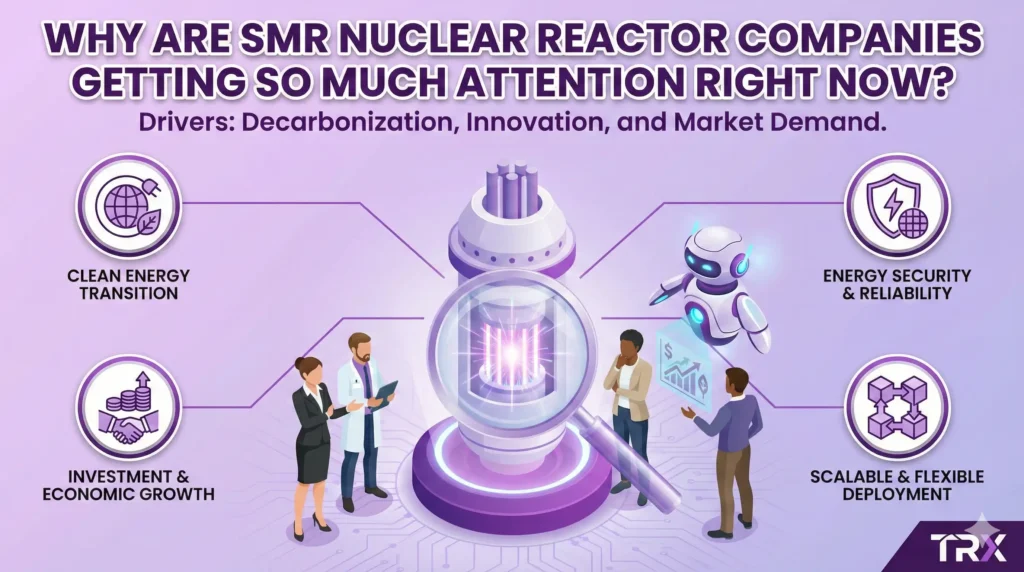
The buzz around SMR nuclear reactor companies is not just hype. There are real, concrete reasons why this sector has moved from the fringes of energy policy to the centre of global conversations. Here is what is driving it.
The Global Energy Transition and Nuclear’s Role
The world is under serious pressure to decarbonise, and fast. Renewables have made great strides, but they come with an unavoidable challenge: intermittency. The sun does not always shine, and the wind does not always blow. Nuclear energy produces clean, reliable, round-the-clock power, and SMRs are making that power more accessible than ever before. As countries race to hit net-zero targets, SMR nuclear reactor companies are increasingly being seen as a critical piece of the puzzle, not a backup plan.
Why Governments and Investors Are Backing SMRs?
Follow the money, and you will understand just how seriously SMRs are being taken. The US Department of Energy has poured billions into its Advanced Reactor Demonstration Program. The UK government has committed hundreds of millions to Rolls-Royce SMR. Canada, South Korea, Poland, and Romania all have active national SMR programmes.
On the private side, venture capital and strategic investors are funding companies like TerraPower, Oklo, and X-energy at levels that would have seemed unthinkable a decade ago. The combination of government backing and private investment signals that SMR reactor companies are not just a promising idea, they are a serious industrial bet.
SMRs vs. Renewables: Are They Competing or Complementary?
This is one of the most common questions people new to the space ask, and the honest answer is that it is largely the wrong question. SMRs and renewables are not in a head-to-head fight for dominance. They serve different roles in an energy grid. Renewables are excellent for meeting fluctuating demand when conditions are right. SMRs provide the stable, always-on baseload power that keeps the grid balanced when renewables dip. Many energy experts argue that a clean grid of the future will need both, working in tandem. SMR nuclear reactor companies are not trying to replace solar panels or wind farms; they are trying to fill the gap that those technologies cannot cover on their own.
Key Advantages of SMRs Over Large-Scale Nuclear Plants
SMR energy companies are not just building smaller reactors. They are rethinking how nuclear power gets built, deployed, and scaled. Here are the advantages that are making the industry sit up and take notice.
- Lower Upfront Capital Cost: One of the biggest reasons traditional nuclear fell out of favour was the eye-watering cost of construction. A single large reactor can cost upwards of $10 billion. SMRs dramatically reduce that upfront financial burden, making nuclear viable for utilities and markets that could never have considered it before.
- Faster Construction Timelines: Large nuclear plants can take 15 to 20 years from planning to power generation. SMRs, with their factory-built components and modular assembly, aim to cut that down to just a few years. For a world that needs clean energy solutions now, that speed matters enormously.
- Flexible Siting Options: Traditional reactors need large plots of land, proximity to water sources, and robust grid infrastructure. SMRs can be deployed in remote locations, on retired fossil fuel sites, or in regions with limited existing infrastructure. This flexibility opens up nuclear energy to parts of the world that were previously out of reach.
- Enhanced Passive Safety Systems: Modern SMR designs incorporate passive safety systems that rely on natural physical processes like gravity and convection rather than active mechanical intervention. This means that in the event of an emergency, the reactor can shut itself down safely without requiring operator action or external power, a significant leap forward from older nuclear technology.
Challenges and Criticisms SMR Companies Still Face
In the interest of giving a balanced picture, it is worth being upfront about the hurdles that SMR reactor developers are still working through. No emerging technology is without its complications.
- Regulatory Hurdles: Nuclear is one of the most heavily regulated industries in the world, for good reason. Getting a new reactor design approved is a long, rigorous, and expensive process. Many SMR designs are based on technologies that regulators have limited prior experience with, which means the licensing process can take years and involve significant back-and-forth with authorities like the US Nuclear Regulatory Commission or the UK’s Office for Nuclear Regulation.
- Levelized Cost of Energy (LCOE) Concerns: Critics have pointed out that while SMRs reduce upfront costs, their smaller output means they generate less electricity per unit, which can result in a higher cost per megawatt-hour compared to large nuclear plants or even some renewables. Proponents argue that mass manufacturing and economies of scale will bring costs down significantly once the first fleets are deployed, but this remains an open debate in the industry.
- Public Perception and Licensing Timelines: Nuclear energy still carries a stigma in many communities, shaped by historical events like Chernobyl and Fukushima. Even with dramatically improved safety profiles, SMR companies face the challenge of winning public trust, particularly when it comes to siting new facilities. Combined with lengthy licensing timelines, this means that even the most advanced SMR nuclear reactor companies are still years away from widespread commercial deployment in many markets.
The Global Landscape of SMR Reactor Companies
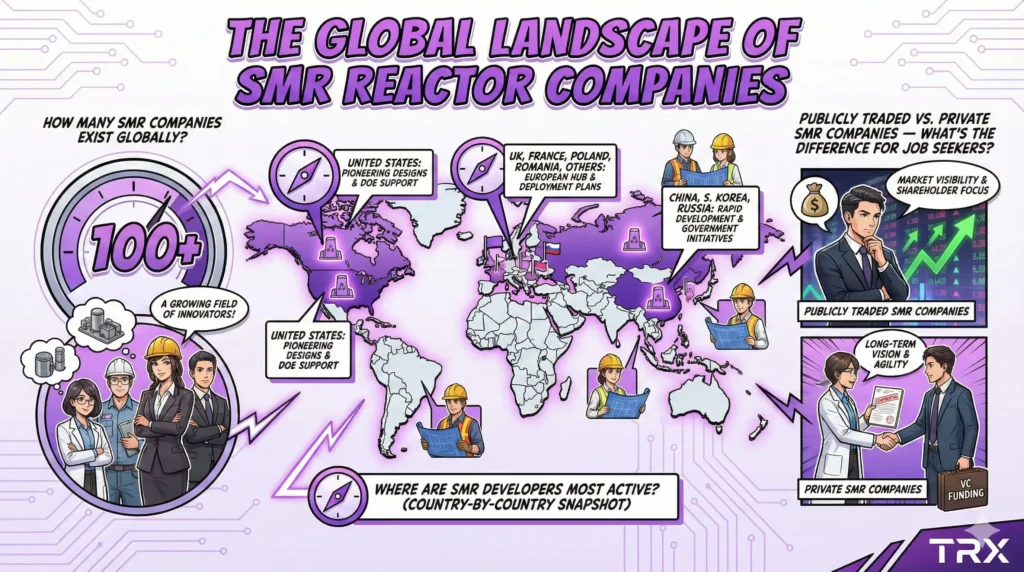
SMR reactor companies are no longer a uniquely American or British story. This is a global race, and understanding who is active where gives you a much clearer picture of where the jobs, the funding, and the opportunities are concentrated.
How Many SMR Companies Exist Globally?
The numbers are impressive. According to the International Atomic Energy Agency (IAEA), there are over 80 SMR designs in various stages of development across more than 18 countries. Not all of these will make it to commercial deployment, but the sheer volume of activity tells you something important: this is not a one-horse race. From well-capitalised US startups to state-backed programmes in Asia and Europe, the field of SMR nuclear reactor companies is wide, diverse, and growing every year.
Where are SMR Developers Most Active? (Country-by-Country Snapshot)
| Country | Key SMR Companies / Programmes | Development Stage | Government Support |
|---|---|---|---|
| United States | NuScale, TerraPower, X-energy, Kairos Power, Oklo | Advanced | High (DOE ARDP Funding) |
| United Kingdom | Rolls-Royce SMR, U-Battery | Advanced | High (Civil Nuclear Roadmap) |
| Canada | Terrestrial Energy, Moltex, ARC Clean Technology | Mid-to-Advanced | High (SMR Action Plan) |
| China | CNNC (ACP100 / Linglong One) | Under Construction | State-Driven |
| Russia | ROSATOM (RITM-200) | Operational | State-Driven |
| South Korea | KAERI (SMART Reactor) | Design Approved | Moderate |
| Poland | NuScale, Westinghouse partnerships | Early-to-Mid | Growing |
| Romania | NuScale (Doicesti Project) | Early | Growing |
| France | EDF, CEA Research Programmes | Research Phase | Moderate-High |
Here is a quick look at where SMR development is most concentrated right now.
- United States: The US leads the pack, with companies like NuScale, TerraPower, X-energy, Kairos Power, and Oklo all actively developing and deploying SMR technology, supported by significant funding from the Department of Energy’s Advanced Reactor Demonstration Program.
- United Kingdom: Rolls-Royce SMR is the headline act here, backed by government funding and a national commitment to deploying SMR units by the mid-2030s. Hiring in the sector is already picking up well ahead of that deadline.
- Canada: With its SMR Action Plan in full swing, Canada has built a strong ecosystem around companies like Terrestrial Energy, Moltex Energy, and ARC Clean Technology, supported by both federal and provincial governments.
- China: China’s ACP100 reactor, Linglong One, is the world’s first land-based commercial SMR to enter construction. Progress here is fast, state-driven, and closely watched by the global industry.
- Russia: ROSATOM’s RITM-200 reactors are already operational in Arctic deployments, making Russia one of the few countries with SMR technology that is actually up and running.
- South Korea: The SMART reactor received full design approval back in 2012, and South Korea continues to pursue international partnerships and export opportunities in the SMR space.
- Europe: Poland and Romania are actively partnering with US-based SMR companies, while France continues to invest in next-generation nuclear research. European momentum behind SMR nuclear reactor companies is growing steadily.
Publicly Traded vs. Private SMR Companies: What’s the Difference for Job Seekers?
This is a distinction worth understanding before you start sending out applications. SMR reactor companies fall into two broad categories, and each comes with a different set of implications for your career.
Publicly traded SMR companies, like NuScale Power (listed on NYSE) and Oklo Inc. (listed on NYSE), are subject to greater financial transparency. Their performance, funding levels, and strategic plans are regularly disclosed in public filings, which means you can do meaningful research before deciding to join. They also often offer stock-based compensation tied to market performance.
Private SMR companies, like X-energy, Kairos Power, and Terrestrial Energy, tend to move faster and operate with less public scrutiny. They are often backed by venture capital or strategic investors and can be more agile in their hiring and decision-making. The trade-off is less financial visibility, which means you need to do a bit more digging on their funding runway and project pipeline before committing.
For job seekers, neither is inherently better. What matters more is the company’s stage of development, its funding security, and the specific role on offer. A well-funded private company in the demonstration phase can offer just as much stability and career growth as a publicly listed one, sometimes more.
Leading SMR Reactor Companies in the United States
The US is home to the most active and well-funded group of SMR reactor companies in the world. Here is a closer look at the key players, what they are building, and what kinds of roles they are looking to fill.
| Company | Reactor Design | Key Market | Hiring Focus |
|---|---|---|---|
| NuScale Power | VOYGR™ (Light Water SMR) | Utilities and grid power | Nuclear engineers, licensing, safety analysts |
| TerraPower | Natrium (Sodium-Cooled Fast Reactor) | Coal replacement, grid power | Engineering, construction, regulatory affairs |
| X-energy | Xe-100 (High-Temp Gas Reactor) | Grid power and industrial heat | Engineering, fuel manufacturing, project development |
| Kairos Power | KP-FHR (Fluoride Salt-Cooled) | Demonstration and grid power | Early-career engineers, reactor operations |
| Oklo Inc. | Aurora (Microreactor) | Remote and off-grid power | Engineering, regulatory, business development |
| Holtec International | SMR-300 (Light Water SMR) | Utilities and global markets | Manufacturing, supply chain, project management |
| GE Hitachi Nuclear Energy | BWRX-300 (Boiling Water SMR) | Utilities and government partners | Technology, engineering, project partnerships |
| Ultra Safe Nuclear (USNC) | MMR (Microreactor) | Defence, remote, industrial | Reactor design, systems engineering, programme management |
NuScale Power
NuScale is arguably the most well-known name among SMR energy companies in the US. Its VOYGR™ plant design is based on small, stackable reactor modules, each capable of generating 77 MWe, which can be combined to meet varying energy demands. NuScale made history as the first SMR design to receive approval from the US Nuclear Regulatory Commission.
While the company faced a setback with the cancellation of its Utah Associated Municipal Power Systems project, it continues to pursue deployments internationally and domestically. On the hiring front, NuScale regularly recruits nuclear engineers, licensing specialists, project managers, and safety analysts.
TerraPower
Founded with backing from Bill Gates, TerraPower is developing the Natrium reactor, a sodium-cooled fast reactor paired with an energy storage system. Its first demonstration plant is being built in Kemmerer, Wyoming, on the site of a retiring coal plant, with commercial operation targeted for the late 2020s. TerraPower is actively growing its workforce across engineering, construction, regulatory affairs, and operations as it moves from design into the build phase.
X-energy
X-energy is developing the Xe-100, a high-temperature gas-cooled reactor that uses pebble-bed fuel technology. The design is well-suited not just for electricity generation but also for industrial heat applications, giving it a broader commercial appeal. X-energy is a recipient of DOE funding through the Advanced Reactor Demonstration Program and has recently expanded its scope through a partnership with Dow Chemical for industrial energy deployment. Career opportunities span engineering, fuel manufacturing, and project development roles.
Kairos Power
Kairos Power is taking a different approach with its fluoride salt-cooled high-temperature reactor design. The company is currently constructing the Hermes demonstration reactor in Oak Ridge, Tennessee, which marks a significant milestone as one of the first non-light-water demonstration reactors to receive a construction permit from the NRC in decades. Kairos has a reputation for a strong internal culture focused on learning and iteration, making it an attractive option for early-career nuclear professionals looking to grow fast.
Oklo Inc.
Oklo is one of the more unconventional names among SMR reactor companies. Its Aurora microreactor is designed for off-grid and remote deployment, using advanced fast reactor technology. Oklo went public via a SPAC merger in 2024, giving it greater access to capital markets as it works toward its first commercial deployment. As the company scales up post-listing, it is building out teams across engineering, regulatory, business development, and communications.
Holtec International
Holtec is a well-established name in the nuclear industry that has expanded into SMR development with its SMR-300 design. The company has a significant manufacturing footprint and is developing a dedicated facility for SMR component production. With operations spanning multiple countries, Holtec offers career opportunities across engineering, manufacturing, supply chain, and project management at various stages of the reactor lifecycle.
GE Hitachi Nuclear Energy (BWRX-300)
GE Hitachi’s BWRX-300 is one of the most commercially advanced SMR designs globally, with agreements and partnerships in place across the US, Canada, Poland, and Estonia. Rather than building and operating plants itself, GE Hitachi works through a partnership model with utilities and governments, which means career opportunities span both the parent organisation and its network of project partners. Roles tend to be more engineering and technology-focused, with strong pathways for experienced nuclear professionals.
Ultra Safe Nuclear Corporation (USNC)
USNC is focused on the smaller end of the spectrum with its Micro Modular Reactor, designed for remote communities, industrial operations, and defence applications. The company has active projects in the US and Canada and works closely with government agencies including NASA and the US Department of Defense. USNC is recruiting across reactor design, fuel technology, systems engineering, and programme management, with a particular focus on candidates who have a background in defence or aerospace.
Leading SMR Nuclear Reactor Companies in the United Kingdom
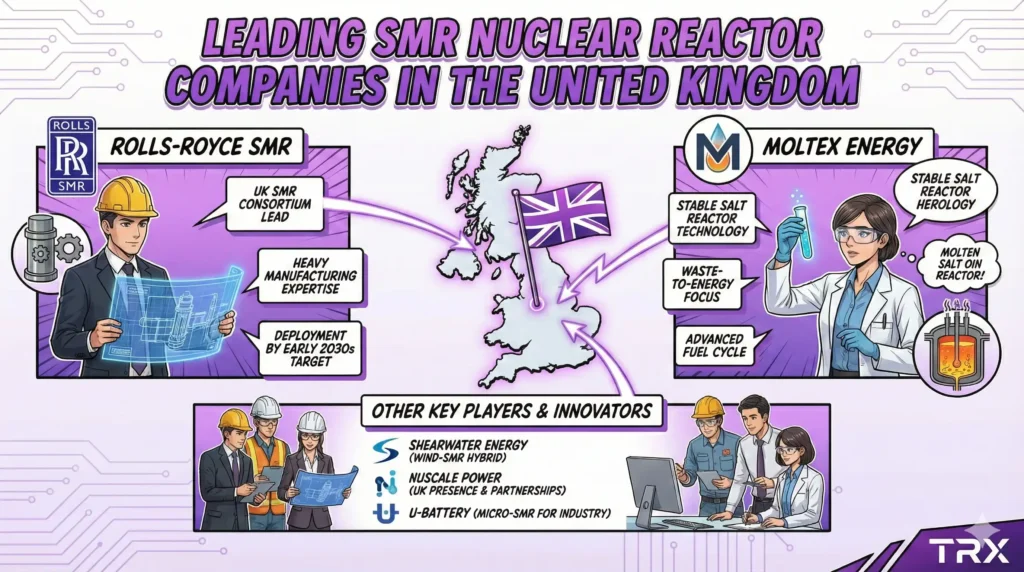
The UK has firmly positioned itself as one of the leading nations in the global SMR race. With strong government commitment, an established nuclear workforce, and a clear industrial strategy, British SMR nuclear reactor companies are moving quickly from blueprint to build.
Rolls-Royce SMR
Rolls-Royce SMR is the biggest name in the UK’s SMR story, and for good reason. The company is developing a 470 MWe factory-built reactor design that is specifically engineered for serial manufacture, meaning each unit is built to the same standard in a controlled factory environment before being assembled on site. This approach is central to its cost and timeline advantages over traditional nuclear builds.
The UK government has backed Rolls-Royce SMR with substantial funding, and the company has also secured significant private investment, bringing its total raised to over £500 million. On siting, several locations across the UK are under active consideration, with a focus on existing nuclear and industrial sites that already have the infrastructure and local workforce to support deployment.
For job seekers, Rolls-Royce SMR represents one of the most significant hiring opportunities in the UK nuclear sector. The company has ambitious plans to grow its workforce substantially over the coming years, recruiting across nuclear engineering, manufacturing, project management, regulatory affairs, and corporate functions. It also runs apprenticeship and graduate programmes, making it one of the more accessible entry points into the SMR industry for those at the start of their careers.
U-Battery (Urenco)
U-Battery is a microreactor project developed under the umbrella of Urenco, one of the world’s leading uranium enrichment companies. The U-Battery design aims to produce around 4 MWe, targeting remote industrial sites, off-grid communities, and applications where a small, reliable, and clean power source is needed. It is a high-temperature gas-cooled reactor concept, and while it is still in the research and development phase, it has received funding support from the UK government’s nuclear innovation programmes.
Career opportunities at U-Battery tend to be more research and development oriented at this stage, attracting physicists, reactor designers, fuel technology specialists, and engineers interested in working at the cutting edge of microreactor innovation. For those who enjoy being part of early-stage technical development rather than large-scale deployment, U-Battery offers a genuinely interesting environment to work in.
Looking for Qualified Nuclear Professionals?
TRX International specializes in nuclear and energy sector recruitment. Reach out to our team and let us help you make the right connection.
Other UK-Based SMR Initiatives to Watch
Beyond the two headline names, there are several other developments in the UK SMR space worth keeping an eye on.
Newcleo is an Anglo-Italian company developing a lead-cooled fast reactor with a strong UK presence and growing investment backing. It has set ambitious targets for deployment in the early 2030s and is actively building its team.
Moltex Energy has a UK operation alongside its Canadian arm, working on its Stable Salt Reactor technology. The UK programme feeds into its broader international development pipeline.
The UK’s Great British Nuclear (GBN) initiative is also worth noting. Established by the UK government to drive nuclear expansion, GBN ran a competitive process to select SMR technologies for potential UK deployment. The outcome of this process will shape which additional SMR companies become significant employers in the UK market over the coming decade.
For anyone building a career in nuclear energy, the UK is one of the most active and opportunity-rich environments in the world right now, and that is only set to grow as SMR projects move closer to construction.
Key SMR Companies in Canada
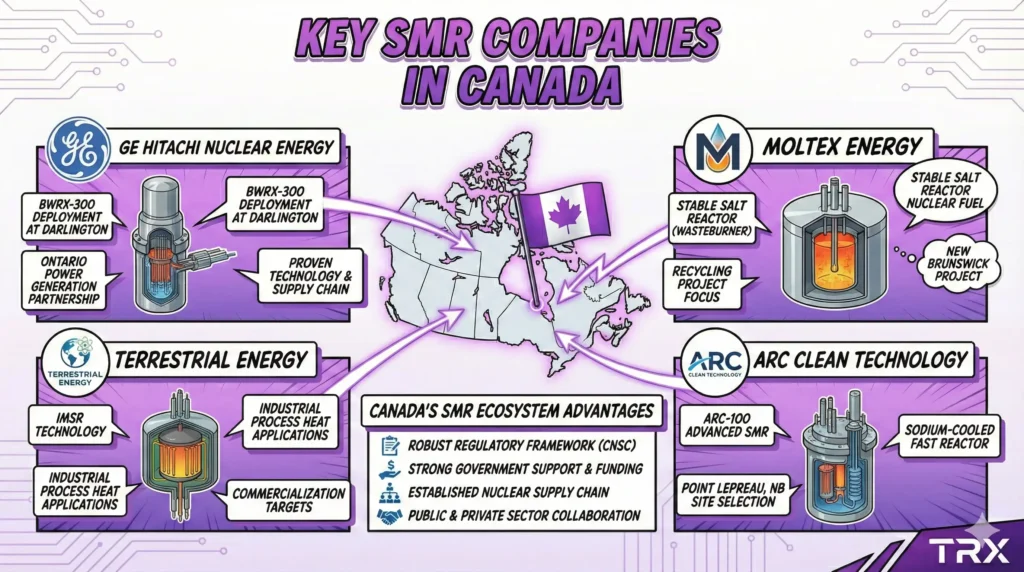
Canada does not always get the attention it deserves in the global SMR conversation, but it absolutely should. The country has a long and respected history in nuclear energy, a skilled workforce, and a government that has actively committed to making SMRs a cornerstone of its clean energy future.
Terrestrial Energy (IMSR)
Terrestrial Energy is developing the Integral Molten Salt Reactor (IMSR), a design that uses liquid fuel rather than solid fuel rods, operating at high temperatures with strong safety and efficiency characteristics. The IMSR is targeted at both electricity generation and industrial heat applications, which significantly broadens its commercial potential. Terrestrial Energy is working through the Canadian Nuclear Safety Commission’s pre-licensing review process and has attracted attention from both Canadian and US government bodies.
Moltex Energy
Moltex Energy is another molten salt reactor developer with a strong Canadian presence, focused on its Stable Salt Reactor Wasteburner (SSR-W) design. What makes Moltex particularly interesting is its ability to use spent nuclear fuel as its primary fuel source, addressing both the waste challenge and the clean energy challenge simultaneously. The company is advancing its work in New Brunswick, with support from the provincial government and federal funding.
Global First Power
Global First Power is developing a small modular microreactor in partnership with Ontario Power Generation and Ultra Safe Nuclear Corporation. Its MMR project at Chalk River Laboratories in Ontario would be the first SMR in Canada to reach the construction stage. The project has completed key pre-licensing milestones and is progressing steadily through the regulatory process, making it one of the most near-term deployment opportunities in the Canadian market.
ARC Clean Technology
ARC Clean Technology is developing an advanced sodium-cooled fast reactor, the ARC-100, also based in New Brunswick. The design is capable of using spent nuclear fuel, generating 100 MWe, and operating for 20 years without refuelling. ARC has secured government support and is progressing through regulatory pre-licensing, positioning itself as a strong contender for near-term Canadian deployment.
Canada’s SMR Action Plan and What It Means for Jobs
Canada’s SMR Action Plan, released in 2020 and regularly updated since, is a coordinated effort between federal and provincial governments, utilities, Indigenous communities, and industry to bring SMRs to market. The plan identifies SMRs as a key tool for decarbonising remote communities, industrial operations, and the electricity grid.
For job seekers, this is significant. A government-backed roadmap means sustained funding, regulatory support, and long-term demand for nuclear professionals across engineering, licensing, operations, and project management. Canada is actively working to grow its nuclear talent pipeline, and for those open to working in North America, it represents a genuinely strong and stable career destination.
SMR Reactor Developers in Europe and Asia
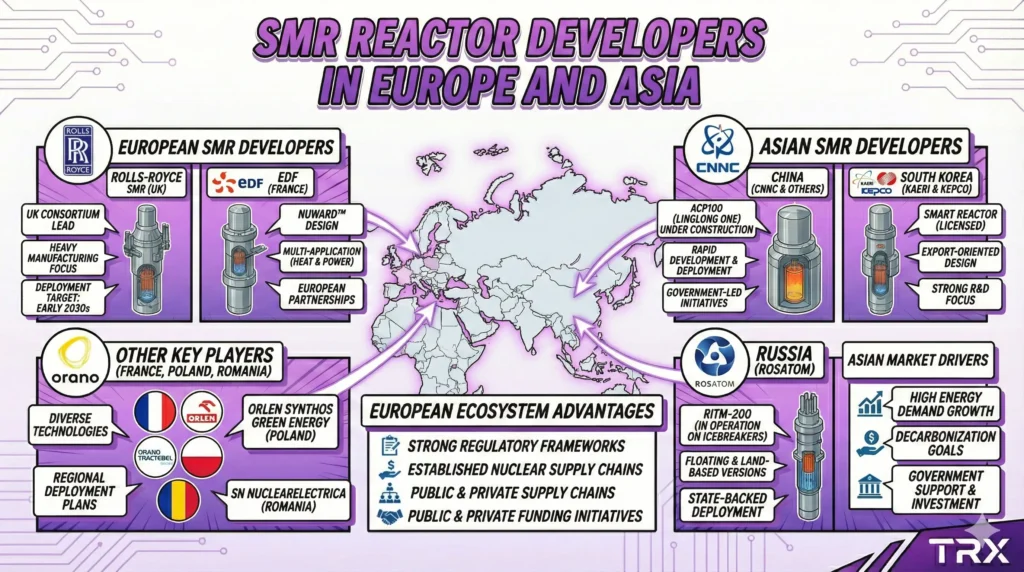
While North America and the UK attract most of the headlines, some of the most consequential SMR developments are happening in Asia and across continental Europe.
China’s CNNC and the ACP100 (Linglong One)
China’s ACP100, developed by the China National Nuclear Corporation (CNNC) and commercially branded as Linglong One, holds a notable distinction: it is the world’s first land-based commercial SMR to have begun construction. The project is located on Hainan Island and is progressing at a pace that reflects China’s broader ambition to become a global leader in nuclear technology. For the international nuclear job market, China’s rapid progress is an important benchmark, even if direct employment opportunities for overseas candidates remain limited.
Russia’s ROSATOM and the RITM-200 Fleet
ROSATOM is arguably the most operationally advanced SMR developer in the world. Its RITM-200 reactors are not just designs on paper; they are already generating power aboard nuclear icebreakers and in land-based deployments in remote Russian regions. ROSATOM is also actively exporting its technology and expertise internationally, building nuclear plants in multiple countries across Asia, Africa, and the Middle East. For experienced nuclear professionals, ROSATOM’s international projects can represent niche but interesting opportunities.
South Korea’s SMART Reactor Program
South Korea’s SMART reactor, developed by the Korea Atomic Energy Research Institute (KAERI), was the first SMR in the world to receive standard design approval from a national nuclear regulator, achieving that milestone back in 2012. Domestic deployment has moved more slowly than expected, but South Korea continues to develop international partnerships and explore export opportunities, particularly in the Middle East and Southeast Asia.
European Newcomers: Romania, Poland, and France
Europe is becoming an increasingly active region for SMR development. Romania is advancing a NuScale deployment project at its Doicesti site, supported by US government backing and an intergovernmental agreement. Poland, in the process of phasing out coal, has signed agreements with both NuScale and Westinghouse to bring SMR technology to the country, with considerable government urgency behind the transition.
France, with its deeply embedded nuclear culture and strong engineering base, is investing in advanced reactor research through EDF and the French Alternative Energies and Atomic Energy Commission (CEA). Across the continent, SMR reactor companies are finding receptive governments and growing public support, creating new pockets of employment and opportunity for nuclear professionals.
How to Evaluate SMR Companies as a Job Seeker?
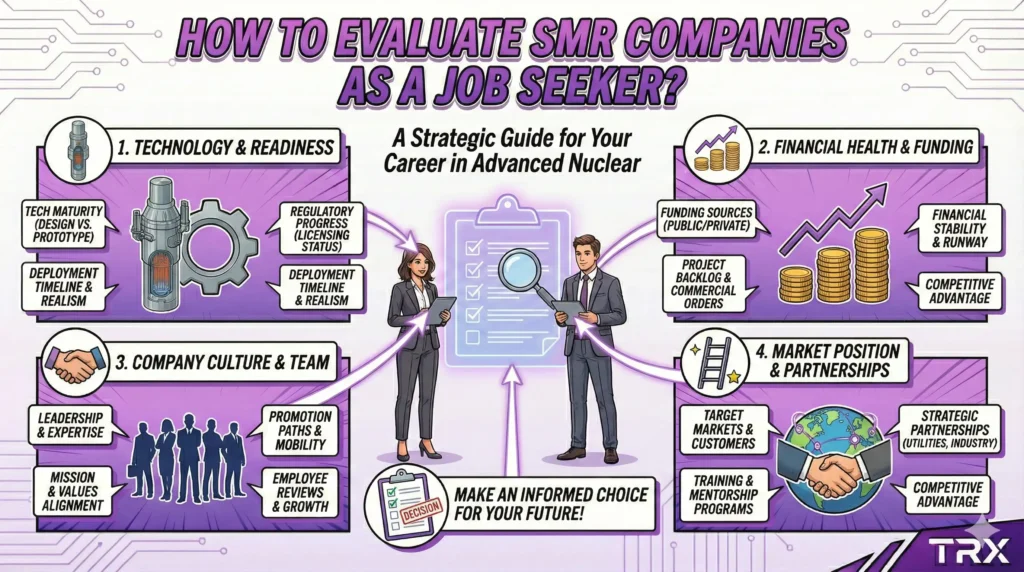
Not all SMR reactor companies are at the same stage, and not all of them represent the same career opportunity. Before committing to a role, it is worth taking a step back and evaluating the company through a job seeker’s lens.
Stage of Development Matters: What Does Each Phase Mean for You?
Where a company sits in its development journey has a direct impact on what your day-to-day will look like, how secure the role is, and what growth opportunities exist.
- Concept and Design Phase: Companies at this stage are primarily research-driven. The work is intellectually stimulating, but commercial deployment is still years away. Roles here suit those who enjoy early-stage technical development and are comfortable with uncertainty.
- Regulatory Licensing Phase: This is where companies spend significant time and resource working through the approval process with national regulators. It creates strong demand for licensing engineers, regulatory affairs specialists, and legal and compliance professionals.
- Demonstration and Pilot Phase: Companies building demonstration reactors are in a fast-paced, high-energy environment. Multi-disciplinary teams are needed, and the pace of hiring tends to increase significantly. This phase offers great exposure across multiple functions.
- Commercial Deployment Phase: This is where the jobs really scale up. Construction crews, operations staff, project managers, and supply chain professionals all come into high demand. Roles at this stage tend to be more stable and longer-term in nature.
Funding and Financial Backing: Why It Should Influence Your Decision
A great technology means very little if the company running out of money six months after you join. Funding stability is one of the most practical things to assess before accepting a role at any SMR company.
- DOE ARDP Grants: Companies that have received funding through the US Department of Energy’s Advanced Reactor Demonstration Program have been through a rigorous selection process. This is a meaningful signal of technical credibility and near-term viability.
- Private Equity and Venture Capital: VC-backed SMR companies can move fast and offer exciting upside, but it is worth understanding how much runway they have and whether they are approaching their next funding round. Ask questions during the interview process.
- Government-to-Government Agreements: Companies backed by intergovernmental agreements, such as those supporting SMR deployments in Poland or Romania, tend to have a higher degree of political and financial stability behind their projects.
Company Culture, Mission, and Values in the Nuclear Sector
The culture at SMR companies tends to reflect that sense of purpose, but it varies considerably between organisations. Some are fast-moving startups where agility and adaptability are prized. Others operate with the rigour and process-orientation you would expect from a highly regulated industry. Neither is better, but knowing which environment suits you before you apply will save everyone time. Look at how companies communicate publicly, talk to people who work there, and pay attention to how they behave during the hiring process itself.
Startup vs. Established Nuclear Company: Pros and Cons for Career Growth
| Factor | Startup SMR Company | Established Nuclear Company |
|---|---|---|
| Career Progression | Fast, broad exposure | Structured and defined |
| Job Security | Higher risk, higher reward | Generally more stable |
| Learning Curve | Steep but valuable | Methodical and process-driven |
| Compensation | Often includes equity | Competitive salaries, strong benefits |
| Impact | High individual contribution | Part of a larger system |
| Innovation | Encouraged and expected | More constrained by regulation |
Questions to Ask Before Accepting a Role at an SMR Company
Going into an interview with the right questions is just as important as answering theirs well. Here are some worth asking:
What Jobs are SMR Reactor Companies Hiring For?
One of the most common questions from people new to the sector is: do I need to be a nuclear engineer to work at an SMR company? The answer is no. These companies need a wide range of professionals, and the demand is growing fast.
Engineering Roles
Engineering sits at the core of every SMR reactor company, and it is where the bulk of hiring typically happens.
- Nuclear Engineers are responsible for reactor design, fuel management, safety analysis, and performance optimisation. They are the most in-demand professionals across the sector.
- Mechanical and Structural Engineers work on the physical design and integrity of reactor components, pressure vessels, and plant structures.
- Electrical and Instrumentation Engineers design and maintain the systems that control, monitor, and protect the reactor.
- Systems and Safety Engineers take a holistic view of how all reactor systems interact and ensure that designs meet the stringent safety standards required for nuclear licensing.
Science and Research Roles
For those with a more academic or research-oriented background, SMR companies offer compelling opportunities.
- Nuclear Physicists work on reactor core design, neutron behaviour, and fuel cycle analysis.
- Materials Scientists are critical for developing and qualifying the advanced materials used in high-temperature and radiation-intensive reactor environments.
- Reactor Physics Analysts model and simulate reactor behaviour, providing the data that underpins safety cases and licensing submissions.
Regulatory and Licensing Roles
Getting a new reactor design approved is one of the most complex challenges an SMR company faces, and it requires dedicated specialist teams.
- NRC and Regulatory Affairs Specialists manage the relationship with nuclear regulators, prepare licence applications, and coordinate responses to regulatory reviews.
- Licensing Engineers work on the technical documentation that supports design certification and construction permits.
- Environmental Compliance Experts assess and manage the environmental impact of reactor siting and operations, a growing area of focus as community engagement becomes more central to project approvals.
Operations and Project Management
As SMR projects move from design into construction and operation, project delivery professionals become essential.
- Project Managers and Program Directors lead the complex, multi-year programmes involved in building and commissioning nuclear facilities.
- Construction and Commissioning Managers oversee the physical build and the critical process of bringing a reactor into operational service for the first time.
- Supply Chain and Procurement Specialists manage the intricate network of vendors and manufacturers that supply components to SMR projects, many of which require nuclear-grade qualification.
Non-Technical Roles With High Demand
SMR companies are not just hiring engineers and scientists. As these organisations scale, the demand for business and corporate professionals grows significantly.
- Communications and Public Affairs professionals manage media relations, community engagement, and the critical work of building public trust in nuclear energy.
- Finance and Investor Relations teams manage capital, report to investors, and support the funding rounds that keep SMR companies moving forward.
- Policy and Government Affairs specialists engage with legislators and policymakers to shape the regulatory and political environment that SMR companies operate in.
- HR and Talent Acquisition professionals with nuclear sector knowledge are among the most sought-after non-technical hires, as companies compete fiercely for a limited pool of qualified candidates.
Entry-Level, Graduate, and Internship Opportunities at SMR Companies
If you are just starting out, the good news is that SMR companies are actively investing in early talent. Many have established graduate programmes, internships, and apprenticeships specifically designed to bring new people into the industry. Companies like Rolls-Royce SMR, TerraPower, and Kairos Power are known for structured early-career pathways. Starting at the ground level in a growing SMR company can fast-track your career in ways that a more established organisation simply cannot match, given the pace of growth and the breadth of exposure available.
Qualifications and Skills SMR Companies Are Looking For
Knowing what SMR reactor companies actually want from candidates gives you a clear advantage in a competitive field.
Academic Backgrounds That Open Doors in the SMR Sector
Nuclear engineering is the most direct route, but it is far from the only one. Mechanical, electrical, chemical, and materials engineering degrees are all highly relevant. Physics and applied science degrees are valued in research-heavy roles. For non-technical positions, backgrounds in law, finance, environmental science, communications, and public policy are all in demand as SMR companies build out their broader organisations.
Certifications and Licenses That Give You an Edge
Formal qualifications beyond your degree can meaningfully strengthen your profile in the nuclear job market.
- Professional Engineer (PE) License: Widely recognised in the US, a PE license signals a high level of engineering competence and is often required for senior technical roles at nuclear companies.
- Nuclear Operator Licenses: Relevant for those pursuing operational roles at reactor facilities, these licenses are issued by national regulators and require rigorous training and examination.
- Project Management Professional (PMP): For project and programme management roles, a PMP certification demonstrates structured delivery capability, which is highly valued in complex nuclear builds.
- Health Physics Certifications: For those working in radiation protection and safety, certifications from bodies like the American Board of Health Physics are a strong differentiator.
Soft Skills That Matter in SMR Startup Environment
Technical ability gets you through the door, but soft skills are what set candidates apart in a startup-style nuclear environment. Clear communication, the ability to work across disciplines, comfort with ambiguity, and a proactive approach to problem-solving are consistently cited by hiring managers at SMR companies. The ability to distil complex technical concepts for non-technical audiences is particularly valuable, given how much community engagement and regulatory communication these companies do.
Security Clearances: When Are They Required?
Not every SMR role requires a security clearance, but some do, particularly those involving defence applications, government contracts, or work on certain classified programmes. Companies like USNC, which works with NASA and the US Department of Defense, are more likely to require clearances than civilian-focused developers. If you already hold a clearance from a previous role in defence, aerospace, or government, it is a meaningful asset worth highlighting in your applications.
Transferable Skills From Other Industries (Oil & Gas, Aerospace, Defense)
One of the most important things to understand about the SMR job market is that it actively values professionals from adjacent industries. Oil and gas professionals bring deep expertise in plant operations, instrumentation, project engineering, and safety management systems.
Aerospace engineers contribute precision manufacturing knowledge and systems engineering rigour. Defence professionals understand regulated environments, complex project delivery, and security protocols. If you are coming from one of these backgrounds, you are not starting from scratch; you are bringing a highly relevant skillset that SMR companies genuinely need.
Salary and Compensation Benchmarks at SMR Reactor Companies
Compensation in the nuclear sector has always been competitive, and the rise of SMR companies has pushed that further, particularly as startups compete with established players for a limited talent pool.
Average Salaries by Role and Seniority
| Role | Entry Level | Mid-Level | Senior Level |
|---|---|---|---|
| Nuclear Engineer | $75,000 – $95,000 | $100,000 – $130,000 | $140,000 – $180,000+ |
| Reactor Physics Analyst | $80,000 – $100,000 | $110,000 – $140,000 | $150,000 – $190,000+ |
| Licensing and Regulatory Specialist | $70,000 – $90,000 | $100,000 – $130,000 | $140,000 – $170,000+ |
| Project Manager | $85,000 – $105,000 | $115,000 – $145,000 | $155,000 – $200,000+ |
| Health and Safety Professional | $65,000 – $85,000 | $90,000 – $115,000 | $120,000 – $155,000+ |
| Communications and Public Affairs | $55,000 – $75,000 | $80,000 – $105,000 | $110,000 – $140,000+ |
Figures are approximate USD benchmarks and will vary by company, location, and specific role.
How Startup Equity and Stock Options Work in Nuclear Companies?
Publicly listed SMR companies like NuScale and Oklo typically offer stock-based compensation as part of their packages, which can be a meaningful part of your total earnings if the company performs well. Private SMR companies often offer equity or options as well, particularly at the senior level, as a way of compensating for the higher risk and attracting talent that might otherwise opt for a more established employer. It is important to understand vesting schedules, strike prices, and the company’s funding stage before placing too much weight on equity as part of your decision.
Benefits Packages Common in the Nuclear Industry
Beyond base salary, nuclear sector employers tend to offer strong benefits packages. These commonly include comprehensive health insurance, generous pension or 401(k) contributions, paid professional development and certification support, relocation assistance for specialist roles, and in some cases, site-specific allowances for remote or unusual deployment locations. Larger companies like GE Hitachi and Holtec typically offer more structured and comprehensive benefits, while startups may offer leaner packages offset by equity and growth potential.
How SMR Company Salaries Compare to Traditional Utilities and Large-Scale Nuclear?
SMR startups, particularly those that are well-funded and in growth mode, are increasingly matching or exceeding the salaries offered by traditional utilities and large-scale nuclear operators. The key difference is the risk profile. A traditional utility offers stability, established career ladders, and long-term security.
An SMR startup offers higher potential upside, faster progression, and the chance to be part of something genuinely new. For many nuclear professionals, particularly those earlier in their careers, the trade-off is increasingly worth making.
Where to Find SMR Reactor Company Jobs?
Knowing where to look is half the battle. The nuclear job market is not as visible as sectors like tech or finance, so being deliberate about your search strategy matters.
Company Career Pages Worth Bookmarking
The most direct route to SMR job openings is through the careers sections of company websites. Pages worth checking regularly include those of NuScale Power, TerraPower, X-energy, Kairos Power, Oklo, Rolls-Royce SMR, Holtec International, GE Hitachi Nuclear Energy, and Terrestrial Energy. Setting up job alerts on these sites ensures you are not missing openings the moment they go live.
Nuclear-Specific Job Boards and Recruitment Platforms
General job boards like LinkedIn and Indeed carry nuclear roles, but specialist platforms are often more effective. Nuclear-focused job boards aggregate openings from across the sector and tend to attract higher-quality, more relevant listings. Specialist nuclear recruitment agencies also maintain their own portals and candidate databases, which can surface roles that are never publicly advertised.
The Role of Specialist Nuclear Recruiters in Landing SMR Jobs
This is worth emphasising. A significant proportion of senior and specialist roles in the SMR sector are filled through recruitment agencies before they ever reach public job boards. Nuclear-specialist recruiters have established relationships with hiring managers at SMR companies, understand the technical language of the sector, and can advocate for your application in ways that a cold online submission simply cannot replicate. Registering with a reputable nuclear recruitment firm is one of the smartest moves a job seeker in this space can make.
LinkedIn Strategies for Getting Noticed by SMR Hiring Managers
LinkedIn is genuinely useful in the nuclear space if you use it well. Start by optimising your profile with relevant keywords: nuclear engineer, SMR, advanced reactor, reactor design, nuclear licensing, and similar terms. Follow the major SMR companies and engage meaningfully with their content.
Connect with professionals already working in the sector, and do not be afraid to send a thoughtful direct message to someone whose career path interests you. Many hiring managers in the nuclear sector are active on the platform and do pay attention to candidates who show genuine interest and knowledge.
Industry Conferences and Networking Events That Connect You to SMR Employers
In-person events remain one of the best ways to build relationships in the nuclear sector. The following are worth prioritising:
- Nuclear Energy Assembly: Hosted by the Nuclear Energy Institute, this is one of the premier gatherings for nuclear industry leaders and a strong networking opportunity for job seekers.
- SMR and Advanced Reactor Summit: A more focused event specifically for the SMR community, bringing together developers, investors, regulators, and supply chain professionals.
- WNA Symposium: The World Nuclear Association’s annual event draws an international audience and is particularly useful for those interested in the global SMR market.
- ANS Annual Meeting: The American Nuclear Society’s flagship conference is a broad and well-attended event that covers the full spectrum of nuclear topics and attracts professionals from across the industry.
How Nuclear Recruitment Agencies Can Accelerate Your SMR Career?
If you are serious about building a career in the SMR sector, working with a specialist nuclear recruitment agency is one of the most effective steps you can take. Here is why.
What a Nuclear-Specialist Recruiter Does Differently? (Like TRX International)
A general recruiter can submit your CV to an SMR company. A nuclear-specialist recruiter can do much more than that. They understand the technical requirements of the roles they are filling, speak the language of the sector, and have often spent years building relationships with hiring managers at the companies you want to work for. They can tell you which companies are genuinely growing versus which ones are struggling, which roles are likely to lead somewhere, and how your specific background positions you against other candidates. That kind of insight is genuinely hard to find elsewhere.
Why SMR Companies Partner With Recruitment Firms to Scale Their Teams Fast?
SMR companies, particularly those moving from design into demonstration or deployment, often need to grow their teams quickly. Building an internal recruitment function from scratch takes time and resource that fast-moving companies do not always have. Partnering with a specialist nuclear recruitment firm gives them immediate access to a pre-vetted pool of qualified candidates, significantly shortening the time from vacancy to hire. For job seekers, this means that a good recruiter is not just a service provider; they are a genuine channel to roles that matter.
How to Work With a Nuclear Recruiter Effectively?
Getting the most out of a relationship with a nuclear recruiter comes down to a few practical principles.
- What to share with your recruiter: Be upfront about your full experience, the types of roles you are interested in, your salary expectations, your location preferences, and any restrictions on the types of projects you can work on. The more context a recruiter has, the better they can match you to the right opportunities.
- How to stay top of mind for SMR roles: Keep in regular contact, even when you are not actively looking. Update your recruiter when you take on new responsibilities, complete certifications, or shift your career priorities. Recruiters work from their most current knowledge of a candidate’s situation, so staying in their orbit pays off.
- Understanding contract vs. permanent placements: Many SMR companies hire on both a contract and permanent basis, particularly for project-specific roles during the construction and commissioning phase. Contract roles can offer higher day rates and valuable project exposure, while permanent roles offer stability and longer-term development. A good recruiter will help you understand the trade-offs for your specific situation.
How Our Recruitment Team Connects Talent With SMR Employers?
As a specialist nuclear recruitment agency, we work directly with SMR reactor companies at every stage of their development, from early-stage startups to large-scale deployment programmes. Our team understands the technical and commercial realities of the sector, and we have built relationships with hiring managers across the US, UK, Canada, and beyond. If you are looking to take your next step in the SMR industry, we can help you find the right role, in the right company, at the right time.
Get in touch with our team and have a look at our current nuclear vacancies to get started.
Frequently Asked Questions Related to SMR Reactor Companies
Are SMR reactor companies hiring internationally or only locally?
Many SMR companies hire internationally, especially for specialist roles. Visa sponsorship availability varies by company, so always check individual job postings carefully.
How long does it typically take to get hired at an SMR company?
Hiring timelines vary, but nuclear roles often take six to twelve weeks due to technical assessments, background checks, and multi-stage interview processes.
Is prior nuclear experience mandatory to work at an SMR startup?
Not always. Many SMR startups welcome candidates from aerospace, defence, and oil and gas with transferable skills and strong technical foundations.
Do SMR companies offer remote or hybrid working arrangements?
Some corporate and non-technical roles offer hybrid flexibility, but engineering and site-based positions typically require on-site presence at specific project locations.
What is the biggest skills gap SMR reactor companies are trying to fill right now?
Licensing engineers, reactor safety analysts, and experienced project managers with nuclear backgrounds are among the most critically short-supplied roles across the sector.