Why Material Science Engineering Rules Nuclear Jobs?
If you have been keeping an eye on the global energy sector recently, you have likely noticed a massive shift. Nuclear energy is experiencing a renaissance. Governments are extending the lifespans of existing fleets, and private companies are pouring billions into next-generation reactor technologies.
But behind the complex physics and the grand promises of carbon-free baseload power, there is a fundamental bottleneck that the industry is racing to solve. It is not just about splitting the atom; it is about containing that reaction safely, efficiently, and economically over decades.
This is exactly where Material Science Engineering steps into the spotlight.
I often find myself thinking about how underrepresented this discipline is in mainstream conversations about nuclear power. Everyone talks about the nuclear physicists or the mechanical engineers designing the turbines. But honestly? If you don’t have the right materials to withstand a neutron flux or extreme thermal cycling, you don’t have a reactor, you just have a very expensive, very dangerous science experiment.
If you hold a degree in Material Science Engineering, you are currently holding a golden ticket in the modern job market. Companies are scrambling for talent that understands how metals, ceramics, and novel composites behave under some of the most extreme conditions on Earth.
Why Material Science Engineering Drives Nuclear Careers?
Here’s something that doesn’t always make the headlines: every major decision in nuclear energy eventually comes down to materials. Reactor designs don’t get approved because the physics looks good on a whiteboard. They get approved because someone proved the materials can handle what the reactor will throw at them, decade after decade, under conditions most engineers never have to think about.
Material science engineering is the discipline that sits at that intersection. It’s where theory meets the pressure vessel. Where a corrosion rate isn’t just a number in a textbook but a factor that determines whether a plant gets a twenty-year life extension or begins decommissioning.
And honestly, that’s what makes this field so compelling for anyone considering a career in nuclear. You’re not solving abstract problems. You’re solving problems that have real operational, safety, and economic consequences. The industry knows this, which is why material science professionals continue to be some of the most actively recruited engineers in the nuclear workforce.
The Unique Ecosystem of Nuclear Materials
The nuclear environment is uniquely punishing. When we talk about engineering materials for a nuclear power plant, we are not just talking about structural integrity in the traditional sense. We are dealing with an environment where the very atomic structure of your building materials is under constant assault.
The Triad of Extreme Conditions
To understand why Material Science Engineering is so critical, you have to understand the three primary enemies of nuclear components: heat, corrosion, and radiation.
First, there is the thermal stress. Nuclear reactors generate massive amounts of heat, and the materials used for cladding, pressure vessels, and piping must maintain their mechanical properties at highly elevated temperatures.
Second, there is corrosion. Whether a reactor uses light water, heavy water, or novel coolants like liquid sodium or molten salts, the chemical interactions between the coolant and the reactor components are intense. A material scientist is constantly battling the creeping threat of stress corrosion cracking.
Finally, the most unique factor: radiation damage. When fast neutrons bombard a crystalline metal structure, they physically knock atoms out of their lattice positions. Over time, this causes radiation embrittlement, swelling, and a fundamental change in the material’s properties.
Whenever I speak with senior hiring managers at top nuclear utilities, they always tell me the same thing: “We can teach a smart engineer our internal processes, but we desperately need people who intuitively understand how a neutron spectrum degrades a zirconium alloy over a forty-year lifespan.” That specialized knowledge is exactly what makes you invaluable.
The Rise of Small Modular Reactors (SMRs)
The industry isn’t just maintaining old legacy plants; it is innovating rapidly. Small Modular Reactors (SMRs) are the frontier of nuclear energy. These reactors are designed to be built in factories, shipped to a site, and assembled quickly.
However, many SMR designs rely on advanced concepts, like high-temperature gas cooling or molten salt coolants; that push the boundaries of current material science. We are seeing a massive recruitment drive for engineers who can develop, test, and qualify entirely new classes of materials. You are no longer just looking at standard stainless steels; you are exploring advanced silicon carbide composites, high-entropy alloys, and refractory metals.
If you are a candidate with a background or keen interest in SMR technologies, you are exactly what the market is looking for. The companies developing these reactors are essentially well-funded tech startups operating in the heavy industry space, and they are hiring aggressively.
The Great Migration: From Oil & Gas to Nuclear
One of the most interesting trends we are witnessing on the recruitment side is the cross-industry migration of talent. If you have spent the last five to ten years working as a materials engineer in the Oil and Gas sector, you might be wondering if your skills are relevant to nuclear.
My thought on this is simple: Absolutely, yes. I have seen countless candidates make this exact transition, and it is smoother than you might think.
Think about it. In Oil and Gas, you deal with high-pressure pipelines, highly corrosive petrochemical environments, and stringent safety protocols. You understand how to select materials for harsh environments, how to manage welding and fabrication standards, and how to conduct non-destructive testing (NDT) to predict failure before it happens.
The nuclear sector is hungry for this exact pedigree of operational experience. While you may need to get up to speed on radiation-specific degradation, your foundational knowledge in metallurgy, corrosion mitigation, and quality assurance is highly transferable. Hiring managers love candidates who bring a fresh perspective from another highly regulated, safety-critical heavy industry.
Stop Searching, Start Getting Found
At TRX International, we specialise in helping talented engineers transition their highly valuable skills into the booming nuclear sector. If you are coming from Oil & Gas or another heavy industry, let us help you translate your resume for nuclear hiring managers.
Core Responsibilities on the Job
So, what does a Material Science Engineer actually do inside a nuclear facility or an OEM (Original Equipment Manufacturer)? The roles are diverse, but they generally fall into a few key categories:
- Component Lifespan Extension: For existing plants, you will analyze samples and data to prove that a reactor pressure vessel can safely operate for another 20 years. This involves incredibly precise microscopic analysis and predictive modeling.
- Failure Analysis: When a valve leaks or a pipe shows unexpected wear, you are the detective. You will use scanning electron microscopes (SEM) and X-ray diffraction to determine exactly why the material failed and how to prevent it.
- New Material Qualification: For new builds and SMRs, you will design testing protocols to ensure a new alloy meets the rigorous standards set by bodies like the ASME (American Society of Mechanical Engineers) or the NRC (Nuclear Regulatory Commission).
- Supply Chain Quality Assurance: You will often work with vendors and foundries, auditing their processes to ensure the steel they are pouring perfectly matches the required metallurgical specifications.
How to Position Yourself in the Nuclear Hiring Boom?
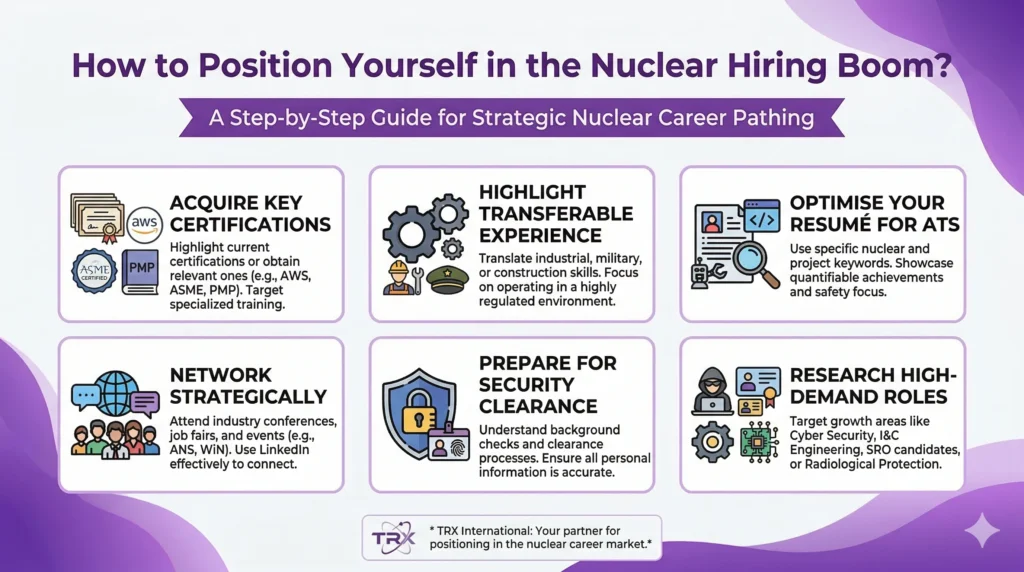
Now that we have established the technical landscape, let us talk about your career trajectory. Having the degree is the foundation, but knowing how to navigate the recruitment ecosystem is how you build the house. The nuclear industry has a very specific hiring culture, and understanding the nuances of how these companies recruit will give you a massive advantage over the competition.
The Talent Gap: Your Biggest Advantage
To put it bluntly, there is a severe shortage of qualified Material Science Engineers in the nuclear space. During the 1990s and early 2000s, the nuclear industry saw a period of stagnation. Fewer students chose nuclear-related fields, leading to a “missing generation” of mid-career professionals.
Now, as the industry expands rapidly, there is a bottleneck of talent. The senior experts are retiring, and the influx of new graduates, while promising, lacks the seasoned experience required to lead major projects.
This is a recruiter’s reality check: If you have a degree in Material Science Engineering and even just 3 to 5 years of relevant industrial experience, you are a unicorn. You don’t just have options; you have leverage.
This talent gap means that companies are willing to pay a premium, offer better relocation packages, and provide accelerated tracks to leadership. They are not just hiring for today; they are hiring to secure their intellectual capital for the next thirty years of operation.
What Hiring Managers Actually Look For?
When a hiring manager looks at your resume, they are scanning for a blend of technical prowess and cultural fit. Here is how you need to position yourself:
- A Fixation on Safety Culture: The nuclear industry does not compromise on safety. It is the bedrock of everything they do. If you can communicate in your interview that you understand the concept of a “Corrective Action Program” and that you prioritize conservative decision-making in your engineering judgments, you will instantly earn their respect.
- Code and Regulatory Familiarity: You don’t need to have the ASME Boiler and Pressure Vessel Code memorized, but you need to show you know how to work within strict regulatory frameworks. Mentioning your experience with ASTM standards, ISO certifications, or specific NDT codes shows you are ready to hit the ground running.
- Hands-On Analytical Skills: Be highly specific about the equipment and software you know. Do you have experience with specific finite element analysis (FEA) software? Are you an expert in metallography? Don’t just list “Material Science”—list the tools of your trade.
- Communication Skills: I always remind my candidates that the best engineers are also translators. You will routinely have to explain complex metallurgical failures to plant managers or regulators who are not material scientists. Demonstrating clear, concise communication during your interview is just as critical as your technical answers.
Salary Expectations and Growth Trajectory
Let’s talk compensation. Because of the specialized nature of the role and the talent shortage, Material Science Engineers in nuclear command highly competitive salaries. While exact numbers vary heavily based on location, experience, and the specific nature of the facility (e.g., a commercial utility versus a national laboratory), the baseline is strong.
Entry-level roles often start well above the median for general engineering graduates. As you move into senior engineering roles, Principal Engineer titles, or Subject Matter Expert (SME) positions, the compensation packages become incredibly lucrative, often augmented by robust pension plans or generous 401(k) matching—benefits that remain unusually strong in the utility sector compared to standard tech or manufacturing.
Furthermore, the career trajectory is not purely technical. Many Material Science Engineers transition into Plant Management, Regulatory Affairs, or directorships within the new-build supply chain. Because materials are at the heart of every critical path in a nuclear project, you inherently gain a holistic view of the entire operation, making you a prime candidate for executive leadership down the line.
The Role of Security Clearances
One unique aspect of the nuclear hiring process is the requirement for security clearances and background checks. Depending on the facility, you may be required to obtain unescorted access authorization, which involves rigorous background screening, psychological evaluations, and drug testing.
For roles at national laboratories or facilities dealing with defense-related nuclear technologies, you may need high-level government clearances (like a DOE Q clearance).
A quick tip from the recruitment side: Be completely transparent with your recruiter about anything that might flag on a background check. The process is thorough, and maintaining a clean record and good credit history is actually a professional asset in this industry.
How TRX International Connects You to the Best Roles?
Navigating the nuclear job market on your own can be daunting. Many of the best roles, the ones with the most innovative SMR companies or the highest-paying senior utility positions, are never posted on public job boards. They are handled quietly through specialized recruitment partners.
This is where your partnership with TRX International becomes your greatest career asset. As one of the premier nuclear recruitment agencies globally, we don’t just collect resumes; we build careers. We have spent years cultivating direct relationships with the hiring managers, VP of Engineerings, and HR directors at the forefront of the nuclear renaissance.
When you work with TRX International, we ensure your specific Material Science Engineering expertise is put directly in front of the decision-makers who need it most. We help you tailor your portfolio, prepare for the unique behavioral and technical interviews of the nuclear sector, and negotiate the compensation package your rare skill set deserves.
Build Your Nuclear Dream Team
Every unfilled role is a missed deadline. Top nuclear talent is scarce and getting scarcer. TRX International sources pre-vetted specialists globally so your projects stay on schedule and fully compliant.
Frequently Asked Questions
What is Material Science Engineering in nuclear?
It involves developing and testing materials that safely withstand extreme radiation, heat, and pressure inside reactors.
Are Material Science Engineering jobs high in demand?
Yes, incredibly high. The rise of new reactor technologies has created a massive shortage of qualified material experts.
Can Oil & Gas engineers transition to nuclear?
Absolutely. Material Science Engineering principles regarding corrosion and high-pressure systems transfer seamlessly into the nuclear sector.
What skills help Material Science Engineering candidates stand out?
Expertise in non-destructive testing, metallurgy, and a strong understanding of nuclear safety and regulatory codes.
How does TRX help Material Science Engineering candidates?
TRX International connects specialized engineers directly with top-tier nuclear facilities and innovative energy companies actively hiring.
Do Material Science Engineering roles require security clearance?
Often, yes. Due to the sensitive nature of nuclear facilities, being eligible for security clearance is a major advantage.
Final Thoughts
Material science engineering is one of those disciplines where the deeper you go, the more doors open. In the nuclear industry, that principle holds especially true. The sector needs engineers who understand materials at a fundamental level, and it rewards those engineers with stable, meaningful, and well-compensated careers.
It doesn’t matter if you’ve just finished your degree, you’re ten years into your career and ready for a change, or you’re a senior engineer hunting for something that actually excites you again, there’s room for you in nuclear. And if the path forward feels unclear, TRX International is the kind of partner that can help you make sense of it.
At the end of the day, materials are what keep reactors running and communities safe. If that’s the kind of work that resonates with you, don’t wait for the perfect moment. The moment is already here.