Nuclear Consulting: What It Is, Who Does It, and How to Break In?
What does it actually take to become a trusted voice in one of the world’s most technically demanding industries?
Nuclear consulting sits at the crossroads of deep scientific expertise, complex regulation, and decisions that carry real-world consequences on a massive scale. Yet for most people outside the sector, it remains something of a black box.
The global nuclear energy market is on track to exceed $600 billion by 2030, and behind every reactor build, license renewal, and decommissioning project is a layer of specialized consulting expertise making it happen.
What follows breaks down exactly what nuclear consulting is, who the key players are, what disciplines drive demand, and most importantly, how you can position yourself to break into this high-value, high-stakes career path.
Connect and Level Up Your Game
If you are interested in roles in nuclear space, reach out to the team at TRX International. We often have insights into upcoming outage needs and permanent staff positions before they hit the general job boards.
What Is Nuclear Consulting?
At its core, nuclear consulting involves providing expert advice, analysis, and strategic guidance to organizations operating within or adjacent to the nuclear sector. That sounds broad because it is. The scope of nuclear consulting is enormous, covering everything from reactor design reviews and decommissioning planning to nuclear safety culture assessments and regulatory compliance strategy.
Nuclear consulting is not a single job. It is a spectrum of highly specialized services delivered by professionals who have spent years, often decades, accumulating domain expertise that most people simply do not have.
That growth does not happen without an enormous consulting infrastructure supporting it. Every new reactor build, every license renewal, and every decommissioning project requires expert guidance at multiple stages. The five principal categories of nuclear consulting each address a distinct set of client needs.
- Technical Nuclear Consulting focuses on engineering and scientific advisory work: reactor physics, thermal hydraulics, probabilistic risk assessment (PRA), materials analysis, and nuclear fuel cycle optimization.
- Regulatory and Compliance Consulting helps utilities, governments, and private operators navigate the dense thicket of nuclear regulations. NRC licensing, ONR requirements, IAEA safeguards. Someone has to know these frameworks inside out.
- Safety and Security Consulting covers nuclear safety culture, physical protection systems, cybersecurity for nuclear assets, and emergency preparedness planning. Post-Fukushima, this area grew significantly and has not slowed down since.
- Decommissioning and Waste Management Consulting addresses what happens when a nuclear facility reaches end of life. With over 190 reactors in various stages of decommissioning globally, this is one of the fastest-growing segments within nuclear consulting.
- Strategy and Policy Consulting works with governments, think tanks, and energy companies on nuclear energy policy, non-proliferation frameworks, and long-term energy planning.
“Nuclear consulting is not about having all the answers. It is about knowing the right questions to ask, and understanding the regulatory, technical, and human systems well enough to ask them at the right time.”
– Senior Nuclear Recruitment Specialist, TRX International
The Organizations That Drive Demand for Nuclear Consultants
Understanding who hires nuclear consultants gives you a much clearer picture of where this industry actually lives. The demand side is more diverse than most people assume.
- Nuclear Utilities and Operators are the obvious first category. Companies like EDF, Exelon, Entergy, and Vattenfall regularly engage consultants for everything from outage support to long-term fleet management strategy. A single nuclear plant generates billions of dollars in electricity annually. Spending on high-quality nuclear consulting advice is not a cost; it is an investment in operational continuity.
- Government Agencies and National Laboratories represent another major client base. The U.S. Department of Energy, the UK’s Nuclear Decommissioning Authority, and equivalent bodies in France, Japan, and South Korea all engage external nuclear consultants to provide independent technical reviews and supplement internal expertise.
- Engineering and Construction Firms working on new builds, such as Bechtel, Fluor, and AECOM, rely heavily on nuclear consulting firms to staff specialized technical roles during project execution. The nuclear new build market, particularly around small modular reactors (SMRs), is generating fresh demand at pace.
- Defence and National Security Organizations require nuclear consulting expertise for weapons program management, submarine propulsion systems, and arms control verification. This is a discrete corner of the market with its own entry requirements and clearance processes.
- International Organizations including the IAEA, World Nuclear Association, and various UN bodies engage consultants on safeguards, non-proliferation, and capacity-building programs for emerging nuclear nations.
- Private Investment and Finance is a growing client segment. As nuclear energy attracts renewed interest from private equity and infrastructure investors, financial institutions are increasingly seeking technical due diligence from nuclear consultants before committing capital.
Each of those emerging nations represents a potential growth market for nuclear consulting services, particularly in regulatory framework development and workforce capability building.
33 Countries
Currently operate nuclear power plants, with at least 20 additional nations actively pursuing nuclear energy programs.
Key Disciplines Within Nuclear Consulting
One of the things that distinguishes nuclear consulting from most professional services fields is how genuinely interdisciplinary it is. A project might require nuclear engineers, health physicists, environmental scientists, lawyers, former regulators, and project managers all working in close coordination.
Engineering and Physics
The technical foundation of nuclear consulting rests on nuclear and mechanical engineering, reactor physics, and materials science. Consultants in this space develop deep expertise in areas like neutron flux analysis, coolant system behavior, containment integrity, and fuel performance modeling. These are not skills you pick up quickly. A consultant advising on reactor safety analysis typically brings 10 to 20 years of hands-on technical experience before they are credible in that capacity.
Health Physics and Radiation Protection
Health physics consulting is a particularly active area. Every nuclear site has radiation protection requirements, and consultants in this discipline advise on dose assessment, shielding design, contamination control, and worker safety programs.
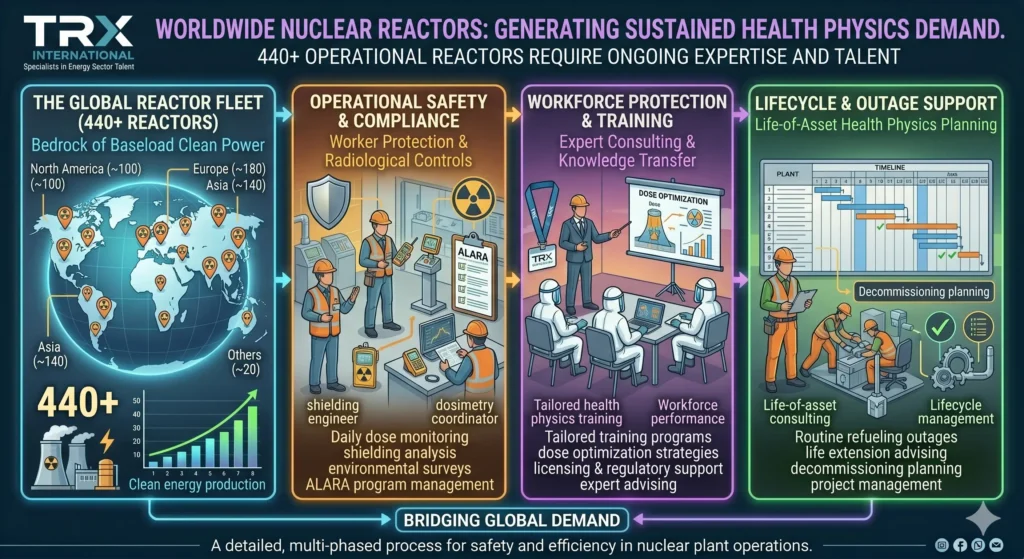
440+ Operational nuclear reactors worldwide generating sustained, ongoing demand for health physics consulting.
Nuclear Law and Regulatory Affairs
Regulatory consulting is arguably where nuclear consulting intersects most visibly with business outcomes. A missed license renewal deadline or a poorly managed regulatory interaction can cost an operator hundreds of millions of dollars. Consultants who understand nuclear law and have established relationships with regulators are worth their fees many times over.
Project Management and Commissioning
Large nuclear projects are notoriously complex. The delays and cost overruns on projects like Hinkley Point C and Vogtle Unit 3 have become case studies in project risk. Experienced nuclear project managers who can operate effectively within these environments are in consistent demand as consultants.
Waste Management and Environmental Remediation
Nuclear waste management is one of the sector’s most persistent challenges. From interim storage solutions to geological disposal concepts, consultants in this field work on problems that span decades.
That scale of activity requires sustained nuclear consulting support across engineering, environmental, legal, and regulatory disciplines simultaneously.
“The consultants who add the most value in nuclear are the ones who understand both the technical detail and the organizational reality of how nuclear sites actually operate. Book knowledge alone does not cut it in this industry.”
– Head of Technical Recruitment, TRX International
Build Your Nuclear Dream Team
Every unfilled role is a missed deadline. Top nuclear talent is scarce and getting scarcer. TRX International sources pre-vetted specialists globally so your projects stay on schedule and fully compliant.
Who Actually Works in Nuclear Consulting?
Nuclear consultants come from several professional backgrounds, and the paths into the field are more varied than most people realize. Understanding these entry points matters whether you are planning your own career move or hiring for nuclear consulting capability.
Younger professionals who enter nuclear consulting now are stepping into an environment of growing demand and a thinning supply of experienced practitioners. That is a structural advantage worth understanding.
50-55
Average age of nuclear industry workers in many Western countries, signalling a significant knowledge transfer challenge and a genuine career opportunity for younger entrants.
The Skills That Actually Get You Hired
Nuclear consulting is not a field where generalists thrive, at least not early in their careers. The clients paying for nuclear consulting expertise expect domain depth. That said, certain transferable skills consistently separate good nuclear consultants from great ones.
“In nuclear recruitment, the most employable consultants are never just technically brilliant. They know how to work with people, how to present findings clearly, and how to bring a client along on complex technical judgements. That combination is genuinely rare.”
Why Nuclear Professionals Trust TRX International?
Finding the right nuclear consulting role is not just about having the right CV. It is about getting in front of the right people, at the right time, with the right context. That is exactly where TRX International comes in.
Since 2019, TRX has operated exclusively within the nuclear sector, building a database of over 5,000 nuclear professionals and placing talent across some of the most complex and high-profile projects in the world.
A Network Built Inside the Industry
TRX works across all six major nuclear segments: Large New Build, SMR and MMR, Fusion, Radioactive Waste Management, Decommissioning, and Fuel Handling. That vertical focus means the team understands what specific roles actually require, not just what a job description says.
Global Reach, Sector-Specific Depth
Headquartered in London, TRX places professionals across Europe, North America, and the Middle East, spanning 15 countries including the UK, USA, Saudi Arabia, UAE, Poland, Japan, and Finland. Only 10% of their business sits within the UK, which reflects the genuinely international nature of nuclear consulting demand today.
Proven at the Highest Level
TRX has supported nuclear programs for clients including GE-Hitachi, Tractebel, Jacobs, and KA-CARE on Saudi Arabia’s first nuclear power plant, where over 150 qualified candidates were delivered within 30 days of engagement.
For nuclear professionals looking to move into consulting, or consulting firms looking to scale their technical teams, TRX International is the recruitment partner that speaks the language of the sector.
How to Break Into Nuclear Consulting?
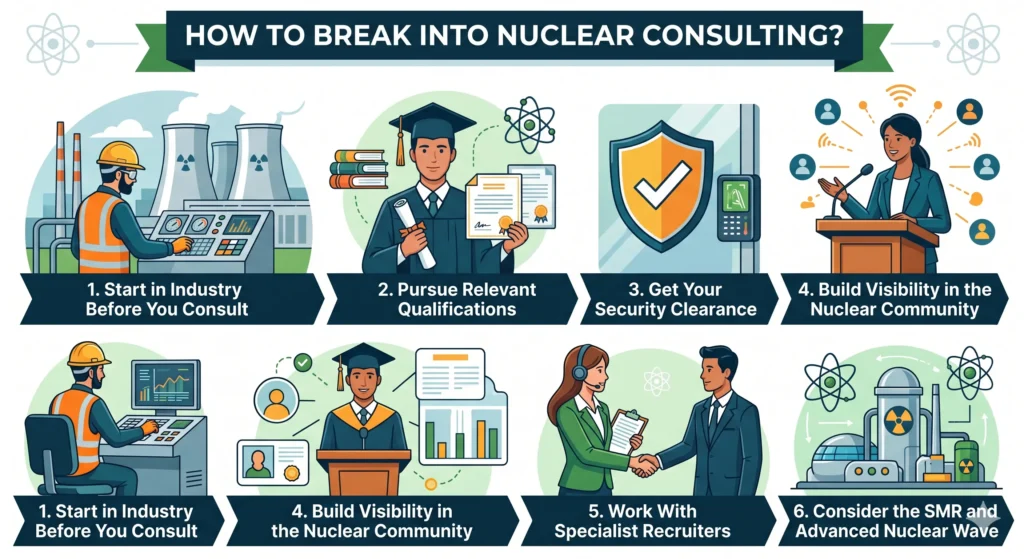
Now the part everyone wants. How do you actually get in? The answer is more structured than most people expect, and the path is navigable if you are intentional about it.
Start in Industry Before You Consult
The single most reliable path into nuclear consulting begins with several years of direct industry experience. Consulting firms are not structured to train people in nuclear fundamentals. They expect you to arrive knowing them. Work at a utility, a national laboratory, a regulator, or a major engineering contractor. Build a track record. Develop relationships. Then, when you move into consulting, you bring both expertise and a network.
A common entry point is moving from a permanent role at a nuclear organization into a contractor position supporting that same organization. This is effectively nuclear consulting with a familiar client base and a known technical environment. It is a lower-risk step that still teaches you the fundamentals of independent working.
Pursue Relevant Qualifications
A degree in nuclear engineering, physics, mechanical engineering, or a closely related field is a standard baseline. Beyond that, professional certifications and chartered status matter. In the United Kingdom, Chartered Engineer status through the Nuclear Institute or IMechE signals credibility. In the United States, the American Nuclear Society offers certifications worth pursuing.
Health physicists benefit from certification through the American Board of Health Physics. Project managers working in nuclear consulting increasingly hold PMP or PRINCE2 qualifications alongside their technical credentials.
Get Your Security Clearance
Apply for clearance as early as your career allows. In many nuclear consulting roles, particularly in defence, clearance is not optional. The process in the UK can take 12 to 18 months for the highest levels, so waiting until you need it before applying costs you time and opportunity.
Build Visibility in the Nuclear Community
Nuclear is a remarkably small world. Thousands of people, not millions, have the expertise to work effectively as nuclear consultants at a senior level. That means your reputation travels quickly, and professional relationships matter enormously.
Present at conferences like the Nuclear Institute Annual Conference or IAEA Technical Meetings. Write technical papers. Engage with professional bodies. Become known in your specific area of expertise. Consulting business in nuclear often flows through relationships and referrals, not job boards.
Work With Specialist Recruiters
Nuclear consulting recruitment is highly specialized. Generalist recruiters rarely have the network or sector knowledge to place candidates effectively in senior nuclear roles. Working with a specialist firm like TRX International, which focuses exclusively on nuclear and energy sector recruitment, gives you access to roles that never reach the open market and advice from people who understand what different clients actually value in candidates.
Consider the SMR and Advanced Nuclear Wave
The emergence of small modular reactors and advanced nuclear technologies is creating fresh demand for a specific kind of nuclear consulting, one that combines deep technical knowledge with an ability to operate in less well-defined regulatory environments.
Companies like NuScale, Rolls-Royce SMR, and Kairos Power are not just building new reactors; they are developing new regulatory frameworks, new supply chains, and new operational models. Consultants who get in early on these programs build career capital that will be worth a great deal as this segment matures.
“The SMR sector is creating consulting demand unlike anything we have seen in nuclear for a generation. The clients are different, the problems are different, and the opportunities for consultants willing to get comfortable with ambiguity are significant.” — Senior Recruitment Consultant, TRX International
Looking to hire nuclear professionals or explore nuclear career opportunities?
TRX International connects world-class talent with critical roles across the global nuclear industry. Visit trx-international.com or get in touch with the team to start the conversation.
Nuclear Consulting Compensation: What to Expect?
Compensation in nuclear consulting reflects the scarcity of expertise and the consequences of getting advice wrong. Nuclear consultants at mid-career and senior levels are consistently among the better-compensated technical professionals in the energy sector.
Independent nuclear consultants in the United Kingdom typically charge day rates between £600 and £1,200, with senior specialists in areas like PRA, decommissioning, or nuclear safety commanding rates at the higher end or beyond. In the United States, nuclear consulting hourly rates for experienced independents commonly fall between $150 and $350 per hour depending on specialism and clearance level.
Consultants within large firms operating on a salaried basis earn correspondingly well, with senior nuclear consultants at major engineering or management consulting firms typically earning between £90,000 and £150,000 annually in the UK, with comparable ranges in the US adjusted for market.
The defence and security segment of nuclear consulting carries a premium for cleared consultants. If you hold DV clearance in the UK or a Top Secret clearance in the US and have relevant nuclear expertise, your market value is meaningfully higher than peers without that combination.
The Future of Nuclear Consulting
Nuclear consulting is not a declining field. If anything, the trajectory points in the opposite direction.
The global net zero agenda has rehabilitated nuclear energy’s political and commercial fortunes in ways that were difficult to predict even five years ago. The UK government’s target of 24 GW of nuclear capacity by 2050, the United States’ Inflation Reduction Act support for existing and new nuclear, and the European Commission’s inclusion of nuclear in its sustainable finance taxonomy all signal sustained investment in the sector.
Decommissioning of legacy plants will generate decades of consulting demand. New builds, particularly SMRs, will require fresh technical advisory support. Emerging nuclear nations in the Middle East, Southeast Asia, and Sub-Saharan Africa will need consultants to help build regulatory frameworks and operational capability from the ground up.
The intersection of nuclear with emerging technologies, including artificial intelligence, advanced simulation, and digital twins, is creating new advisory niches that did not exist a decade ago. Consultants who can bridge deep nuclear domain knowledge with digital and data capabilities will be particularly well positioned for what comes next.
30+ Countries
Currently working with the IAEA on pursuing nuclear energy programs at various stages of development, each representing demand for nuclear consulting expertise.
Queries Related to Nuclear Consulting
What qualifications do you need to start a career in nuclear consulting?
A degree in nuclear engineering, physics, or a related field is standard. Professional certifications and chartered status strengthen your credibility significantly.
How long does it take to break into nuclear consulting?
Most consultants transition after 5 to 10 years of direct industry experience, once they have built credible technical expertise and a professional network.
Is security clearance mandatory for all nuclear consulting roles?
Not all roles require it, but clearance opens significantly more opportunities, particularly in defence-related and government nuclear consulting positions.
What is the average day rate for an independent nuclear consultant?
In the UK, day rates typically range from £600 to £1,200 depending on specialism, seniority, and whether security clearance is held.
Which nuclear consulting disciplines are currently in highest demand?
Probabilistic risk assessment, decommissioning, regulatory affairs, and SMR-related technical advisory roles are among the most actively recruited disciplines right now.
Final Thoughts
Nuclear consulting is demanding, specialized, and enormously consequential work. It is also, for the right professional, one of the most intellectually rewarding and commercially attractive career paths in the technical services sector.
The barriers to entry are real. You cannot fake the expertise. But for those who invest the time to build genuine nuclear knowledge and the professional credibility to go with it, the demand is there, the compensation is strong, and the work genuinely matters.
If you are considering a move into nuclear consulting, or if you are already in the sector and looking to position yourself more effectively in the consulting market, the team at TRX International specializes in exactly this. We work with nuclear professionals across the full technical spectrum, connecting expert candidates with organizations that need what they have built over careers.
The nuclear sector does not advertise its best roles publicly. The best opportunities are found through networks, relationships, and specialist recruiters who know the terrain. TRX International is that partner for nuclear professionals who are serious about what comes next.