Nuclear Decontamination: Methods, Process & Safety 2026
Nuclear energy is back in the conversation, loudly. After a decade of hesitation following Fukushima, governments from Washington to Warsaw are recommitting to nuclear power as a cornerstone of their clean energy strategies. Thirty-plus countries signed a landmark pledge at COP28 to triple global nuclear capacity by 2050.
Sixty new reactors are currently under construction worldwide. Small modular reactors are attracting multi-billion-dollar investments from both the public and private sectors.
But beneath the headlines about new builds and net-zero pledges, there is an equally important story, one that unfolds quietly inside reactor buildings every 18 to 24 months, in the form of refueling outages, decontamination campaigns, and the intensive maintenance operations that keep existing plants safe and productive.
Nuclear decontamination and generator refueling are not the glamorous side of nuclear energy. They are, however, arguably the most operationally critical. When a plant gets this right, it generates power reliably and safely for decades. When it gets it wrong, the consequences, financial, reputational, and safety-related, can be severe.
This article covers what nuclear decontamination and generator refueling actually involve, why they matter so much in the context of the current nuclear renaissance, what the workforce behind these operations looks like, and how TRX International supports organisations and professionals in this specialist space.
What Is Nuclear Decontamination?
Nuclear decontamination is the process of removing radioactive contamination from surfaces, equipment, pipework, structures, and materials within a nuclear facility. It is not a single activity, it is a broad discipline that encompasses dozens of techniques, applied across a wide range of contexts from routine maintenance to full-scale decommissioning.
Contamination in a nuclear plant typically builds up over time as radioactive isotopes, primarily cobalt-60, caesium-137, and strontium-90, are deposited on the surfaces of reactor circuits, piping systems, heat exchangers, and containment structures. Left unmanaged, this contamination increases radiation fields across the plant, raises worker dose rates, and complicates maintenance tasks.
The core objective of decontamination is dose reduction. By removing radioactive deposits from surfaces, operators can lower the radiation environment in working areas, enable maintenance crews to carry out tasks safely within dose limits, and extend the working life of key components. In a decommissioning context, decontamination also reduces the volume of material classified as radioactive waste, which has a direct impact on the cost and complexity of final site clearance.
Decontamination work ranges in scale from localised spot cleaning of a single valve body to large-scale chemical treatment of an entire primary circuit during a major outage. The techniques deployed depend on the type of surface, the nature of the contamination, the radiation field involved, and the operational context, whether the plant is in routine operation, shutdown maintenance, or active decommissioning.
Key Decontamination Methods and When They Are Used?
There is no single ‘best’ method for nuclear decontamination. Each technique has its place depending on the surface type, contamination profile, dose rate environment, and waste management constraints. A skilled decontamination team, and the engineers who design decontamination programmes, need a thorough working knowledge of all available approaches.
The table below provides an overview of the primary decontamination methods used across the global nuclear industry, along with their applications and key advantages:
| Method | Type | Best Used For | Key Advantage |
|---|---|---|---|
| Chemical Decontamination (CORD / LOMI) | Wet Chemical | Primary circuit surfaces, piping, reactor internals | Deep penetration of oxide layers; proven at scale |
| Electrochemical Decontamination | Electrochemical | Metal surfaces, stainless steel components | Highly controlled removal; minimal secondary waste |
| Foam / Gel Decontamination | Physical-Chemical | Irregular surfaces, large areas, containment walls | Reduced liquid waste; effective on vertical surfaces |
| Ultrasonic Decontamination | Mechanical | Small components, fuel assemblies, tool decon | Non-destructive; removes contamination in cavities |
| CO₂ Pellet Blasting | Mechanical | Concrete, equipment surfaces, containment | Dry process; no secondary liquid waste generated |
| Scabbling / Scarifying | Mechanical Abrasion | Concrete floors and walls in decommissioning | Removes surface layer entirely; effective for D&D |
| Robotics-Assisted Decontamination | Remote / Automated | High-dose areas, confined spaces, underwater zones | Zero direct worker dose; operable in extreme environments |
In practice, most large-scale decontamination programmes use a combination of these methods at different stages. A primary circuit decontamination campaign, for example, might begin with a chemical process to attack the bulk of the oxide layer, followed by ultrasonic cleaning of removed components, and conclude with robotic inspection and spot treatment of remaining hotspots.
The shift toward robotic and remotely operated decontamination technologies deserves particular attention. As plants age and accumulated dose in key areas increases, the business case for remote tooling grows stronger.
Connect and Level Up Your Game
If you are interested in roles at either Turkey Point or St. Lucie, reach out to the team at TRX International. We often have insights into upcoming outage needs and permanent staff positions before they hit the general job boards.
What Is Generator Refueling in a Nuclear Context?
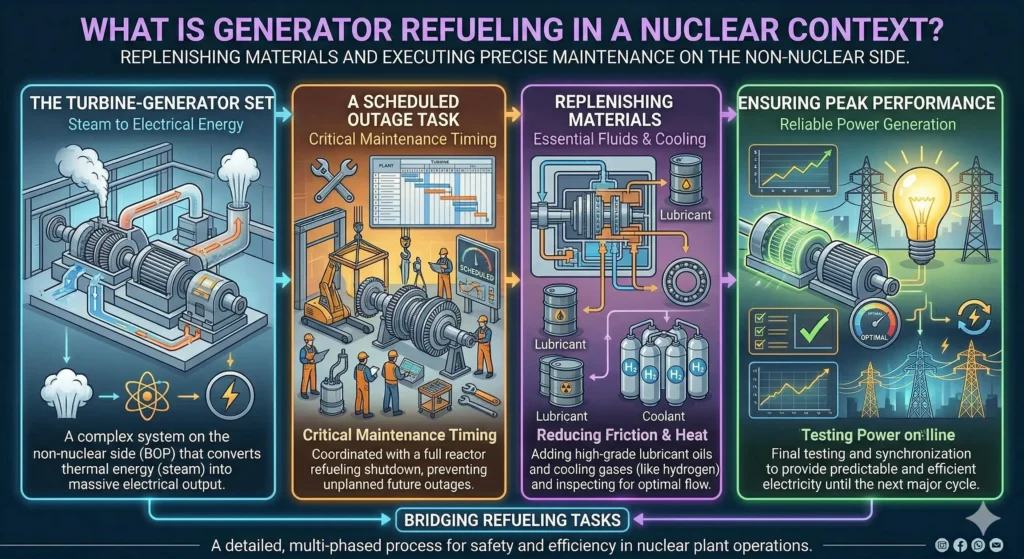
The term ‘generator refueling’ in the nuclear industry refers to the process of replacing spent nuclear fuel within a reactor during a planned shutdown, more commonly called a refueling outage. It is distinct from what the term might suggest in other industrial contexts. There is no fuel nozzle involved. What happens is considerably more technically complex.
Nuclear fuel, typically enriched uranium in the form of fuel assemblies, has a finite operational life within a reactor. Over 18 to 24 months of continuous operation (the typical cycle length for a Pressurised Water Reactor), the fuel is gradually depleted as the fission process extracts energy. At a certain point, the fuel can no longer sustain the reaction at required power levels and must be replaced.
During a refueling outage, the reactor is shut down in a controlled sequence, the reactor vessel head is removed, and the fuel assemblies are transferred underwater, using the plant’s spent fuel pool, from the reactor core to interim storage. Fresh fuel assemblies are then loaded into the core in a precise configuration determined by the nuclear fuel management team, and the reactor is gradually returned to full power.
Refueling outages are the single most important planned maintenance event in a nuclear plant’s calendar. They are the window during which essentially all major maintenance, inspection, testing, and modification work takes place. Everything that cannot be done on a running reactor happens during this window, and the clock is ticking from the moment the turbine is taken offline.
Build Your Nuclear Dream Team
Every unfilled role is a missed deadline. Top nuclear talent is scarce and getting scarcer. TRX International sources pre-vetted specialists globally so your projects stay on schedule and fully compliant.
The Anatomy of a Nuclear Refueling Outage
A modern PWR refueling outage is a masterpiece of industrial scheduling. Hundreds of individual work packages are sequenced across a period of typically 17 to 25 days, with parallel work fronts running simultaneously across different areas of the plant.
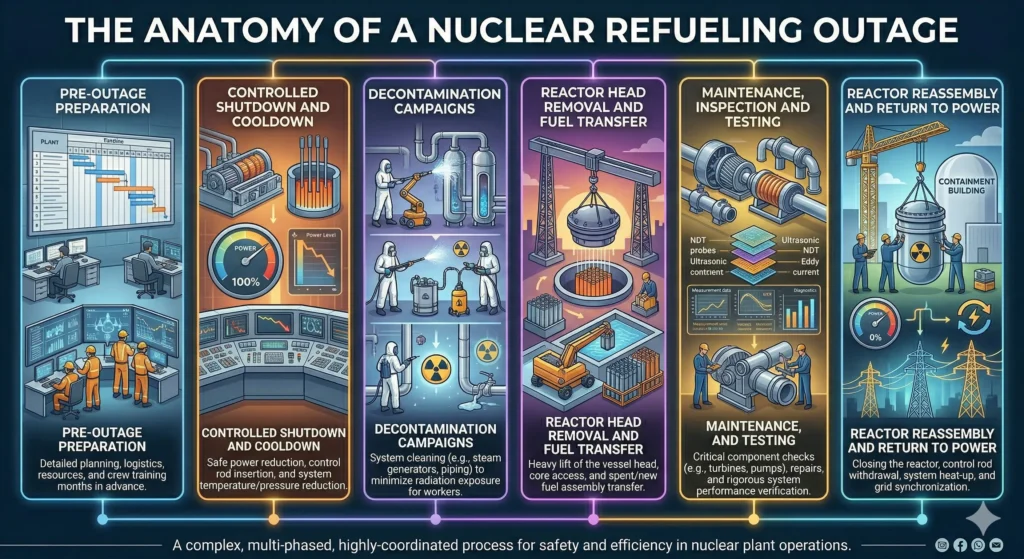
The outage management team coordinates everything from reactor disassembly to valve overhauls to electrical testing, all within a compressed and carefully planned timeline.
Understanding the key phases of a refueling outage helps to illustrate why the workforce demands are so specific and why the wrong hire in a critical role can have very real financial consequences.
Phase 1: Pre-Outage Preparation
Months before the outage begins, the plant’s outage management and maintenance planning teams prepare work packages for every scheduled task. Scaffolding plans are drawn up, specialist contractors are contracted and briefed, and radiation work permits are drafted in advance. The decontamination team begins pre-outage dose assessments to identify which areas will require decontamination work before maintenance can begin safely.
Phase 2: Controlled Shutdown and Cooldown
The reactor is taken offline and the primary circuit is cooled from operating temperature (around 300°C in a PWR) to cold shutdown conditions. This process typically takes several days and is carefully managed to avoid thermal stress on reactor components. Radiation surveys are updated as the plant cools and dose rates in various areas of the containment building shift.
Phase 3: Decontamination Campaigns
Before maintenance workers can access many parts of the reactor building, decontamination campaigns are executed to reduce dose rates to levels that permit the necessary work within ALARA (As Low As Reasonably Achievable) dose limits. This might involve chemical flushing of pipework, foam decontamination of surfaces, or robotic deployment in high-dose zones.
The decontamination phase is often on the critical path. Delays here cascade directly into the overall outage schedule, which is why experienced decontamination supervisors and technicians are among the most valued members of an outage workforce.
Phase 4: Reactor Head Removal and Fuel Transfer
The reactor pressure vessel head is unbolted and lifted, a precision operation requiring specialist rigging teams and meticulous control. Fuel handling operators, working from a platform above the flooded reactor vessel, use remote fuel handling machines to transfer spent fuel assemblies from the core to the spent fuel pool, and load fresh assemblies in the carefully designed refueling pattern.
Fuel handling is conducted underwater throughout, as the water provides both shielding and cooling for the highly radioactive spent fuel. Fuel handling operators require specialist training, and their work is carried out under continuous supervision and real-time monitoring.
Phase 5: Maintenance, Inspection and Testing
With the reactor defueled and access granted, the full maintenance programme can proceed. Steam generator inspections using eddy current testing, primary pump overhauls, valve replacements, electrical equipment testing, civil structure inspections, all happening simultaneously across multiple work fronts. The outage manager’s job is to keep every thread of this work on schedule and safely coordinated.
Phase 6: Reactor Reassembly and Return to Power
Once all maintenance is complete and tested, the reactor is reassembled, the primary circuit is filled and pressurised, and the plant is gradually brought back to full power through a series of controlled startup tests. Post-outage radiation surveys confirm the effectiveness of the decontamination work carried out earlier, and the plant re-enters its next operational cycle.
Looking to hire nuclear professionals or explore nuclear career opportunities?
TRX International connects world-class talent with critical roles across the global nuclear industry. Visit trx-international.com or get in touch with the team to start the conversation.
Why Outage Duration Matters So Much?
There is a reason nuclear operators treat outage duration with something approaching obsession. Every day a reactor is offline represents a significant loss of generation revenue. For a large 1,000 MW+ PWR operating in a market with reasonable electricity prices, a single additional day of unplanned outage extension can cost between $1 million and $2.5 million in lost output.
Multiply that across an outage that runs five days over schedule, not uncommon when decontamination delays, unexpected maintenance findings, or workforce issues arise, and the financial impact is immediately measurable in the tens of millions.
This is why the workforce quality going into an outage is not an abstract HR concern. It directly determines whether the plant comes back online on time. Skilled decontamination technicians who work efficiently and within dose limits, experienced fuel handling operators who do not drop a fuel assembly, outage supervisors who can manage competing work fronts without creating conflicts, these people are worth considerably more than their day rates.
Here is a snapshot of the broader operational and market data underpinning these operations globally:
| Metric | Figure | Source / Context |
|---|---|---|
| Global operational nuclear reactors | 440+ reactors across 32 countries | IAEA, 2024 |
| Reactors under construction | 60+ new units globally | IAEA / WNA, 2024 |
| Average refueling outage duration (PWR) | 17–25 days | World Nuclear Association |
| Global nuclear decommissioning market (2023) | $7.4 billion | Projected to reach $12.2B by 2030 |
| Cost of a one-day outage extension (large PWR) | $1M – $2.5M in lost generation revenue | Industry estimate; varies by market price |
| Avg. refueling cycle length (modern PWR) | 18–24 months | Fuel management optimisation driving longer cycles |
| Countries committed to new nuclear by 2050 | 30+ nations (incl. UK, France, US, Poland) | COP28 nuclear declaration, Dec 2023 |
The Workforce Behind Nuclear Decontamination and Refueling
Nuclear decontamination and refueling operations require a highly specialised workforce, not just technically, but in terms of safety culture, radiological awareness, and the ability to work under significant time pressure in a controlled environment.
The key roles across these operations span a wide range of disciplines and seniority levels. Understanding who these people are, and what makes a good one, is essential for both hiring managers and professionals considering a career in this space.
Decontamination Technicians and Supervisors
The frontline of decontamination work. Technicians carry out the physical decontamination tasks, applying chemicals, operating equipment, and monitoring dose rates throughout. Supervisors coordinate work packages, manage radiological controls, and ensure that decontamination campaigns stay on schedule.
Good decontamination technicians are disciplined, methodical, and have a genuine respect for radiological safety procedures. They are not just cleaning, they are executing a technically controlled process in a radiologically sensitive environment.
Health Physics and Radiation Protection Professionals
Radiation protection officers (RPOs) and health physics technicians are the guardians of dose management during any outage. They conduct pre-job surveys, set up controlled areas, issue radiation work permits, monitor worker dose uptake in real time, and advise on contamination control measures.
In a complex outage with hundreds of workers entering and exiting multiple controlled areas simultaneously, the radiation protection team’s workload is enormous, and their decisions have direct regulatory significance.
Fuel Handling Operators
Fuel handling is among the most safety-critical manual operations in a nuclear plant. Operators must be specifically trained and qualified on the plant’s fuel handling system, and their work is conducted under close supervision with multiple independent verification steps.
Errors in fuel handling, though rare, can result in fuel damage with significant consequences for the plant’s radiological inventory and operational schedule. Experienced, qualified fuel handling operators are a genuinely scarce resource in the industry.
Outage Managers and Planners
The people who hold the whole operation together. Outage managers are responsible for the overall schedule, resource coordination, contractor management, and real-time decision-making when the inevitable unexpected findings occur. It is a role that demands deep technical knowledge, strong leadership, and the ability to remain clear-headed under genuine pressure.
Outage planners work ahead of the event, building the detailed work package schedules that the outage manager then executes against. Their ability to identify critical path activities and build realistic sequences is foundational to outage success.
Robotic and Remote Technology Specialists
An emerging category of nuclear worker, robotic and remote systems specialists deploy, operate, and maintain the increasingly sophisticated remote tooling used in high-dose decontamination and inspection work. As the industry invests more heavily in remote technologies, from underwater ROVs to wall-climbing decontamination robots, the demand for people who can operate and maintain these systems is growing accordingly.
Innovation Reshaping Nuclear Decontamination and Refueling
The nuclear industry has historically been conservative about adopting new technologies, for understandable reasons. But the combination of an ageing global reactor fleet, tightening dose limits, and a shortage of qualified nuclear workers is driving genuine innovation across both decontamination and refueling operations.
Advanced Robotic Decontamination Systems
Robotics is rapidly moving from novelty to necessity in nuclear decontamination. Systems capable of navigating complex pipe runs, climbing containment walls, and operating cutting or chemical decontamination tools autonomously are already deployed at several major plants. The development of AI-assisted robotic inspection and decontamination, where the robot maps contamination levels and selects the appropriate treatment in real time, is an active area of R&D.
Outage Digital Twins
Several major nuclear operators are now building digital twin models of their plants to optimise outage planning. By simulating the outage in a digital environment before it begins, testing sequencing options, identifying potential resource conflicts, stress-testing the schedule against typical delay scenarios, operators can reduce real-world outage duration and improve workforce utilisation.
Longer Fuel Cycles
Advances in nuclear fuel design and reactor physics modelling are enabling longer operational cycles before refueling is required. Modern fuel management approaches are extending PWR cycles from 18 months toward 24 months and beyond, which means fewer outages per decade and lower overall outage-related costs. The downside: when outages do occur, they must accomplish more in the same or shorter window, increasing operational intensity.
Laser Decontamination
Laser decontamination, using high-power pulsed lasers to ablate contaminated surface layers with high precision and minimal secondary waste, is moving out of the laboratory and into operational use at some facilities. Its advantages in terms of waste minimisation and precision make it particularly attractive for decommissioning contexts where waste classification and volume reduction are critical cost drivers.
How TRX International Supports Nuclear Decontamination and Refueling Operations?
TRX International specialises in recruitment for the nuclear and energy sectors, and outage-related staffing is one of the most operationally demanding areas we work in. When a plant has an outage window of 20 days and needs 15 specialist contractors in post before work begins, there is no margin for a slow hiring process or a mismatched placement.
We understand the technical requirements of decontamination and refueling roles because we have spent years building relationships with the people who carry out this work, and the organisations that depend on them. Whether you are a plant operator looking to staff an upcoming outage or a nuclear professional looking for your next contract, TRX International offers a recruitment service built around the specific demands of this sector.
| For Candidates | For Employers |
|---|---|
| Access to exclusive nuclear operations vacancies | Pre-screened, radiation-qualified technical talent |
| CV coaching and outage role application support | Rapid mobilisation for outage and shutdown staffing |
| Contract and permanent placement options | Contingency and retained search across disciplines |
| Salary and rate benchmarking guidance | Market intelligence and workforce planning support |
| Confidential career transition handling | International sourcing across UK, EU, US, and beyond |
For Candidates: Find Your Next Nuclear Operations Role
The market for skilled nuclear decontamination and outage professionals is active. There is genuine demand for experienced technicians, radiation protection officers, fuel handling operators, and outage managers, both in the UK and internationally, as new build programmes and ageing fleet maintenance create parallel workforce needs.
TRX International maintains an active network of nuclear operations professionals and a pipeline of live vacancies across both contract and permanent positions. We work with candidates across all levels, from technicians looking for their next outage contract to senior outage managers seeking a permanent role with a major operator.
We also understand that many nuclear professionals value confidentiality in their job search. If you are currently in post and quietly exploring what else is available, TRX International handles that process with complete discretion.
For Employers: Outage-Ready Talent, When You Need It
Outage staffing is not standard recruitment. The timelines are compressed, the technical requirements are specific, and the cost of getting it wrong, in terms of schedule impact alone, far outweighs any saving made on recruitment fees. This is an area where working with a specialist pays for itself.
TRX International has placed nuclear operations professionals across reactor types, regulatory environments, and international jurisdictions. We can support rapid mobilisation for outage-specific contracts, build shortlists for permanent operational roles, and provide market intelligence on salary rates and candidate availability.
If you have an upcoming outage and need to lock in specialist contractors ahead of time, the earlier you engage a specialist recruiter, the better. The most experienced outage professionals in this sector book up well in advance, often months before the outage window opens.
Contact TRX International today to get ahead of your resourcing requirements.
Regulatory Framework Governing Decontamination and Refueling
Nuclear decontamination and refueling operations do not happen in a regulatory vacuum. Every aspect of these activities, from the radiological controls governing who can enter a controlled area, to the licensing requirements for handling fuel assemblies, to the waste classification and management obligations for decontamination byproducts, is governed by a dense and carefully maintained regulatory framework.
In the United Kingdom, the Office for Nuclear Regulation (ONR) is the primary regulatory authority. The Environment Agency and SEPA (in Scotland) govern radioactive waste management. In the United States, the Nuclear Regulatory Commission (NRC) sets the licensing and operational standards for all aspects of reactor operation, including refueling and decontamination activities.
Internationally, the IAEA provides safety standards and guidance that form the basis for national regulatory frameworks in most countries with civil nuclear programmes. For organisations operating in multiple jurisdictions, as is increasingly the case for large nuclear services companies, maintaining compliance across multiple regulatory systems simultaneously is a significant challenge.
Workers in decontamination and refueling roles must be appropriately trained, qualified, and badged for the specific tasks they carry out. Radiation workers are subject to dose monitoring requirements, and their dose records are maintained and regulated. For fuel handling operators, the qualifications are even more specific, tied to the particular reactor type and fuel handling system at the plant where they are working.
Career Paths in Nuclear Decontamination and Refueling
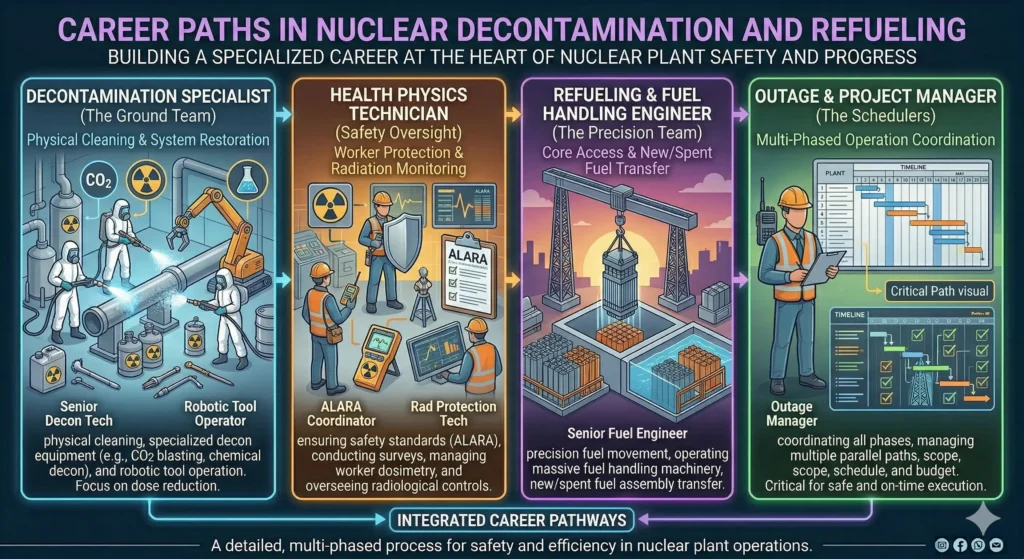
For professionals considering a career in nuclear decontamination and refueling operations, the entry points and progression pathways are broader than many people assume. This is not a field restricted to nuclear engineers and physicists, it draws from mechanical trades, chemistry, project management, health and safety, and remote systems engineering.
- Entry-level decontamination technicians often come from general industrial backgrounds with COSHH and confined space experience, and receive specific nuclear training on the job.
- Radiation protection technicians typically enter with a science or engineering background and obtain formal RP qualifications such as the RPA2000 framework in the UK.
- Fuel handling operators are usually recruited from within the plant’s existing operational workforce, given the plant-specific nature of their qualification requirements.
- Outage planners often come from project management or industrial maintenance scheduling backgrounds before specialising in nuclear outage environments.
- Outage managers typically have 10+ years of nuclear operations experience and a strong track record managing complex multi-disciplinary maintenance events.
- Remote systems specialists increasingly come from robotics, mechanical engineering, or defence backgrounds, with nuclear-specific training added through employer programmes.
The contract market in this space is particularly active. Many experienced nuclear decontamination and outage professionals work on a contractor basis, moving between plant sites and outage programmes as work schedules demand.
For the right profile, this offers both variety and strong day rates, particularly in the current market where demand for qualified outage contractors consistently outpaces supply.
Frequently Asked Questions
What is nuclear decontamination used for?
It removes radioactive contamination from plant surfaces and equipment, reducing worker dose rates and enabling safe maintenance access during outages.
How long does a nuclear refueling outage take?
Modern PWR outages typically last 17 to 25 days. Outage duration varies by plant type, maintenance scope, and workforce performance.
Is decontamination work dangerous for workers?
Managed under strict ALARA principles and radiation work permits, decontamination is carried out safely within regulated annual dose limits.
What qualifications are needed for fuel handling roles?
Fuel handling operators require plant-specific training and formal qualification. Prior nuclear operations experience is typically a prerequisite.
How often are reactors refueled?
Most commercial PWRs refuel every 18 to 24 months. Advanced fuel designs are enabling some plants to extend cycles further.
Can TRX International help with outage staffing?
Yes. TRX International specialises in rapid outage contractor mobilisation across decontamination, radiation protection, and fuel handling roles.
Final Thoughts
Nuclear decontamination and generator refueling are not the most visible parts of the nuclear industry, but they are among the most consequential. Every megawatt-hour a reactor generates in its 40-to-60-year operational life depends on these activities being executed well, on schedule, and safely. That is not a modest claim. It is simply what the numbers say.
As the global nuclear fleet ages, as new build programmes come online, and as decommissioning work scales up across legacy sites, the demand for skilled professionals in this space is going to grow significantly over the coming decade. The workforce challenge in nuclear operations is real, and addressing it requires sector knowledge, specialist networks, and a genuine understanding of what these roles actually demand.
TRX International is positioned at exactly that intersection. Whether you are an experienced nuclear professional ready for your next assignment, or an operator looking to build a stronger bench for your upcoming outage programme, our team is ready to have a direct and practical conversation about how we can help.
Reach out to TRX International today, and let us put the right people in the right place, before the outage clock starts.