Where Is Nuclear Energy Used Most? 2026 Overview
Nuclear energy powers a surprisingly large chunk of the world’s electricity. Yet most people have only a vague sense of which countries actually rely on it day to day.
Where is nuclear energy used most? It is a question more people are asking now than ever before, and for good reason. The answer carries real weight for energy policy, climate goals, and the thousands of professionals who keep these plants running safely.
The global conversation around nuclear has shifted dramatically in recent years. What was once a divisive topic is now gaining widespread support as a practical solution to climate change and energy security. Governments that had moved away from nuclear are reconsidering their stance, and new players are entering the space for the first time. This renewed interest is reshaping both the energy and the job market around it.
We are going to walk through the countries and regions leading the way in nuclear energy usage, explore how the technology is applied beyond just electricity, and look at what all of this means for careers in the nuclear industry.
From a job seeker eyeing the sector or simply curious about the global energy mix, there is a lot to unpack here.
How the World Relies on Nuclear Energy Today?
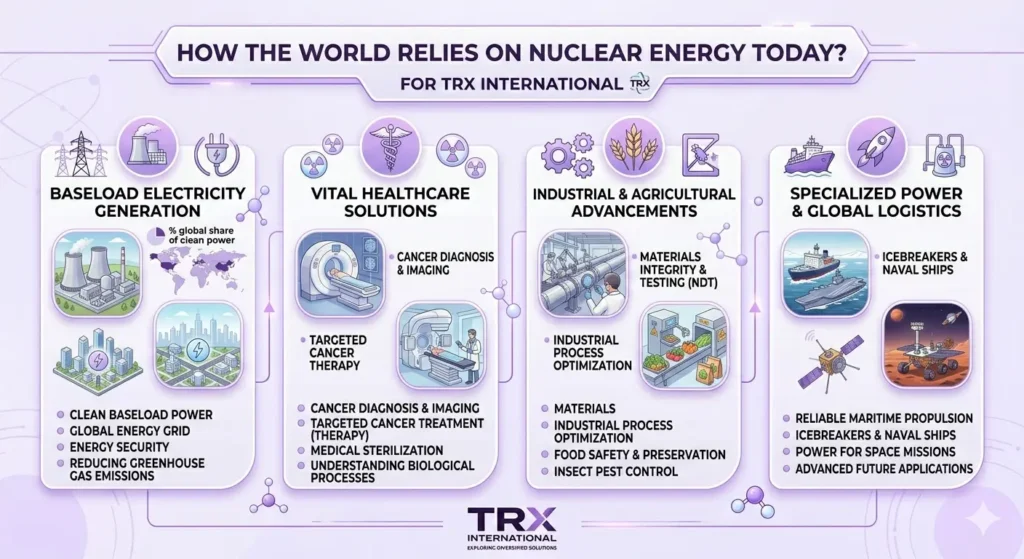
Nuclear energy plays a bigger role in everyday life than most people realise. From powering entire national grids to fuelling critical industries, its reach spans continents and continues to grow steadily with each passing year.
How Big Is Nuclear Energy on the World Stage?
Nuclear energy accounts for roughly 10% of the world’s total electricity generation. That might sound modest until you realise it translates into more than 440 commercial reactors operating across over 30 countries. These plants collectively produce around 2,600 terawatt hours of electricity every year.
What makes nuclear energy usage stand out is its consistency. Unlike solar or wind, nuclear plants run around the clock regardless of weather. This makes them a reliable source of baseload power, which is the minimum level of electricity a grid needs at all times.
For countries that have invested heavily in nuclear, it often forms the backbone of their energy security strategy. It reduces dependence on imported fossil fuels and provides a low-carbon source of electricity that can operate for decades with proper maintenance and skilled personnel.
The geographic spread of nuclear energy usage is worth noting too. Europe has the highest concentration of nuclear-powered nations, but Asia is where the growth is happening fastest. North America remains the largest single producer. Meanwhile, Africa and the Middle East are just beginning to explore nuclear power, with several countries in the early stages of building their first reactors.
This global distribution matters because it shapes the international jobs market for nuclear professionals. A radiation protection specialist trained in the UK might find opportunities in the UAE. A project manager with French nuclear experience could be in demand in India. Nuclear is one of the most internationally transferable career paths in the energy sector.
Connect and Level Up Your Game
If you are interested in roles in nuclear space, reach out to the team at TRX International. We often have insights into upcoming outage needs and permanent staff positions before they hit the general job boards.
Why Some Countries Lean Heavily Into Nuclear?
The reasons behind heavy nuclear energy usage vary from country to country. Some nations adopted nuclear power early because they lacked domestic fossil fuel reserves. France is the classic example. Others, like the United States, embraced it during the Cold War era when nuclear technology was advancing rapidly.
Energy independence plays a major role too. Countries that import most of their oil and gas often see nuclear as a strategic buffer against volatile global energy markets. Japan and South Korea both fall into this category, even though their approaches have evolved over time.
Climate commitments are now adding fresh momentum. As governments set net zero targets, nuclear is increasingly being viewed as a necessary part of the clean energy toolkit. This is especially true in regions where renewables alone cannot meet round-the-clock demand.
The safety record of modern nuclear plants also helps build the case. Today’s reactors incorporate decades of engineering improvements and lessons learned from past incidents. Regulatory frameworks have become more rigorous, and the culture of continuous improvement runs deep across the industry.
For professionals who thrive in environments where precision and safety are paramount, nuclear offers a uniquely rewarding career landscape.
Where is Nuclear Energy Used Most? Top 5 Countries
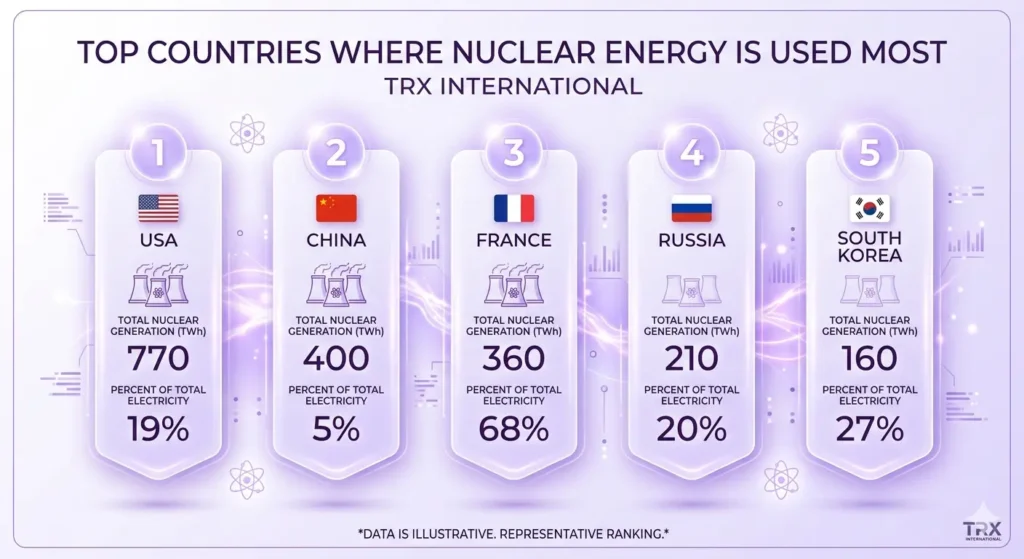
Let us get into the specifics. When it comes to total nuclear energy output, a handful of countries dominate the global picture.
United States
The United States leads the world in nuclear energy production by a wide margin. With around 93 operating reactors spread across the country, nuclear plants generate roughly 18 to 19% of America’s total electricity. That is more nuclear electricity than any other nation produces in total.
The U.S. nuclear fleet is aging, though. Many reactors have been operating for 40 years or more. This creates a steady demand for skilled engineers, technicians, and safety specialists who can manage life extensions and eventual decommissioning projects. It is one of the reasons why nuclear recruitment in the U.S. remains strong.
France
France is arguably the poster child for nuclear energy usage. Nuclear power supplies about 65 to 70% of the country’s electricity, making it the most nuclear-dependent major economy in the world. The French government made a deliberate choice in the 1970s to go nuclear after the oil crisis, and the country has stuck with that strategy ever since.
France’s nuclear workforce is massive. From reactor operators and radiation protection officers to the engineers designing next-generation EPR reactors, the country employs tens of thousands of nuclear professionals. It also exports nuclear technology and expertise to countries around the world.
China
China has the fastest-growing nuclear programme on the planet. While nuclear currently supplies around 5% of China’s electricity, the country is building new reactors at a pace no other nation can match. Over 20 reactors are under construction, with plans for many more in the coming decades.
This expansion is creating enormous demand for nuclear talent. China needs project managers, construction engineers, nuclear physicists, and safety inspectors at scale. For international nuclear professionals, China represents a significant and growing jobs market.
Russia
Russia operates around 37 reactors and gets about 20% of its electricity from nuclear power. The country is also one of the world’s largest exporters of nuclear technology, building reactors in countries across Asia, Africa, and the Middle East through its state-owned corporation Rosatom.
Russia’s nuclear ambitions extend well beyond its own borders. This global footprint means Russian nuclear projects create employment opportunities in dozens of countries, often requiring internationally experienced professionals.
Build Your Nuclear Dream Team
Every unfilled role is a missed deadline. Top nuclear talent is scarce and getting scarcer. TRX International sources pre-vetted specialists globally so your projects stay on schedule and fully compliant.
South Korea
South Korea generates around 30% of its electricity from nuclear power, making it one of the most nuclear-reliant economies in Asia. The country has also become a major exporter of nuclear technology, winning contracts to build reactors in the United Arab Emirates and pursuing opportunities in other markets.
South Korea’s nuclear sector employs a highly skilled workforce, and the country is known for its efficient construction timelines and strong safety record. For nuclear professionals with engineering or project management backgrounds, South Korea is a market worth watching.
Other Notable Countries
Several other nations deserve mention when discussing where nuclear energy is used most. Canada operates 19 reactors and relies on nuclear for about 15% of its power. The country is also a global leader in CANDU reactor technology, which uses natural uranium fuel and heavy water as a moderator.
The United Kingdom is investing in new nuclear builds, including the Hinkley Point C project, while also managing a large decommissioning portfolio. Japan, despite scaling back after the Fukushima disaster in 2011, has been gradually restarting reactors as part of its energy security strategy.
India has an ambitious nuclear expansion plan tied to its thorium fuel cycle research. With limited uranium reserves but vast thorium deposits, India is pursuing a unique three-stage nuclear programme that could eventually make it a global leader in thorium-based nuclear power.
Countries like Sweden, Finland, and Ukraine all generate significant shares of their electricity from nuclear sources. Finland recently completed the Olkiluoto 3 reactor, while Sweden has reversed its earlier phase-out policy. Ukraine, despite the conflict-related challenges at Zaporizhzhia, continues to rely heavily on nuclear for its electricity needs.
Nuclear Energy Usage Beyond Electricity
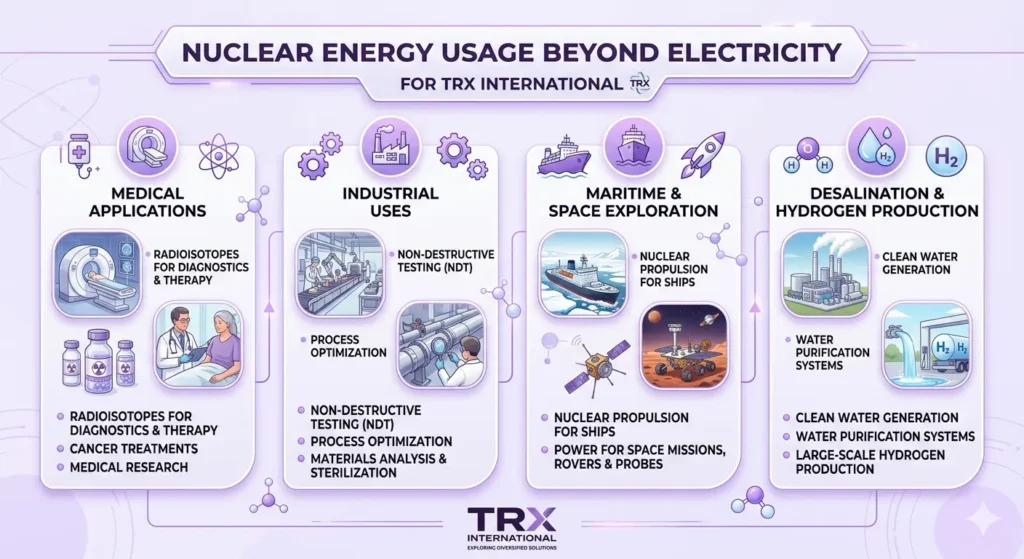
When people ask where nuclear energy is used most, the conversation usually centres on electricity. But nuclear technology has applications that stretch far beyond power plants.
Medical Applications
Nuclear medicine is a huge field. Radioactive isotopes are used in diagnostic imaging, cancer treatment, and sterilisation of medical equipment. Hospitals around the world depend on a steady supply of these isotopes, many of which are produced in research reactors. The professionals who work in this space need specialised training in radiation safety and nuclear physics.
Industrial Uses
Industry uses nuclear technology for everything from quality control to food preservation. Radiography, for instance, allows engineers to inspect welds and structural components without cutting them open. Industrial gauging uses radiation sources to measure the thickness, density, and composition of materials during manufacturing.
Maritime and Space Exploration
Nuclear propulsion powers submarines and aircraft carriers for several navies around the world. The technology allows vessels to operate for years without refuelling. In space exploration, radioisotope thermoelectric generators (RTGs) provide power to deep-space probes like NASA’s Voyager missions and the Perseverance Mars rover.
Desalination and Hydrogen Production
Some countries are exploring nuclear energy for desalination, which is converting seawater into fresh water. This is particularly relevant in water-scarce regions of the Middle East and North Africa. Kazakhstan has already demonstrated the concept, and several Gulf states are evaluating nuclear desalination as part of their long-term water security strategies.
Nuclear-powered hydrogen production is another emerging application that could play a role in decarbonising transport and heavy industry. High-temperature reactors are especially well suited for this purpose because they can provide the intense heat needed to split water molecules through thermochemical processes. Green hydrogen produced this way could fuel everything from long-haul trucks to steel furnaces, opening up new industrial applications for nuclear technology.
The Workforce Behind Nuclear Energy
Behind every reactor, every isotope production facility, and every decommissioning project, there are people. The global nuclear workforce is enormous and incredibly diverse in terms of the skills it requires.
Reactor operators, health physicists, nuclear engineers, welders, project managers, radiation protection advisors, decommissioning specialists, waste management experts, regulatory compliance officers, and quality assurance professionals all play essential roles. And that is just scratching the surface.
The nuclear industry also needs people in less obvious roles. Cybersecurity specialists protect plant control systems from digital threats. Environmental scientists monitor the ecological impact of nuclear facilities. Supply chain managers ensure that highly specialised components and materials arrive on time and meet exacting standards. Communications professionals help companies engage with local communities and build public trust.
One of the biggest challenges facing the nuclear industry right now is workforce renewal. In many countries, a significant portion of the current nuclear workforce is approaching retirement. At the same time, new builds and life extension programmes are creating fresh demand. The result is a talent gap that the industry is actively working to close.
This gap is particularly acute in specialist areas. Finding a qualified nuclear welding inspector, for example, is not something you can do through a general job board. Similarly, recruiting a reactor physicist with the right clearances and experience requires a targeted approach.
This is where specialist nuclear recruitment becomes critical. Finding the right people for highly regulated, safety-critical roles is not the same as filling a generic engineering vacancy. It requires deep knowledge of the sector, strong networks, and an understanding of the qualifications and clearances involved.
Future of Nuclear Energy and What It Means for Your Career
The nuclear industry is changing fast, and with that evolution comes a wave of fresh career opportunities. New technologies, expanding programmes, and a retiring workforce are creating openings that did not exist a decade ago.
New Technologies Reshaping the Industry
The nuclear industry is not standing still. Several emerging technologies are set to reshape how and where nuclear energy is used in the coming years.
Small Modular Reactors (SMRs) are one of the most talked-about developments. These compact reactors can be factory-built and transported to site, making nuclear power feasible for locations that could never support a traditional large-scale plant. Countries like the UK, the U.S., and Canada are all actively pursuing SMR deployment.
The appeal of SMRs goes beyond their size. They require lower upfront capital investment, can be deployed incrementally to match growing demand, and are designed with passive safety systems that reduce the risk of accidents. For remote communities, industrial sites, and developing nations, SMRs could make nuclear energy accessible for the first time.
From a careers perspective, SMRs are creating entirely new job categories. The manufacturing, assembly, and modular construction methods involved differ significantly from traditional nuclear plant builds. Professionals with backgrounds in advanced manufacturing, modular construction, and systems integration will find growing opportunities as SMR projects move from design to deployment.
Advanced reactor designs, including high-temperature gas reactors and molten salt reactors, promise improved safety features, greater fuel efficiency, and the ability to provide high-temperature process heat for industrial applications. These technologies are still largely in the development and demonstration phase, but they are attracting significant investment.
Nuclear fusion, while still some way from commercialisation, is another area generating excitement. Projects like ITER in France and various private sector ventures are working toward proving that fusion can deliver virtually unlimited clean energy. If and when fusion becomes viable, it will create an entirely new category of nuclear careers.
Why Nuclear Careers Are Worth Considering?
If you are thinking about a career in the nuclear sector, the timing could hardly be better. The combination of workforce retirements, new construction programmes, decommissioning projects, and emerging technologies means there are opportunities at every level.
Entry-level roles in health physics, radiation monitoring, and plant operations offer strong starting salaries and clear progression pathways. Mid-career professionals with project management or engineering experience can find leadership roles on major construction or decommissioning programmes. And senior specialists in areas like reactor physics, nuclear safety, and waste management are in high demand globally.
The nuclear industry also offers something that many other sectors cannot: a genuine sense of purpose. Whether you are helping to generate clean electricity, treating cancer with nuclear medicine, or safely dismantling retired facilities, the work has a direct and meaningful impact.
Compensation in the nuclear sector tends to be competitive as well. The combination of regulatory requirements, security clearances, and specialised skills means that nuclear professionals often command higher salaries than their counterparts in other energy sectors. Benefits packages typically reflect the safety-conscious culture of the industry, with strong provisions for training, professional development, and work-life balance.
International mobility is another significant perk. Because nuclear technology and safety standards share common frameworks across borders, professionals can often transfer their skills from one country to another. A health physicist trained in the UK can work on a decommissioning project in Canada. A reactor engineer from South Korea might find opportunities on new build sites in Europe or the Middle East.
Looking to hire nuclear professionals or explore nuclear career opportunities?
TRX International connects world-class talent with critical roles across the global nuclear industry. Visit trx-international.com or get in touch with the team to start the conversation.
How to Find the Right Nuclear Role?
Breaking into the nuclear industry, or making a move within it, can feel daunting. The sector has its own language, its own regulatory frameworks, and its own expectations around qualifications and security clearances. That is why working with a specialist recruitment agency can make a real difference.
A good nuclear recruiter understands the technical requirements of each role, knows which companies are hiring, and can guide you through the often complex application and vetting process. They can also help you position your existing skills in a way that resonates with nuclear employers, even if you are coming from an adjacent industry like oil and gas, defence, or conventional power generation.
TRX International is one such specialist. With deep roots in the nuclear industry, TRX connects talented professionals with opportunities across the full spectrum of the nuclear sector, from new build and operations to decommissioning and waste management. Their team understands the unique demands of nuclear recruitment and works closely with both candidates and employers to get the right fit.
What the Data Tells Us About Nuclear Energy’s Trajectory
The numbers paint a clear picture. Global nuclear capacity is expected to grow over the next two decades, driven by new construction in Asia, life extensions in Europe and North America, and a wave of SMR deployments. The International Atomic Energy Agency (IAEA) projects that nuclear capacity could increase by as much as 100% by 2050 under high-case scenarios.
This growth trajectory has direct implications for employment. The nuclear sector will need hundreds of thousands of new workers worldwide to meet its expansion and replacement needs. Countries that are ramping up their nuclear programmes are already competing for talent, and that competition is only going to intensify.
For professionals who are already in the industry, this means strong job security and growing opportunities for international mobility. For those considering a move into nuclear, it means there has rarely been a better time to make that transition.
Regional Hotspots for Nuclear Employment
If you are wondering where the jobs are, here is a quick snapshot of the most active nuclear employment markets right now.
The United Kingdom is experiencing a nuclear renaissance of sorts. The Hinkley Point C project in Somerset is one of the largest construction projects in Europe, and Sizewell C is in the pipeline behind it. The UK is also one of the world leaders in decommissioning, with a portfolio of legacy sites managed by the Nuclear Decommissioning Authority. All of this creates thousands of roles for engineers, project managers, safety professionals, and skilled trades.
The United States continues to offer a vast nuclear jobs market. Life extension programmes, advanced reactor development, and the ongoing operational needs of nearly 100 reactors sustain strong demand. The Department of Energy’s investment in next-generation nuclear technologies is also creating roles in research and development.
The Middle East is an emerging market worth watching. The UAE’s Barakah Nuclear Energy Plant, which began commercial operations in recent years, represents the region’s first large-scale nuclear power programme. Saudi Arabia has also signalled interest in nuclear energy. These developments are opening doors for experienced nuclear professionals who are willing to work internationally.
France remains a powerhouse of nuclear employment, especially with its programme to build six new EPR2 reactors. Finland, the Czech Republic, and Poland are all progressing with new nuclear projects as well, adding to the European demand pool.
In Asia, China and India are the primary growth engines. Both countries have ambitious long-term nuclear expansion plans that will require vast numbers of skilled workers across every discipline.
Commonly Asked Queries Related to Nuclear Energy
Which country produces the most nuclear energy in the world?
The United States leads globally with around 93 operating reactors, generating roughly 18 to 19% of the country’s total electricity output.
What percentage of global electricity comes from nuclear energy?
Nuclear energy accounts for approximately 10% of the world’s total electricity generation, produced by over 440 commercial reactors across more than 30 countries.
Is nuclear energy only used for generating electricity?
No. Nuclear technology is also used in medical diagnostics, cancer treatment, industrial radiography, maritime propulsion, space exploration, desalination, and hydrogen production.
Are there good career opportunities in the nuclear industry?
Yes. Workforce retirements, new reactor builds, decommissioning projects, and emerging technologies like SMRs are creating strong demand for skilled nuclear professionals worldwide.
Why is specialist recruitment important in the nuclear sector?
Nuclear roles require specific qualifications, security clearances, and technical expertise. Specialist recruiters understand these requirements and can match candidates with the right opportunities effectively.
Making Your Move in Nuclear
The nuclear industry is not going anywhere. If anything, it is poised for one of the most significant growth periods in its history. Whether you are drawn to the engineering challenges, the safety culture, the international opportunities, or the chance to contribute to clean energy, there is a place for you in this sector.
Start by understanding the qualifications and certifications that matter in your target market. Look into organisations like the Institution of Nuclear Engineers, the Nuclear Institute, or equivalent bodies in your country. Consider whether you need additional training in areas like radiation protection, nuclear safety, or project management.
And do not underestimate the value of working with a specialist recruiter. The nuclear industry is relationship-driven, and having someone in your corner who knows the landscape can make all the difference. Agencies like TRX International have the connections and the expertise to match you with roles that align with your skills and career ambitions.
The question of where nuclear energy is used most will keep evolving as new countries enter the nuclear arena and existing programmes expand. What will not change is the need for talented, dedicated professionals to keep the industry moving forward. If that sounds like you, now is the time to act.
The nuclear industry rewards people who bring commitment, technical curiosity, and a respect for safety to their work. It is a sector where your contributions genuinely matter, where the career paths are well defined yet flexible, and where the global nature of the work means you will never run out of new challenges.
From the control rooms of established reactors to the construction sites of tomorrow’s SMRs, there has never been a more exciting time to build a career in nuclear energy.