European Nuclear Power Stations: Map and Guide to Active and Upcoming Plants
Flip a light switch anywhere from Paris to Prague, and there is a decent chance the electricity flowing through it started life inside a nuclear reactor.
Nuclear power stations in Europe quietly generate nearly a quarter of the continent’s electricity, and the fleet is about to get busier.
After years of hesitation, governments are greenlighting new reactors, extending the life of older ones, and placing big bets on small modular designs. The map of European nuclear power stations in 2030 will look meaningfully different from today.
This guide breaks down where the plants sit, which ones are under construction, and what the next decade holds for the sector.
Consider it your shortcut to understanding Europe’s nuclear ecosystem.
The State of European Nuclear Power Stations Today
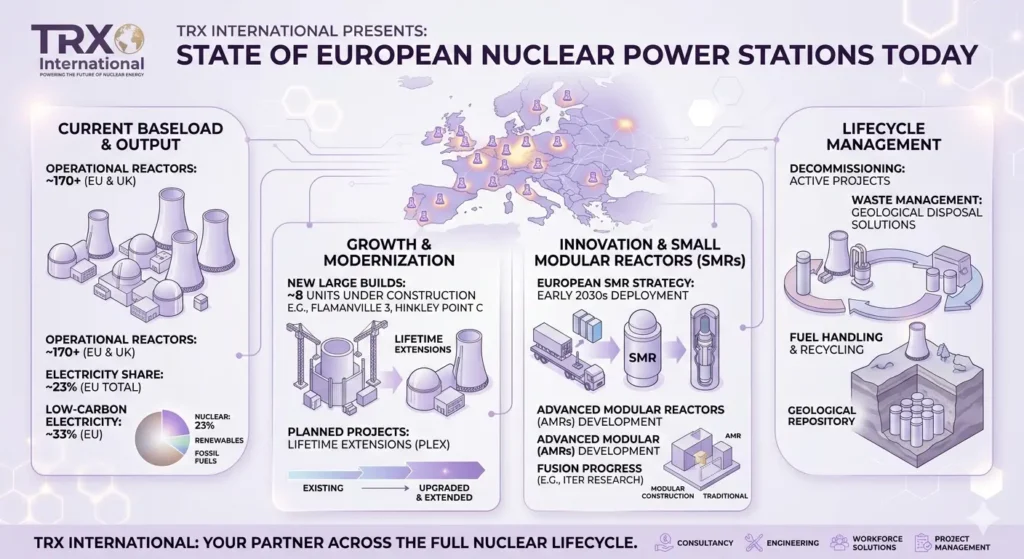
Let us start with the big picture. Europe currently operates one of the largest fleets of nuclear reactors in the world, second only to the combined output of the Asia-Pacific region.
As of late 2025, there were roughly 165 operational nuclear reactors across Europe, with a combined installed capacity of nearly 148,000 megawatts electric. That is a serious chunk of power, and it keeps a significant portion of the continent’s grid stable every single day.
Connect and Level Up Your Game
If you are interested in roles in nuclear space, reach out to the team at TRX International. We often have insights into upcoming outage needs and permanent staff positions before they hit the general job boards.
A Quick Look at How Europe Got Here
Europe’s nuclear journey started in the mid-1950s, not long after the technology made the leap from laboratories to the grid. The UK’s Calder Hall plant in Cumbria, which came online in 1956, is widely credited as the world’s first industrial-scale nuclear power station. It ran for 47 years before being shut down in 2003.
France followed quickly, and the 1970s oil crisis kicked off the country’s aggressive build-out of its fleet. Most of France’s currently operating reactors trace back to the messianic push for energy independence during that decade. A similar story played out in Sweden, Belgium, and Switzerland around the same time.
Europe’s oldest reactor still running today sits at Switzerland’s Beznau plant near the German border. Beznau Unit 1 started commercial operation on 9 December 1969 and has clocked well over 55 years of service, making it one of the longest-serving commercial reactors anywhere in the world.
Which Countries Host Nuclear Power Stations in Europe?
Twelve EU member states currently operate nuclear reactors on their soil. These are Belgium, Bulgaria, Czechia, Finland, France, Hungary, the Netherlands, Romania, Slovakia, Slovenia, Spain, and Sweden.
Outside the EU, you also have the United Kingdom, Switzerland, and Ukraine running active nuclear fleets. Russia and Belarus also operate reactors on the European side of their territory. Germany, once a heavyweight in European nuclear generation, completed its phase-out in April 2023 and no longer produces nuclear power.
So when people talk about European nuclear power stations, they are really talking about a cluster of around 15 countries doing the heavy lifting.
The Types of Reactors You Will Find Across Europe
Not all reactors are built the same, and Europe hosts a genuinely diverse mix of designs. The overwhelming majority of reactors on the continent are pressurised water reactors (PWRs), which use ordinary water under high pressure as both coolant and moderator. France’s entire fleet is built on this technology.
A smaller group of plants uses boiling water reactors (BWRs), particularly in Sweden and Finland, while the UK operates a unique design called the advanced gas-cooled reactor (AGR), which uses carbon dioxide as a coolant. Eastern Europe hosts a cluster of Russian-designed VVER reactors, which are essentially a different flavour of pressurised water technology.
These designs fall into what the industry calls “generations“. Most operating reactors in Europe are Generation II, built between the 1970s and 1990s. Newer units like Finland’s Olkiluoto 3 and France’s Flamanville 3 are Generation III, with upgraded passive safety features. Generation IV designs are still in development.
France: The Undisputed Nuclear Heavyweight
You cannot discuss European nuclear power stations without starting in France. The country operates 56 reactors, the largest fleet on the continent by a wide margin.
Nuclear energy makes up around 69% of France’s electricity production, which is the highest share of any country in the world. Big names in the fleet include Gravelines, Paluel, Cattenom, Bugey, and the recently connected Flamanville 3, which joined the grid in December 2024 and was the most recent new reactor to come online in the EU.
France is not slowing down either. The government has committed to building six new EPR2 reactors, with an option for two more, and construction is already progressing at the Penly site on the English Channel coast.
Other Major Nuclear Players Across Europe
France is the headline act, but several other countries lean heavily on nuclear as well. Slovakia generates around 66% of its electricity from nuclear plants, putting it second globally in terms of nuclear share.
Czechia, Finland, Hungary, Slovenia, and Bulgaria all pull between 39% and 42% of their electricity from nuclear reactors. Belgium, Sweden, and Switzerland sit comfortably above 27% nuclear share, making them quietly important players in the European nuclear power landscape.
The UK runs nine reactors across sites like Heysham, Hartlepool, Torness, and Sizewell B, though several are scheduled for retirement in the coming years.
Build Your Nuclear Dream Team
Every unfilled role is a missed deadline. Top nuclear talent is scarce and getting scarcer. TRX International sources pre-vetted specialists globally so your projects stay on schedule and fully compliant.
European Nuclear Power Stations at a Glance
The table below gives a quick snapshot of major nuclear power stations across Europe, along with their current status. France dominates the list, while Central and Eastern Europe host a strong cluster of VVER reactors. Ukraine’s Zaporizhzhia plant, Europe’s largest by capacity, has been under Russian military occupation since 2022.
| Country | Power Station | Reactors | Status |
|---|---|---|---|
| France | Gravelines | 6 | Operational |
| France | Cattenom | 4 | Operational |
| France | Paluel | 4 | Operational |
| France | Bugey | 4 | Operational |
| France | Tricastin | 4 | Operational |
| France | Flamanville | 3 | Operational |
| France | Penly | 2 active, 2 planned | Operational and expanding |
| France | Dampierre | 4 | Operational |
| France | Blayais | 4 | Operational |
| France | Chinon | 4 | Operational |
| France | Cruas | 4 | Operational |
| France | Golfech | 2 | Operational |
| France | Nogent | 2 | Operational |
| France | Saint-Alban | 2 | Operational |
| France | Saint-Laurent | 2 | Operational |
| France | Belleville | 2 | Operational |
| France | Chooz | 2 | Operational |
| France | Civaux | 2 | Operational |
| UK | Heysham 1 and 2 | 4 | Operational |
| UK | Hartlepool | 2 | Operational |
| UK | Torness | 2 | Operational |
| UK | Sizewell B | 1 | Operational |
| UK | Hinkley Point C | 2 | Under construction |
| UK | Sizewell C | 2 | Planned |
| Spain | Almaraz | 2 | Operational |
| Spain | Ascó | 2 | Operational |
| Spain | Cofrentes | 1 | Operational |
| Spain | Trillo | 1 | Operational |
| Spain | Vandellós II | 1 | Operational |
| Sweden | Forsmark | 3 | Operational |
| Sweden | Oskarshamn | 1 | Operational |
| Sweden | Ringhals | 2 | Operational |
| Finland | Olkiluoto | 3 | Operational |
| Finland | Loviisa | 2 | Operational |
| Belgium | Doel | 2 | Operational |
| Belgium | Tihange | 1 | Operational |
| Switzerland | Beznau | 2 | Operational |
| Switzerland | Gösgen | 1 | Operational |
| Switzerland | Leibstadt | 1 | Operational |
| Czechia | Dukovany | 4 | Operational |
| Czechia | Temelín | 2 | Operational |
| Slovakia | Bohunice | 2 | Operational |
| Slovakia | Mochovce | 3 active, 1 commissioning | Operational and expanding |
| Hungary | Paks | 4 | Operational |
| Hungary | Paks II | 2 | Planned |
| Bulgaria | Kozloduy | 2 | Operational |
| Romania | Cernavodă | 2 | Operational |
| Slovenia | Krško | 1 | Operational |
| Netherlands | Borssele | 1 | Operational |
| Ukraine | Zaporizhzhia | 6 | Operational (occupied) |
| Ukraine | Rivne | 4 | Operational |
| Ukraine | South Ukraine | 3 | Operational |
| Ukraine | Khmelnitski | 2 | Operational |
| Poland | Choczewo | 3 | Planned |
| Poland | Włocławek | 1 | Planned SMR |
Note that reactor counts reflect the most recent publicly available figures and may shift as new units come online or older ones retire.
How Much Electricity Do European Nuclear Power Stations Actually Produce?
Here is where the numbers get genuinely interesting. Nuclear power generated roughly 23.4% of the EU’s total electricity in 2025, according to figures from Ember and the Energy Institute.
That share climbs much higher in individual countries. France leads at about 69%, Slovakia at 66.4%, and Czechia at 42.3%. Across the broader European region (EU plus the UK, Switzerland, and Ukraine), nuclear remains one of the largest sources of low-carbon electricity.
Worth noting: European nuclear output has actually declined over the past two decades, falling around 30% between 2004 and 2024. Much of that drop came from Germany’s phase-out and France’s maintenance issues in the early 2020s. Recent years have seen a rebound, though.
Why Nuclear Still Matters to Europe’s Energy Mix?
Nuclear power stations in Europe do something renewables currently struggle with: they produce steady, predictable, low-carbon baseload electricity around the clock. Wind and solar are brilliant, but they rely on the weather cooperating.
Nuclear also offers energy security. The war in Ukraine and the resulting gas price shocks made European governments rethink how dependent they wanted to be on imported fossil fuels. Several countries that had been cooling on nuclear (the Netherlands, Sweden, Belgium, Italy) have warmed back up to the idea.
For an industry that employs hundreds of thousands of skilled professionals across the continent, this renewed interest translates directly into more projects, more jobs, and a very active talent market.
Recruitment agencies focused on the nuclear sector, such as TRX International, have seen this shift firsthand as demand for specialist engineers, safety professionals, and project leads continues to climb.
Upcoming and Future Nuclear Power Stations in Europe
The next decade is going to be busy. Between new builds, lifetime extensions, and the arrival of small modular reactors (SMRs), the map of European nuclear power stations is set to change significantly.
The European Commission estimates that around €241 billion in investment will be needed by 2050 to deliver on EU member states’ nuclear ambitions. That figure covers both lifetime extensions of existing reactors and the construction of new large-scale facilities.
Reactors Currently Under Construction
Slovakia is the only EU member state with active nuclear plant construction at the moment. Mochovce 4 is expected to enter commercial operation in 2026, rounding out the four-unit site.
The UK has two EPR reactors under construction at Hinkley Point C, with commissioning expected later this decade. Sizewell C, also in the UK, secured its final investment decision in 2024 and construction work is progressing.
Elsewhere in the region, Russia, Belarus, and Turkey all have reactors under construction using VVER technology, while Ukraine has Khmelnitski 3 and 4 listed as under construction (though work is currently suspended due to the ongoing war).
Planned Large-Scale Nuclear Projects
France leads the planned pipeline with six EPR2 reactors, starting at Penly, followed by Gravelines and Bugey. These are expected to come online progressively from the mid-2030s onwards.
Czechia has green-lit Dukovany 5, with plans for additional units. Bulgaria is moving forward with two new reactors at Kozloduy, while Romania is advancing Cernavodă 3 and 4. Finland has plans for another reactor, though the timeline is still being finalised.
Poland is perhaps the most interesting new entrant. The country has no operational nuclear reactors today but has committed to building a large fleet, targeting up to 9 GW of capacity by 2040. The first project is planned for Choczewo on the Baltic coast.
Looking to hire nuclear professionals or explore nuclear career opportunities?
TRX International connects world-class talent with critical roles across the global nuclear industry. Visit trx-international.com or get in touch with the team to start the conversation.
The Small Modular Reactor Revolution
Here is where things get properly exciting. Small modular reactors are smaller, factory-built units that can be transported and assembled on site, which (in theory) makes them faster and cheaper to deploy than traditional gigawatt-scale plants.
The European Commission adopted its SMR strategy in March 2026, aiming to bring the first European SMRs online by the early 2030s. Total SMR capacity in the EU could reach between 17 GW and 53 GW by 2050, according to the Commission’s Nuclear Illustrative Programme.
Several countries are already making moves. Poland’s Orlen and Synthos Green Energy are building the country’s first SMR in Włocławek. Czech utility ČEZ has partnered with Rolls-Royce SMR to develop reactors in Czechia. Romania is advancing a NuScale VOYGR project with six small modular units on a former coal plant site.
Countries Making a Nuclear Comeback
A handful of European countries are rejoining the nuclear club after years of hesitation or opposition. Italy, which shut down its entire fleet after a 1987 referendum, is now actively exploring a return to nuclear, particularly through SMRs.
Sweden reversed its phase-out policy and is now planning new reactors. The Netherlands has committed to building two new large-scale units and is studying SMR deployment. Belgium extended the operating lives of its Doel 4 and Tihange 3 reactors after years of planning a full phase-out.
Even Estonia, Croatia, and Latvia have expressed interest in hosting future SMR projects, either on their own or as part of regional consortia.
Nuclear’s New Role in Data Centres and Industrial Heat
One of the biggest shifts in how Europe thinks about nuclear power stations is what those plants might actually be used for. Traditional reactors were built almost exclusively to feed the electricity grid. The next generation has a much broader job description.
Data centres are a huge driver here. The boom in cloud computing and AI has pushed electricity demand forecasts through the roof, and hyperscalers want clean, 24/7 power that renewables alone cannot reliably deliver. Nuclear, particularly SMRs, fits that brief neatly. Several European tech hubs are already exploring dedicated SMR sites co-located with data centre campuses.
Industrial heat is another frontier. High-temperature reactor designs can supply the 700°C to 1000°C process heat needed for steelmaking, chemical production, and hydrogen generation through water electrolysis. That opens up decarbonisation pathways for some of Europe’s hardest-to-abate industries, which is a genuinely big deal for meeting 2050 climate targets.
What About Germany?
Germany deserves a quick mention because it moved in the opposite direction. The country completed its nuclear phase-out in April 2023, shutting down its last three reactors.
There has been ongoing political debate about whether to reverse course, particularly as energy prices climbed and questions mounted about the reliability of replacement capacity. So far, no reversal has happened, but the conversation is very much alive.
The Other Side of the Coin: Decommissioning Projects
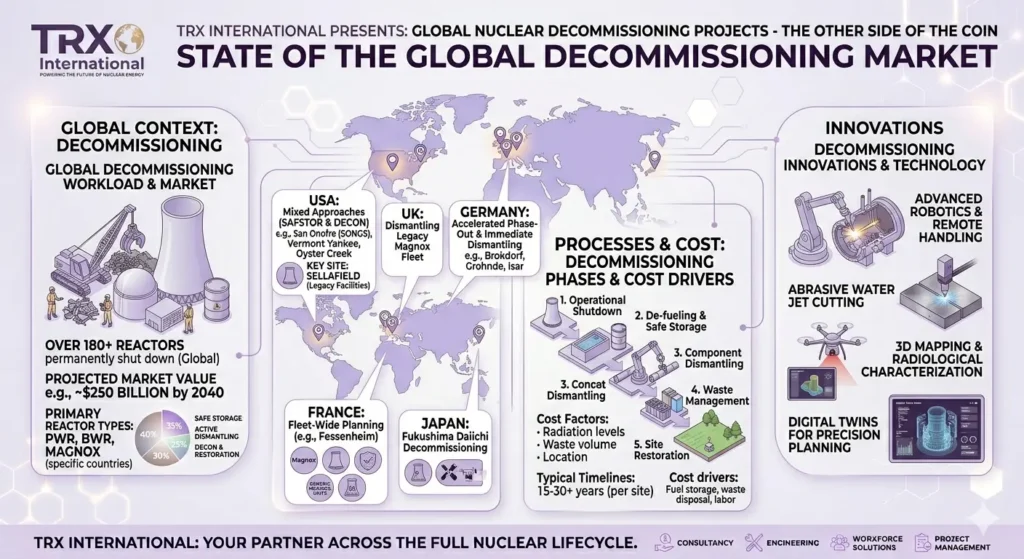
While new reactors grab the headlines, Europe is also managing one of the largest decommissioning workloads in the world. More than 120 European reactors have already been permanently shut down, and most are now in various stages of dismantling.
The UK alone has 36 reactors in decommissioning, including all of its old Magnox units and the earlier Chapelcross and Berkeley plants. Germany is working through 36 shutdown units, with some sites chosen for immediate dismantling and others held in long-term safe storage. France is dismantling the Fessenheim plant, which closed in 2020 after 43 years of operation.
Decommissioning is expensive and slow. European operators typically budget between €900 million and €1.3 billion per reactor, and the full process can take anywhere from 15 to 30 years, sometimes much longer. That creates sustained demand for radiological engineers, waste management specialists, and project controls professionals for decades after a plant stops generating power.
Lifetime Extensions and the Existing Fleet
Not every upcoming change involves new concrete being poured. A massive part of the European nuclear story in the 2020s and 2030s is about extending the operating lives of existing reactors.
France is pushing to extend many of its 56 reactors from 40 years to 50 or even 60 years of operation. Similar lifetime extension programmes are underway in Spain, Sweden, Finland, Switzerland, and Belgium. These extensions require significant investment in safety upgrades, component replacements, and regulatory approvals.
For workers in the sector, this translates into sustained demand for maintenance engineers, safety specialists, decommissioning experts, and new-build project managers all at the same time.
Safety Oversight and Fuel Supply Considerations
European nuclear power stations operate under some of the tightest safety regimes in the world. The Euratom Treaty, signed in 1957, set up a shared legal framework for civilian nuclear activity across the EU, and the European Nuclear Safety Regulators Group (ENSREG) coordinates oversight between national regulators.
After the Fukushima accident in 2011, every operating European reactor went through comprehensive stress tests covering earthquake, flooding, and extreme weather scenarios. The vast majority passed, though many required subsequent safety upgrades costing between €30 million and €200 million per unit.
Fuel supply is the other piece of the puzzle. Europe imports most of its uranium, and historically a significant share of enrichment and fuel fabrication services came from Russia. Since 2022, countries like the Czech Republic, Bulgaria, Slovakia, and Finland have been actively diversifying away from Russian suppliers and working with Westinghouse and Framatome to secure alternative fuel contracts.
Jobs, Skills, and the Talent Crunch
One of the quieter stories behind Europe’s nuclear revival is the sheer scale of the skills shortage the industry is facing. A large portion of the current workforce is approaching retirement, and the pipeline of new entrants has been thin for years.
Every new reactor, every lifetime extension, and every SMR project needs nuclear engineers, radiation protection specialists, welders, instrumentation and control engineers, commissioning managers, and regulatory affairs professionals. Demand across these roles is climbing fast.
Specialist recruitment partners understand the nuances of the sector. TRX International, for example, works exclusively within the nuclear and energy space, connecting skilled professionals with operators, EPCs, and SMR developers across the UK, Europe, and beyond. In a market where most generalist recruiters struggle to tell a BWR from a PWR, that kind of focused expertise matters.
Frequently Asked Questions
How many nuclear power stations are there in Europe?
There are roughly 165 operational nuclear reactors across Europe as of late 2025, spread across around 15 countries. The exact number of individual power stations (which can host multiple reactors) is smaller, sitting at approximately 90 sites.
Which country has the most nuclear power stations in Europe?
France has by far the most nuclear reactors in Europe, with 56 operational units spread across 18 active power stations. It also generates the highest share of electricity from nuclear of any country in the world.
Are any new European nuclear power stations being built right now?
Yes. Slovakia is finishing Mochovce 4, the UK is building Hinkley Point C and has committed to Sizewell C, France is progressing EPR2 reactors at Penly, and several SMR projects are in early construction or planning stages in Poland, Czechia, and Romania.
Which European country will start nuclear power for the first time?
Poland is on track to be the next European country to start operating nuclear power stations, with its first large-scale reactor planned for Choczewo and its first SMR planned for Włocławek. Both projects are targeted for the early 2030s.
Is nuclear power growing or shrinking in Europe?
Total nuclear output has declined over the past two decades, largely due to Germany’s phase-out and ageing reactors. However, the trend is now reversing, with new builds, lifetime extensions, and SMR projects expected to grow nuclear capacity significantly by 2040.
What is the oldest nuclear power station still operating in Europe?
The oldest operating nuclear reactor in Europe is Beznau Unit 1 in Switzerland, which began commercial operation on 9 December 1969. It has run for more than 55 years and is one of the longest-serving commercial reactors in the world.
How long does it take to build a new nuclear power station in Europe?
A large-scale European nuclear plant typically takes between 10 and 15 years from final investment decision to commercial operation, though recent projects like Flamanville 3 and Olkiluoto 3 exceeded that. Small modular reactors are expected to come online much faster once the first designs receive regulatory approval.
The Bottom Line on European Nuclear Power Stations
European nuclear power stations have quietly kept the continent powered for decades, and the sector is entering one of its most active periods since the 1980s. Between the French mega-build programme, the UK’s Hinkley and Sizewell projects, Poland’s fresh entry into the club, and the wave of SMR deployments expected in the early 2030s, the map is about to get busier.
For anyone tracking the industry (whether as a policy watcher, investor, or jobseeker), now is a genuinely interesting time to pay attention. The next ten years will reshape how Europe generates low-carbon baseload electricity, and the people who build, operate, and maintain these plants will be in serious demand.
If you are exploring a career in the nuclear industry or looking to hire specialist talent for an active project, working with a dedicated nuclear recruitment partner like TRX International can cut through the noise. The sector rewards focus, and so does finding the right role or the right hire within it.