After years of conceptual planning, policy deliberation, and feasibility studies, the nuclear energy sector is now transitioning into the physical execution of large-scale new build projects and Small Modular Reactor (SMR) deployments.
Governments across Europe, the Middle East, and Asia-Pacific are committing billions to nuclear power plant construction, recognising nuclear as an indispensable pillar of baseload, carbon-free electricity generation.
Yet technology alone does not build a reactor. Behind every successful nuclear construction project stands a highly specialised workforce—engineers, licensing experts, quality assurance professionals, and commissioning teams—whose availability and competence often determine whether a project is delivered on time and within budget.
According to the International Energy Agency, nuclear employment grew 6% in 2024 to 1.2 million workers globally, yet the industry continues to struggle with a persistent nuclear talent gap. In the United States alone, nearly 40% of nuclear energy workers will be eligible to retire in the next decade, while roughly 90% of employers reported difficulty hiring qualified professionals.
Talent Gap in FEED-to-Operation Roadmap
The talent gap is not merely an HR inconvenience; it is a risk multiplier. Inadequate staffing during the Front End Engineering Design (FEED) phase leads to poor cost estimation. Shortages during construction drive schedule overruns. A failure to plan for operations staffing can compromise the safety case long before a reactor reaches first criticality. This is why establishing a relationship with a specialist nuclear recruitment partner—one with a vertical-market focus and global reach—is critical to maintaining project momentum across every stage of the plant lifecycle.
TRX International is a specialist global nuclear recruitment consultancy with a core mission of facilitating a zero-carbon future. With deep expertise spanning new build, fusion, SMR technology, decommissioning, and radioactive waste management, TRX uses an extensive Nuclear Talent Database and a rapidly expanding global network of clients and candidates. This article serves as a roadmap, aligning niche technical expertise with the shifting demands of a multi-decadal nuclear plant lifecycle—from FEED through to decommissioning.
Phase 1: Front End Engineering Design (FEED) | Architecting Success
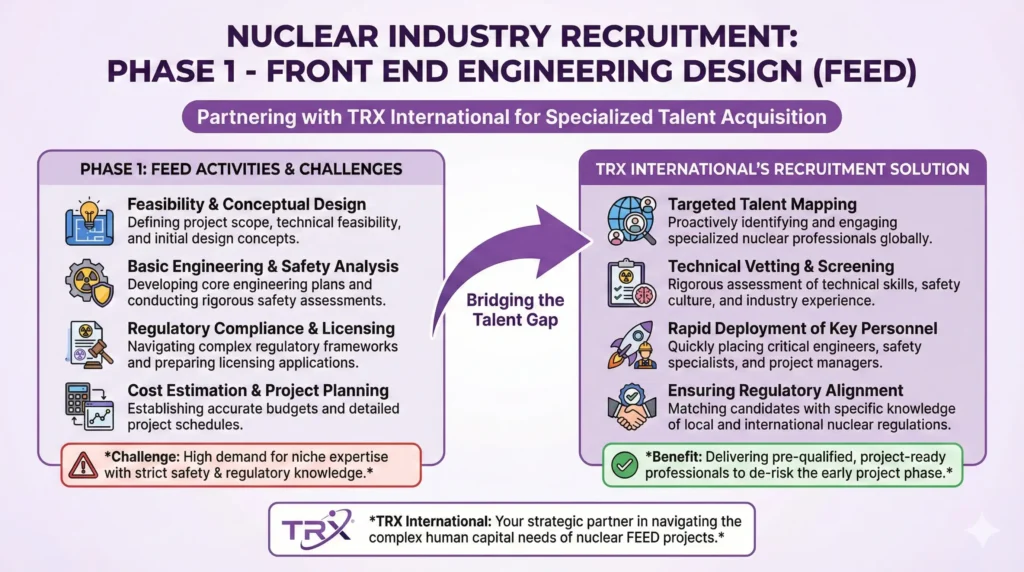
Every nuclear project begins with FEED—the phase where the vision takes shape. Front End Engineering Design defines the technical, financial, and operational feasibility of the project. Though FEED typically represents only about 2% of total project execution cost, a well-executed FEED phase can save up to 30% on later design and construction expenditure. Conversely, a poorly defined FEED leads to cost overruns, design rework, and procurement bottlenecks—problems that have historically plagued nuclear mega-projects.
The primary objective during FEED is to build what the industry calls the “Intelligent Customer” capability: a core in-house team competent enough to oversee EPC (Engineering, Procurement, and Construction) contractors and challenge their deliverables. This team must include specialists in nuclear licensing and regulation, who can deal with complex international frameworks early to avoid late-stage design changes that blow through schedules. It also demands strong project controls professionals who establish scheduling and cost-estimation benchmarks critical to securing the Final Investment Decision (FID).
The challenge? These roles require “First of a Kind” (FOAK) engineering talent—professionals who have actual experience in the early-stage development of nuclear facilities, a cohort that has been shrinking due to decades of underinvestment in Western nuclear programmes. Industry experts note that between the late 1980s and early 2000s, nuclear hiring essentially stalled in Europe and North America, creating a generational gap in experienced staff and leadership.
This is where strategic sourcing through a dedicated nuclear staffing partner becomes essential. TRX International’s global talent network provides project owners with rapid access to verified FEED specialists—from licensing engineers to cost estimators—ensuring that the foundation of the project is built on competence, not compromise.
Beyond individual roles, the FEED phase also requires expertise in environmental impact assessment, seismic hazard analysis, and site characterisation studies. Regulatory bodies such as the Nuclear Regulatory Commission (NRC), the Office for Nuclear Regulation (ONR) in the UK, and the International Atomic Energy Agency (IAEA) each impose distinct requirements that must be navigated concurrently.
A team that understands these overlapping jurisdictions can prevent costly redesigns later in the project. Early engagement with a nuclear recruitment specialist ensures that these critical competencies are identified and filled before the FEED package is finalised.
Phase 2: Detailed Engineering and Procurement | Bridging Design and Supply
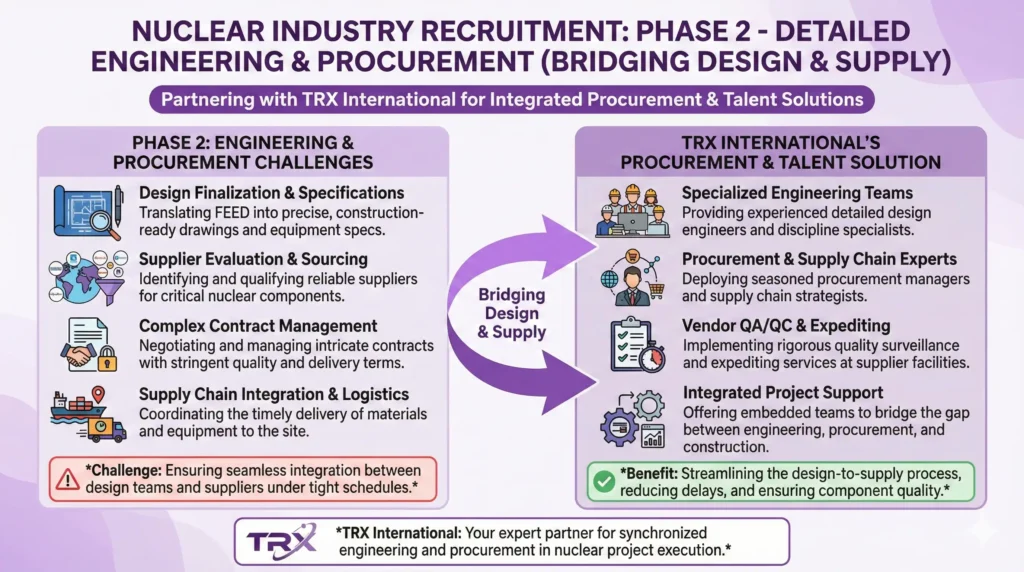
Once the FEED package is finalised and the project receives the green light, it transitions into detailed engineering—a phase where conceptual designs evolve into precise, construction-ready plans. This is where the engineering workforce must scale dramatically as the project moves from approximately 20% to 100% design completion. Each discipline—civil, structural, mechanical, electrical, instrumentation and control (I&C)—produces coordinated, clash-free drawings and specifications.
Simultaneously, the nuclear procurement process activates. This is no ordinary supply chain exercise. Sourcing materials and components for a nuclear facility demands compliance with stringent NQA-1 quality standards—a framework that governs the quality assurance of nuclear-grade items throughout their design, manufacture, and delivery. Procurement specialists in this domain must understand vendor qualification, source inspection protocols, and the unique challenge of counterfeit, fraudulent, and suspect items (CFSI) that can compromise plant safety.
Advanced engineering roles come into sharp focus during this phase. Mechanical and I&C engineers design safety-critical systems that form the backbone of plant operation. Cyber security architects build resilience into the plant’s digital control systems—a growing priority as nuclear facilities integrate AI-driven monitoring and predictive maintenance tools. And piping, structural, and electrical engineers work together within sophisticated 3D modelling environments to eliminate interferences before a single spade breaks ground.
Talent continuity is paramount. A single unfilled niche vacancy can ripple through the design timeline, delaying procurement packages and pushing construction start dates. Organisations that partner with a specialist nuclear recruitment agency like TRX International gain access to a curated Nuclear Talent Database that enables rapid deployment of qualified engineers without disrupting the design schedule. TRX also offers advanced CV analysis tools that evaluate and rank technical candidates against project-specific competency requirements, significantly accelerating the screening process for roles where precision matters most.
Phase 3: Construction and Site Operations | The Physical Blueprint
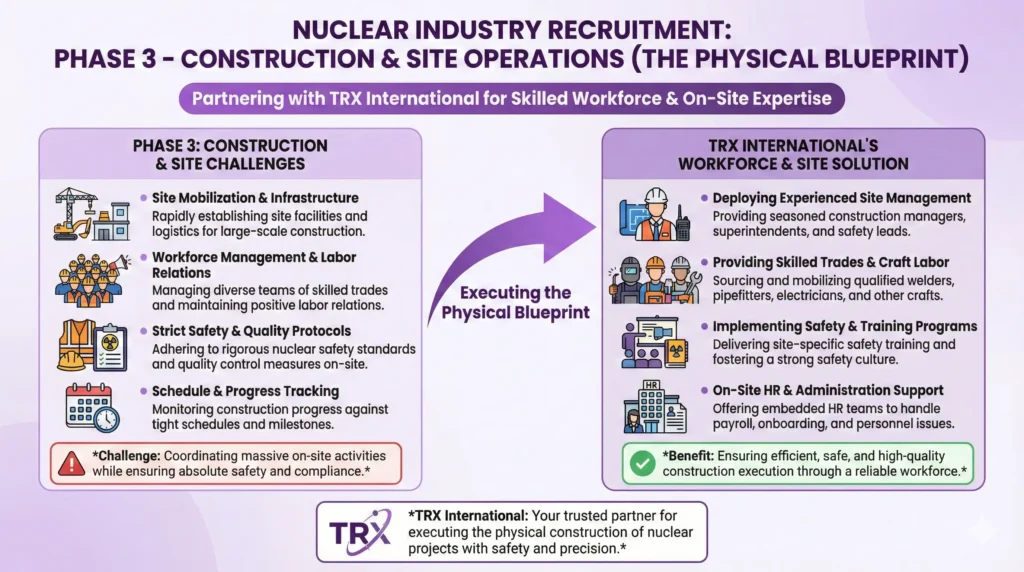
The construction phase represents the industrial peak of any nuclear project. Site workforces can swell to up to 9,000 personnel, requiring a carefully orchestrated blend of local labour, international specialists, skilled trades, and management professionals. Welders, pipefitters, electricians, and ironworkers work alongside nuclear QA/QC inspectors and document control specialists to build structures that must meet exacting regulatory standards.
The ongoing shortage of skilled craft labour is well documented. In 2025, the United States had approximately 600,000 unfilled positions across the construction and manufacturing sectors, a deficit that has pushed craft wages up 20% since the pandemic. For nuclear construction specifically, on-site governance is non-negotiable. QA/QC and document control teams maintain the “as-built” record to ensure regulatory compliance, while HSE supervisors and managers enforce safety protocols in an environment where the consequences of error are uniquely severe.
One of the most underestimated challenges in nuclear construction is mobilisation logistics—managing the complex visa, relocation, and accommodation needs of a multinational site team. A nuclear recruitment consultant with genuine global reach can streamline this process significantly. TRX International supports projects across booming markets including the UK, UAE, and Japan, utilising a database that is versatile in nationality, age, and gender to mobilise the right people at the right time.
The construction phase also demands robust configuration management and design change control. Even with the best planning, unforeseen site conditions, vendor discrepancies, or regulatory updates necessitate real-time adjustments. Construction managers, field engineers, and nuclear safety officers must work in concert to ensure that every modification is documented, reviewed, and approved before implementation. The quality of the as-built documentation produced during this phase directly impacts the success of the commissioning programme that follows, making meticulous record-keeping an operational imperative, not just a regulatory requirement.
For organisations seeking to build or scale their nuclear construction workforce, TRX International offers tailored nuclear staffing solutions that address both the volume and the technical specificity of site-based roles—from civil supervisors and welding inspectors to project directors with multi-billion-pound programme experience.
Phase 4: Commissioning and Startup | Validating the Safety Case
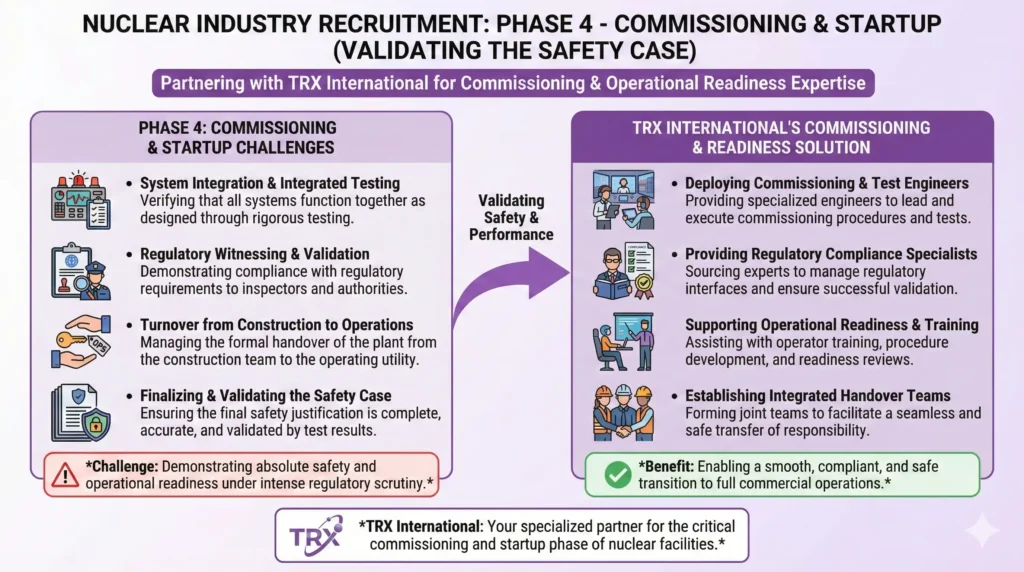
Commissioning marks both a psychological and a technical shift in the project’s trajectory. The construction noise subsides; systems are energised, tested, and validated. The facility is no longer just a structure—it becomes a functioning nuclear plant. This phase requires some of the most highly specialised talent in the industry.
Commissioning engineers conduct systematic functional tests on every Structure, System, and Component (SSC)—verifying that each element performs as designed under normal and emergency conditions. Senior Reactor Operators (SROs) prepare for the pivotal milestones of initial fuel loading and first criticality, stages where precision, training, and experience converge to determine whether the plant will operate safely for the decades ahead.
Equally important is human capacity building—the systematic transfer of knowledge from contractors and commissioning teams to the permanent operating organisation. Training programmes must be implemented early enough to ensure that the owner’s staff are fully competent before the facility reaches commercial operation. This is where long-term nuclear workforce planning pays dividends, and where a recruitment partner’s ability to source both commissioning contractors and permanent operations staff simultaneously proves invaluable.
If your organisation is preparing for commissioning and needs access to experienced startup professionals, TRX International’s dedicated commissioning and operations team can help identify the right candidates from a global pool of verified nuclear talent.
It is worth noting that commissioning is not a single event but a structured sequence of phases—pre-operational testing, hot functional testing, fuel load, and power ascension—each requiring specific technical qualifications and regulatory sign-offs. The commissioning workforce must also include control room operators who have completed full simulator training programmes and nuclear chemistry specialists who monitor primary and secondary water chemistry during initial plant heatup. Staffing these roles early ensures a smooth handover from the construction organisation to the operating organisation, minimising risk during the most sensitive period of a nuclear plant’s life.
Phase 5: Operations & Maintenance (O&M) | Sustaining the 60-Year Asset
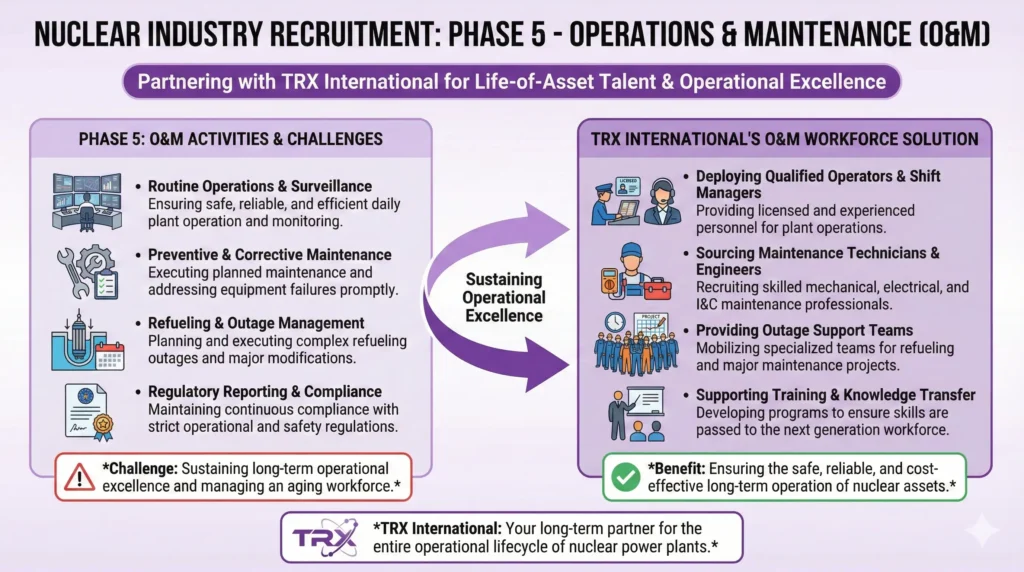
A nuclear power plant is designed to generate clean, reliable electricity for 60 years or more. Sustaining a 90%+ capacity factor throughout that lifespan demands meticulous preventative maintenance, rigorous adherence to safety protocols, and a workforce that is continuously trained, assessed, and renewed.
The ageing workforce challenge is most acutely felt during the operations phase. In the EU, approximately 500,000 people are employed in the nuclear sector, with a significant proportion approaching retirement age. In the United States, around 60% of nuclear professionals are between the ages of 30 and 54, pointing to a substantial wave of retirements in the coming decade. Without proactive nuclear talent acquisition strategies, critical knowledge will walk out the door.
Refueling and outage management presents its own staffing challenge. Outage specialists plan the logistics of high-speed maintenance windows—often executing thousands of tasks within a compressed timeframe—while radiation protection and health physics professionals ensure public and environmental safety throughout the plant’s operational life.
Long-term workforce retention is as important as recruitment. A specialist partner like TRX International provides salary benchmarking and market intelligence that helps operators stabilise their permanent workforce, reduce attrition, and plan succession effectively—ensuring the plant remains staffed with the expertise it needs, decade after decade.
The rise of digitalisation in nuclear operations is also creating entirely new career paths. Data analysts, AI specialists, and digital twin engineers are becoming integral to modern plant performance optimisation. Predictive maintenance systems, powered by machine learning algorithms that analyse data from thousands of sensors, can identify equipment wear and flag potential failures long before they occur.
These digital capabilities reduce unplanned downtime and enhance safety, but they require a new breed of nuclear professional—one that blends traditional nuclear engineering knowledge with advanced digital skills. Organisations that proactively recruit nuclear technical staff with these hybrid competencies will gain a significant operational advantage in the years ahead.
Phase 6: Decommissioning and Waste Management | Closing the Fuel Cycle
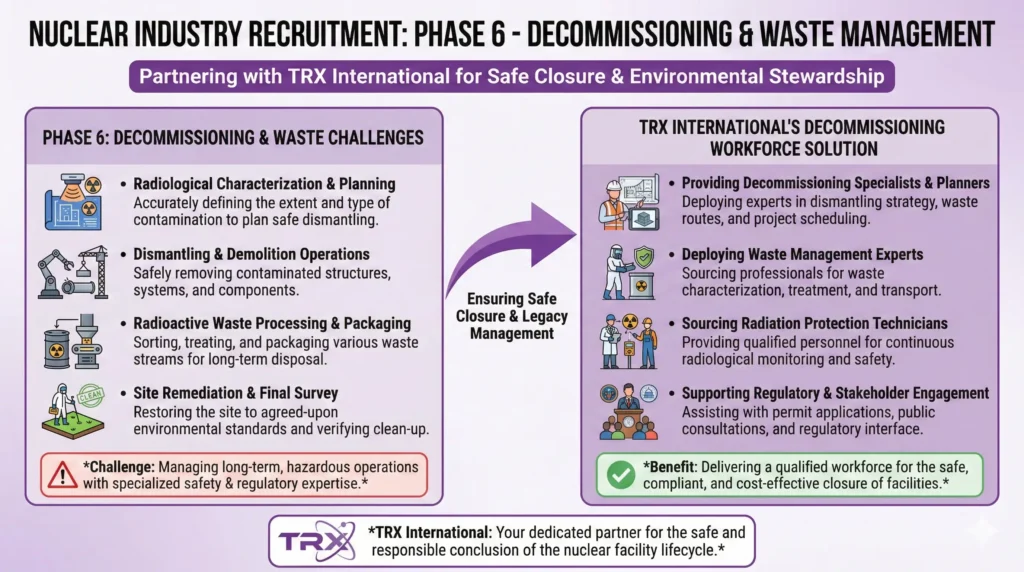
The nuclear lifecycle does not end when a reactor shuts down. Decommissioning is a complex, multi-year engineering undertaking that involves dismantling legacy reactors, managing radioactive waste, decontaminating structures, and restoring sites—all with the same engineering precision that governed the plant’s construction and operation.
The “back end” of the nuclear fuel cycle requires a distinct set of technical specialists. Decommissioning operatives skilled in robotic dismantling and remote decontamination are in high demand as more first-generation reactors reach end of life. Geological experts are needed to select and engineer sites for deep geological disposal (DGD) of high-level radioactive waste—a discipline that sits at the intersection of nuclear science, civil engineering, and environmental regulation.
An often-overlooked opportunity in this phase is talent repurposing—identifying transferable skills from operations staff who can transition into decommissioning roles. Rather than losing experienced professionals to retirement, organisations can extend their contribution by redeploying them into a sector that is growing rapidly as legacy plants close worldwide.
TRX International operates across all five of its core sectors—large new build, fusion, new technology development, decommissioning, and radioactive waste management—making it uniquely positioned to support the full lifecycle, including helping organisations source and transition talent for the decommissioning phase.
Smashing Your Questions Around Nuclear Industry Recruitment
The Front End Engineering Design phase identifies critical licensing and regulatory talent early to prevent costly design changes and project delays.
TRX sources thousands of specialised personnel, including HSE managers and commissioning engineers, ensuring safety and functional validation before the plant’s live operation.
These emerging technologies require niche expertise, such as blanket technology engineers, to manage first-of-a-kind engineering challenges and ensure commercial scalability.
Access to over 5,000 professionals allows for proactive aging-management recruitment and the sourcing of radiation protection experts to sustain 60-year asset reliability.
Recruitment provides the “back-end” expertise needed for safe dismantling, including decommissioning operatives and geological experts for radioactive waste site selection.
With 90% of its business being international, TRX have a global network to mobilize multinational teams for projects in regions like Japan.
Integrating Talent for a Sustainable Nuclear Future
The nuclear industry stands at a critical juncture. With 2026 widely regarded as a tipping point for large-scale hiring, organisations can no longer afford to treat nuclear recruitment as a transactional afterthought. The evidence is clear: project delays, cost overruns, and safety deficiencies are most often traced back to workforce gaps that should have been addressed earlier in the lifecycle.
Specialised recruitment is not a service; it is an engineering necessity. From the first licensing engineer hired during FEED to the last geological specialist appointed for deep geological disposal, every role in the nuclear project lifecycle demands a level of technical vetting and sector knowledge that generalist recruitment firms simply cannot provide.
TRX International brings that sector-specific expertise. With a Nuclear Talent Database that is diverse in nationality, experience level, and specialism, and a track record of supporting projects across the UK, UAE, Japan, Europe, and North America, TRX is positioned as a full-spectrum lifecycle partner for organisations building, operating, and decommissioning nuclear assets worldwide.
As the industry scales toward ambitious capacity targets—the UK alone estimates it will need approximately 123,000 workers this decade—the value of early, strategic nuclear workforce planning cannot be overstated. From nuclear engineers and reactor operators to radiation protection specialists and decommissioning experts, every role across the lifecycle contributes to the safe, reliable delivery of clean energy for generations to come.
Ready to secure the right talent for your nuclear project?
Visit trx-international.com to explore how TRX International’s global nuclear recruitment expertise can support every phase of your project lifecycle.