Nuclear Welding: The Skilled Trade You Haven’t Heard Of
What if the thing standing between you and a six-figure salary isn’t a college degree, a tech bootcamp, or knowing the right people, but the ability to lay a flawless bead of metal inside a nuclear reactor?
Most people have never even heard of nuclear welding jobs, and that’s exactly why they’re so ridiculously lucrative.
While everyone’s fighting over the same oversaturated career paths, a small, skilled group of tradespeople are quietly pulling in $100K to $200K a year working in one of the most demanding, and most rewarding, corners of the skilled trades. No LinkedIn influencer is hyping this career.
No trending TikTok is breaking it down. It just sits there, hiding in plain sight, waiting for the few who are willing to put in the work.
Here’s the deal: Nuclear welding isn’t your typical shop floor gig. Every single weld you make could be the difference between a safely operating power plant and a catastrophic failure. That kind of pressure scares most people off. But for those who thrive under it? It opens the door to a career with remarkable job security, jaw-dropping pay, and a level of professional respect that most trades never see.
What Is Nuclear Welding?
Think of it as welding with zero room for error. Nuclear welders join metal components used in power plants, submarines, and other nuclear facilities, pipes, pressure vessels, containment structures; where even a tiny flaw could spell disaster. It’s the same basic skillset as traditional welding, just held to insanely strict standards. Every single weld gets inspected, tested, and documented.
Why Nuclear Welding Jobs are in High Demand?
Here’s the short version: there aren’t enough nuclear welders, and the problem is only getting worse.
The Nuclear Industry’s Workforce Shortage
A huge chunk of the nuclear workforce is heading into retirement, and there simply aren’t enough younger tradespeople stepping up to fill those boots; especially in nuclear-specific roles. The industry’s been growing steadily, but the talent pipeline hasn’t kept pace. That gap between open positions and qualified candidates? It’s widening every year, which is great news if you’re thinking about getting into this field.
New Projects Driving Demand
And it’s not just replacement hiring. There’s a wave of brand-new work rolling in. Next-generation reactors and Small Modular Reactors (SMRs) are moving from blueprints to construction sites. Older plants are getting life extensions and major upgrades instead of shutting down. Legacy facilities that are closing still need skilled welders for decommissioning. On top of all that, defense and naval nuclear programs continue to need qualified hands.
Nuclear Welder Salary: What You Can Expect to Earn?
Nuclear welding is one of the highest-paying welding specialties in the trades. While a standard welder might earn a comfortable living, nuclear welders often command significantly higher rates due to the strict certification requirements and precision the job demands.
| Experience Level | Estimated Annual Salary |
|---|---|
| Entry-Level | $60,000 – $75,000 |
| Mid-Level (3–5 years) | $80,000 – $100,000 |
| Experienced (5+ years) | $100,000 – $150,000+ |
Your actual earnings depend on factors like the certifications you hold, the type of project (new construction, maintenance, or decommissioning), your work location, and whether the role involves travel.
Many nuclear welding jobs also offer overtime pay, per diem allowances, and travel bonuses, which can push your total compensation even higher.
How to Become a Nuclear Welder? Quick Guide
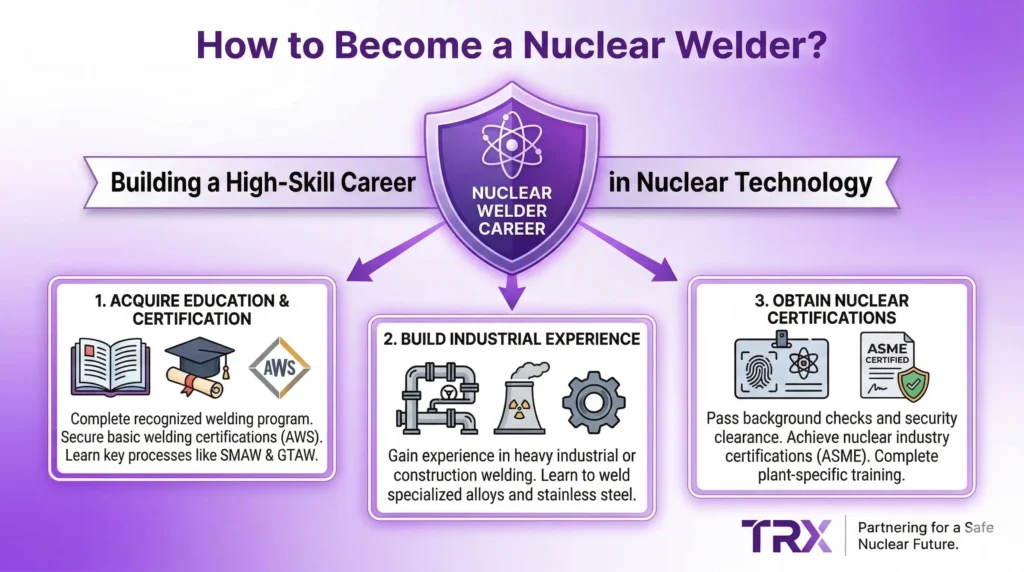
Nobody walks onto a nuclear site on day one. Here’s the realistic path to getting there.
1. Build a Foundation in Welding
Start with the basics. Enroll in a trade school, community college welding program, or apprenticeship and get comfortable with the core processes: TIG (GTAW), Stick (SMAW), and MIG (GMAW). Don’t rush this. Strong fundamentals are everything, because you can’t specialize in nuclear work if your foundation is shaky.
2. Earn Your Welding Certifications
Next, start stacking credentials. AWS (American Welding Society) certifications are your baseline. From there, you’ll want ASME Section IX welder performance qualifications. You’ll also need to understand welding procedure specifications (WPS) and procedure qualification records (PQR); these documents basically govern how every weld gets done and verified.
3. Get Nuclear-Specific Training and Qualifications
This is where things get specialized. You’ll need familiarity with nuclear quality assurance standards (NQA-1), radiation safety protocols, OSHA nuclear site training, and ASME Section III — the code for nuclear components. Most employers will also put you through their own qualification testing before you touch anything.
4. Gain Experience and Build Your Record
Don’t expect to jump straight into nuclear projects. Start with conventional industrial or power generation welding to build a solid track record. Then transition into nuclear maintenance, outage support, or subcontractor roles. Keep a detailed weld log and inspection record along the way, that documentation becomes your professional resume in this field.
Take the First Step Toward a Nuclear Welding Career
The demand is real, the pay is exceptional, and the path is clear, so why wait? It doesn’t matter where you are in your journey right now. What matters is that you start moving toward it today.
TRX International specializes in connecting skilled welders with high-paying nuclear welding opportunities across the industry. Our team can help you navigate the process, find the right fit, and get to work faster.
Ready to get started? Browse our open roles, submit your resume, or speak directly with a recruiter today.
Your next career move is one conversation away.
Essential Skills and Qualities of a Successful Nuclear Welder
So, is this career actually right for you? Let’s be real about what it takes.
You need surgical precision; we’re talking extremely tight tolerances where fractions of a millimeter matter. Every weld you lay will face serious testing, radiographic, ultrasonic, dye penetrant; and you’ll need to pass consistently, not just once.
Beyond the technical side, discipline is non-negotiable. Nuclear environments run on documentation and strict procedures. You’ll follow them to the letter, every single time.
Physically, you should be comfortable working in confined spaces, at heights, and in awkward positions for extended periods. Mentally, you need patience and laser focus under real pressure, because the stakes don’t get much higher than this.
Oh, and one more thing, be ready to travel. Much of this work is project-based or tied to outage schedules, so flexibility with location is practically part of the job description.
Types of Nuclear Welding Jobs and Where to Find Them
Nuclear welding is not a single career path, it spans several industries, each with its own work style and opportunities.
Nuclear Power Plant Maintenance and Outage Work
Scheduled refueling outages happen every 18–24 months at most plants, creating a steady cycle of contract welding work. During these outages, welders handle repairs and maintenance on reactor coolant piping, heat exchangers, and structural supports; all under tight deadlines.
New Nuclear Construction
With next-generation reactors and Small Modular Reactors (SMRs) moving forward, new construction projects are creating long-term employment opportunities for qualified nuclear welders. These roles often last several years on a single site.
Naval and Defense Nuclear Programs
Military shipyards need welders for nuclear-powered submarines and aircraft carriers. These positions typically require security clearance and are filled through government contractors.
Decommissioning and Waste Management
As older plants retire, decommissioning work is growing fast. This involves cutting, welding, and sealing contaminated systems and waste containment structures; a niche that demands specialized training.
Where These Nuclear Welder Jobs are Posted?
Most nuclear welding jobs aren’t listed on general job boards. Here’s where to look:
| Job Source | Best For |
|---|---|
| Nuclear industry recruiting firms (e.g., TRX International) | Getting matched to the right project based on your skills and certifications |
| Nuclear-specific job boards | Targeted listings for specialized roles |
| EPC contractor career pages | Direct-hire roles on major construction projects |
| Government contractor portals | Naval and defense nuclear positions |
| Nuclear staffing agencies | Outage and short-term contract work |
If you’re serious about breaking into nuclear welding, working with an experienced nuclear recruiter makes a real difference.
Firms like TRX International specialize in connecting skilled welders with opportunities across the nuclear industry, from outage contracts to long-term construction projects. They understand the qualifications employers are looking for and can help you find the right fit faster than searching on your own.
Is a Nuclear Welding Career Right for You?
Let’s keep it honest. Nuclear welding offers exceptional pay, strong job security, growing demand, and work that genuinely matters. Not many trades can check all four of those boxes at once.
But it’s not for everyone. The qualification standards are brutal, the physical demands are real, travel is often part of the deal, and the pressure never lets up. Every weld carries weight, and that environment isn’t something you can fake your way through.
So who thrives here? People who are disciplined, detail-obsessed, and motivated by mastering something most welders never attempt. If cutting corners isn’t in your DNA and high standards excite you rather than intimidate you, this career could be one of the best decisions you ever make.
How to Stand Out as a Candidate in the Nuclear Welding Field?
Getting qualified is one thing. Getting hired, and staying in demand; is another game entirely.
First, keep your certifications current and organized. Expired certs are one of the fastest ways to get passed over, and it happens more often than you’d think. Maintain a professional weld log with inspection results, think of it as your portfolio.
Beyond paperwork, build a reputation for reliability. Show up on time, pass your tests consistently, and follow procedures without cutting corners. In this industry, word travels fast.
Being flexible helps too. Willingness to travel and work outage schedules puts you ahead of candidates who won’t. And if you really want to separate yourself, invest in continuing education; picking up NDE awareness, rigging, or pipe fitting skills makes you far more versatile and valuable.
Finally, connect with recruiters who specialise in nuclear skilled trades. The best opportunities in this field aren’t always posted publicly, they’re filled through industry networks and specialized recruiting partners who know exactly what hiring managers need.
Frequently Asked Questions Relevant to Nuclear Welding Jobs and Profile
Can you become a nuclear welder without a college degree?
Absolutely. Most nuclear welders start through trade schools or apprenticeships. Certifications and hands-on skill matter far more than a four-year degree in this field.
How long does it take to become a fully qualified nuclear welder?
Realistically, four to seven years — including foundational welding training, earning certifications, gaining industrial experience, and completing nuclear-specific qualifications and employer testing.
Do nuclear welders get exposed to dangerous levels of radiation?
No. Strict radiation safety protocols, monitoring equipment, and exposure limits are enforced on every nuclear site. Welders rarely approach maximum allowable thresholds.
What’s the difference between nuclear welding and regular industrial welding?
The techniques are similar, but nuclear welding demands far tighter tolerances, more rigorous inspection methods, and extensive documentation that standard industrial welding doesn’t require.
Are nuclear welding jobs only available near power plants?
Not at all. Opportunities exist in naval shipyards, defense facilities, decommissioning sites, SMR construction projects, and even fabrication shops building nuclear-grade components.
Is nuclear welding a stable long-term career or just a temporary boom?
It’s long-term. Between new reactor construction, plant modernization, decommissioning work, and defense programs, demand is projected to grow for decades ahead.
Final Thoughts
Nuclear welding isn’t the career path you’ll see plastered across job boards or trending on social media. But that’s exactly what makes it such a massive opportunity for those willing to put in the work. The pay is outstanding, the demand keeps growing, and the job security is hard to beat in any trade.
If you’ve made it this far, you’re already ahead of most people because now you actually know what’s out there. The next step is yours to take.
And when you’re ready, TRX International is here to help you take it. As one of the most trusted names in nuclear recruitment, TRX connects skilled tradespeople with the industry’s best opportunities.
Don’t just chase a paycheck. Build a career that actually lasts.