Nuclear Operator Salary 2026: Pay, License & Career Path
If you have ever wondered what it actually pays to sit at the controls of a nuclear power plant, the short answer is: a lot more than most people guess.
The longer answer involves licenses, shift differentials, location, and the kind of experience you bring to the control room. This guide breaks down the real numbers behind a nuclear operator salary in 2026, what shapes the pay, and where the career path can take you.
The nuclear field is going through a quiet boom right now. With utilities pushing for clean baseload electricity and the U.S. greenlighting future nuclear builds and small modular reactors, the demand for licensed reactor operators is steady and the pay reflects it.
Average nuclear operator salary in 2026 sits at ~$122,610, with starting pay around $99,300 and top earners crossing $152,690. SROs with bonuses and overtime often clear $200K total compensation.
What a Nuclear Power Reactor Operator Actually Does?
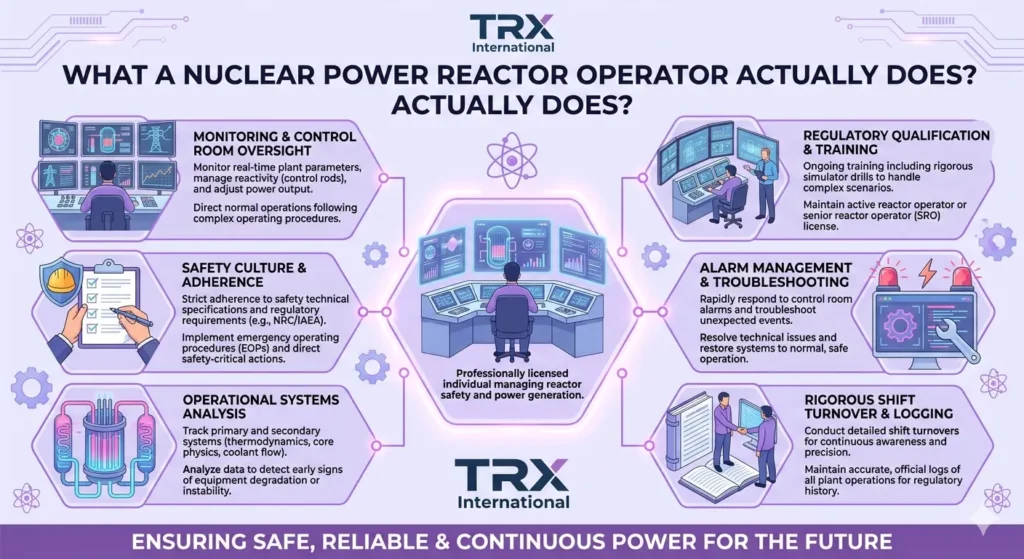
Before we talk money, it helps to know what the job involves. A nuclear power reactor operator is the person who directly controls a nuclear reactor from a control panel inside the control room. They move control rods, start and stop equipment, monitor instruments, and record data in shift logs.
They also respond to abnormalities, determine cause, and recommend corrective action whenever something looks off. The work is precise, procedural, and deeply tied to safety culture. Every action follows the ALARA principle, keeping radiation exposure as low as reasonably achievable.
The job description typically sits inside a wider crew. You will find non-licensed equipment operators in the field, a reactor operator (RO) at the controls, and a senior reactor operator (SRO) acting as shift supervisor. Together they keep the nuclear power plant running safely around the clock.
The Reactor Operator License That Changes Everything
Here is the part most people outside the industry miss: you must be licensed by the U.S. Nuclear Regulatory Commission (NRC) to operate nuclear reactors commercially. There are two licenses worth knowing.
The first is the RO license, which lets you control nuclear reactors directly. The second is the SRO license, which adds the authority to supervise licensed activities and run a shift. Both licenses come from passing tough NRC written and operating exams after a long training program.
That license is the single biggest reason nuclear power reactor operators earn what they do. It is hard to get, hard to keep, and hard to replace. Utilities pay accordingly.
Connect and Level Up Your Game
If you are interested in roles in nuclear space, reach out to the team at TRX International. We often have insights into upcoming outage needs and permanent staff positions before they hit the general job boards.
Daily Reality in the Nuclear Reactor Control Room
A typical day involves monitoring coolant temperature, watching reactor period, regulating flux level by adjusting controls, and running through procedures during plant evolutions. ROs and SROs also direct corrective action when systems behave unexpectedly.
There is paperwork, simulator time, ongoing requalification training, and constant compliance checks against the plant’s technical specifications. Safety systems are tested, signed off, and documented. It is not glamorous work, but it pays for that exact reason.
Inside the Nuclear Power Plant Crew Structure
Knowing where the operator role fits inside the wider plant team makes the salary picture clearer. Equipment operators handle hands-on field work, ROs sit at the controls, and SROs run the shift. Each layer carries different pay because each carries different responsibility under the operating license.
This is also why utility job postings can look so different even for “the same” role. A non-licensed operator at one plant and a licensed RO at another are very different nuclear jobs, and the pay gap reflects the license, not the title.
Nuclear Operator Salary in 2026: The Real Numbers
Now to the part you came for. Salary data for nuclear operators varies depending on which source you trust and how the role is defined, so it pays to look at a few angles.
According to BLS Occupational Employment and Wage Statistics survey data, nuclear power reactor operators earn a median annual salary of $122,610 as of 2026, with a range from $99,300 at the 10th percentile to $152,690 at the 90th percentile. That is the headline figure most career pages and the BLS Occupational Outlook Handbook reference.
Salary.com places the average for a “nuclear reactor operator” role slightly lower at around $108,673 in early 2026, with the typical band falling between $101,345 and $115,559. The differences come from job title definitions, sample size, and whether bonuses and shift premiums are counted.
Operator Hourly Rate, Overtime, and Shift Differential
The base salary is only part of the story. Most nuclear plant operators work 12-hour rotating shifts, which means nights, weekends, and holidays are part of the deal. That schedule comes with a shift differential on top of the base hourly rate.
Overtime is common, especially during outages and refueling windows. With overtime stacking on a strong hourly rate, total compensation can climb meaningfully above base.
Glassdoor’s survey data, which captures total pay including overtime, puts the average for a nuclear reactor operator at around $157,083 per year, with the typical range between $122,893 and $203,586 annually.
Build Your Nuclear Dream Team
Every unfilled role is a missed deadline. Top nuclear talent is scarce and getting scarcer. TRX International sources pre-vetted specialists globally so your projects stay on schedule and fully compliant.
Reactor Operator License Bonus and SRO Premiums
This is where the numbers get interesting. Holding an active NRC license earns you a license bonus on top of base salary, often called a license premium. Plants pay it because losing a licensed operator is genuinely painful for staffing.
Real utility job postings give a clear picture. One Constellation listing for a Peach Bottom SRO role advertises that after obtaining the SRO license, total compensation eligibility starts from $191,000 per year, including a target 15% annual bonus, license premium, and extended hours pay at 1.5 times the base salary.
Another utility role near Oswego, NY offered up to $130K to start plus a sign-on bonus, annual bonus, license-holding bonus, and an additional $20K per year or more once the SRO license is obtained.
Once you are a fully qualified SRO at a major plant, total compensation pushing toward or past $200K is realistic, especially with overtime and license premiums layered in.
Nuclear Power Reactor Operators: Pay by State and Cost of Living
| State | Median Salary (2026) | Cost-of-Living Notes |
|---|---|---|
| New York | ~$131,520 | Highest-paying state for nuclear power reactor operators; cost of living offsets some of the gain near NYC, less so upstate near plants like Nine Mile Point and Ginna. |
| Illinois | ~$128,000 | Largest nuclear fleet in the U.S. (Constellation). Strong union contracts; moderate cost of living outside Chicago metro keeps take-home healthy. |
| Pennsylvania | ~$125,000 | Multiple large plants including Peach Bottom and Limerick. Reasonable cost of living and no local income tax in many plant counties. |
| New Jersey | ~$124,000 | Higher cost of living, but base pay and license premiums at plants like Salem and Hope Creek stay competitive. |
| South Carolina | ~$118,000 | Lower nominal pay, but no estate tax, low property tax, and a much cheaper cost of living make take-home pay strong near V.C. Summer and Catawba. |
| Georgia | ~$117,000 | Home of Vogtle 3 and 4 (newest U.S. reactors). Pay slightly below national median but cost of living well below average. |
| Tennessee | ~$115,000 | TVA fleet (Sequoyah, Watts Bar). No state income tax materially boosts take-home pay. |
| Texas | ~$118,000 | Comanche Peak and South Texas Project. No state income tax and moderate cost of living make total compensation highly competitive. |
Location matters, and it cuts both ways. The highest-paying state for nuclear power reactor operators is New York at $131,520, which is $8,910 above the national median. States with strong utility presence, higher cost of living, or large fleets like Illinois, Pennsylvania, and South Carolina also tend to pay above average.
The Southeast has a heavy concentration of plants but slightly lower nominal pay, although the lower income tax and cost of living often make take-home pay competitive. When you compare offers, look at base salary, license bonus, shift differential, and the local cost of living together rather than focusing on the headline number alone.
Reactor Operator Pay by Years of Experience
| Career Stage | Years of Experience | Salary Range (Total Compensation) |
|---|---|---|
| Non-Licensed Equipment Operator (entry-level) | 0 to 2 years | $60,000 to $80,000 |
| Reactor Operator (RO, post-license) | 2 to 5 years | $90,000 to $120,000 |
| Senior Reactor Operator (SRO) | 6+ years | $150,000 to $200,000+ |
| Shift Supervisor / Operations Management | 10+ years | $200,000+ (often well into upper six figures) |
A rough breakdown of where people sit on the curve looks like this. Entry-level non-licensed equipment operators typically start in the $60K to $80K range during training. After 2 to 4 years of plant experience and passing the RO license, base salary jumps into the $90K to $120K territory.
With 6 years or more of experience and an active SRO license, total compensation regularly clears $150K and can hit $200K-plus including bonuses and overtime. Shift supervisors and operations managers move higher still. The career path rewards staying put, finishing the license, and stacking experience inside one fleet.
Comparing Power Plant Operators and Other Plant Roles
| Role | Median Salary | License or Certification Required |
|---|---|---|
| Nuclear Power Reactor Operator | ~$122,610 | NRC RO license (mandatory); SRO license for shift supervision |
| Senior Reactor Operator (SRO) | $150,000 to $200,000+ total comp | NRC SRO license (1 to 2 years beyond RO) |
| Power Plant Operator (non-nuclear) | ~$103,600 (group median) | No federal license; on-the-job training, plant-specific certifications |
| Nuclear Technician | ~$104,240 | No NRC operator license; associate degree or equivalent, plant qualification |
| Power Distributor / Dispatcher | ~$103,600 (group median) | NERC System Operator certification typically required |
| Reactor Engineer / Shift Technical Advisor | $100,000 to $140,000 | Engineering degree; STA qualification (no NRC license required) |
It also helps to see how the operator role stacks up against similar careers in nuclear energy. Power plant operators in non-nuclear facilities earn less on average. The median annual wage for power plant operators, distributors, and dispatchers as a combined group was $103,600 in May 2024, and nuclear operators sit firmly above that.
Nuclear technicians, who support operations and monitor radiation, sit in a slightly different bracket with median pay around $104,240. The licensed reactor operator role consistently pays more because of the regulatory burden and the responsibility of controlling the reactor itself.
What Drives Nuclear Operator Pay Higher?
A few factors push your salary toward the top end of the range. Holding an active SRO license is the biggest single lever. Shift supervisor or operations management roles add another step up.
Working at a multi-unit site, a higher cost-of-living region, or a utility with strong union contracts also helps. Years of experience, clean qualification record, and willingness to work outage overtime all add up. Certifications, additional reactor-type qualifications (BWR and PWR), and instructor credentials open further doors.
Looking to hire nuclear professionals or explore nuclear career opportunities?
TRX International connects world-class talent with critical roles across the global nuclear industry. Visit trx-international.com or get in touch with the team to start the conversation.
Career Path: How to Become a Nuclear Reactor Operator?
The good news: the entry barrier is lower than people expect. The bad news: the qualification path is long and demanding.
At minimum you need a high school diploma. Most utilities prefer candidates with military nuclear experience (Navy nukes are the classic pipeline), an associate degree in a nuclear or power generation technology, or relevant power plant experience. Many start as non-licensed reactor operators and receive on-the-job training, sometimes paired with an apprenticeship or certification or associate degree program.
From there, you spend roughly 18 to 24 months in an initial license training (ILT) program before sitting the NRC exam. Pass it and you become an RO. Add another 1 to 2 years of experience plus more training and you can sit for the SRO exam.
Education, Training, and Certification Pipeline
The training is built around classroom theory, full-scope simulator practice, and on-the-job qualification at the actual plant. You learn reactor physics, thermodynamics, plant systems, emergency procedures, and how to respond to abnormalities. Simulator time is where things get real, with instructors throwing scenario after scenario at you.
The exam itself is split into a written portion and an operating exam on the simulator, with NRC examiners watching every move. Pass rates are decent for candidates who finish the program, but the program itself filters hard.
Where the Nuclear Power Jobs Are?
Major employers include Constellation Energy, Duke Energy, Dominion, Southern Company, TVA, Vistra, and Entergy, along with naval nuclear programs. The top paying companies in Energy, Mining and Utilities for nuclear reactor operators include Constellation Energy and Duke Energy, while in Government and Public Administration the top paying employer is the US Navy.
The Bureau of Labor Statistics projects a 10% decline in overall power plant operator employment from 2024 to 2034, but openings remain steady because of retirements. Around 3,800 openings for power plant operators, distributors, and dispatchers are projected each year on average over the decade, mostly to replace workers who retire or move to other occupations.
For licensed reactor operators specifically, the retirement wave plus restart projects and SMR builds make the outlook better than the headline number suggests.
Similar Careers Worth Knowing
If the operator path appeals but the licensing route feels too narrow, related roles include reactor engineer, shift technical advisor, nuclear technician, radiation protection technician, and chemistry technician. Each plays a role in plant reliability and pays well, and several can serve as stepping stones into operator training.
For ambitious candidates, the SRO license is also a launchpad into operations management, training instructor roles, plant management, and corporate operations leadership. Shift supervisors who move up in the organization often see total compensation well into the upper six figures.
Why the Nuclear Power Industry Is Worth Betting On in 2026?
The nuclear field is having a moment. License renewals are extending the life of existing reactors, restart projects like Palisades and Three Mile Island Unit 1 are bringing retired plants back, and new builds like Vogtle 3 and 4 plus the small modular reactor pipeline are opening fresh demand for licensed staff.
For people thinking about a future nuclear career, the math is simple. The number of fully qualified ROs and SROs is not growing fast enough to match the projects on the horizon. That tightness keeps base salary, license bonus, and overall total compensation healthy.
If you are an early-career operator weighing whether to commit to the license track, the income trajectory and job security make a strong case. If you are a hiring manager trying to fill a control room, expect a competitive market and plan compensation packages accordingly.
How TRX International Helps Nuclear Reactor Operators and Employers?
This is where a specialist recruitment partner earns its keep. TRX International works exclusively in nuclear and energy recruitment, placing reactor operators, shift supervisors, license-holders, and the wider plant staff that keeps reactors running safely.
The team understands the difference between RO and SRO eligibility, knows how license bonus structures vary across utilities, and can map your experience against real openings rather than generic listings.
For candidates, that means honest salary benchmarking and offers that reflect your license status. For employers, it means access to qualified, vetted operators who can pass the screening, the medical, and the eventual license exam.
If you are exploring your next role in the nuclear industry or building out a control room team, working with recruiters who actually speak the language of NRC licensing, ALARA, and shift rotations saves time and money on both sides.
Quick Reference: Nuclear Reactor Operator Salary at a Glance
A simple snapshot to round things off so you can scan the key numbers in one place.
- Median nuclear power reactor operator salary in 2026: around $122,610 per year
- Typical range: $99,300 (10th percentile) to $152,690 (90th percentile)
- Average hourly rate: roughly $52 to $59 per hour depending on source
- Total compensation including bonuses and overtime: $150K to $200K-plus for licensed SROs
- Highest-paying state: New York at around $131,520 median
- Top employers: Constellation Energy, Duke Energy, Dominion, US Navy
- Entry requirement: high school diploma plus on-the-job training
- License: NRC-issued RO or SRO, required to operate nuclear reactors
- Career path: non-licensed operator to RO to SRO to shift supervisor to operations leadership
- Industry outlook: stable demand driven by retirements, restarts, and new nuclear builds
Frequently Asked Questions
What is the average salary for a nuclear reactor operator in 2026?
It depends on the source and exact role, but a reasonable benchmark is a median around $122,610 per year for licensed nuclear power reactor operators in the U.S., with total compensation often higher once license premium, shift differential, and overtime are added.
Do nuclear operators really earn $200K?
Yes, fully qualified SROs at major utilities can clear $200K in total compensation, especially when annual bonus, license bonus, and extended-hours pay at 1.5 times the base hourly rate are factored in.
How long does it take to become a licensed reactor operator?
Most candidates spend 2 to 4 years progressing from non-licensed operator to RO, including the 18 to 24 month initial license training program and the NRC exam. SRO usually adds another 1 to 2 years on top.
Is the nuclear industry hiring in 2026?
Yes. Despite a projected decline in overall power plant operator employment, the licensed reactor operator role faces tight supply because of retirements, restart projects, and the small modular reactor pipeline.
What is the difference between an RO and an SRO?
An RO controls the reactor from the control panel. An SRO holds a senior license, supervises licensed activities, runs the shift as shift supervisor, and is authorized to direct fuel movement and other activities the RO cannot.
Do I need a college degree to become a nuclear operator?
Not strictly. A high school diploma plus extensive on-the-job training meets the minimum. That said, an associate or bachelor’s degree, military nuclear experience, or relevant power plant experience makes you significantly more competitive.
Final Thoughts
So here is the bottom line: a nuclear operator salary is genuinely one of the strongest pay packages in the energy sector, and the licensing path that builds it is a career worth committing to.
Between rising demand, retiring veterans, and a wave of new builds and restarts, the next decade looks busy for anyone holding an RO or SRO license.
If you are weighing your next move, whether that is your first plant role or a jump to a higher-paying utility, talking to specialists who actually understand the nuclear field helps.
TRX International places operators, supervisors, and license-holders across the industry, and we are always happy to chat about where your experience can take you next.