Nuclear Technician: Career Path, Salary, Skills, and How to Become One in 2026?
If you have ever wondered who keeps a nuclear power plant running safely behind the scenes, the answer almost always points to one role: the nuclear technician. Nuclear technicians typically work in nuclear energy production settings such as nuclear power plants, laboratories, and research facilities, where they play a crucial part in maintaining safety and efficiency.
A nuclear technician sits at the intersection of science, engineering, and hands-on operation. A background in nuclear science or a nuclear power technology program is often essential for entering the field. They assist nuclear engineers, nuclear physicists, and reactor operators with research, testing, and the daily running of a plant.
Nuclear technicians typically monitor radiation levels onsite, operate specialised equipment, and ensure compliance with radiation safety procedures in environments like nuclear power plants and research labs. This guide walks you through everything you need to know about the role.
We will cover the day-to-day reality, the salary, the skills needed, the training nuclear technicians undergo, and the steps to become a nuclear technician. If recruitment in this industry is what you are after, you will find that part too.
What a Nuclear Technician Actually Does?
Let us start with the basics. A nuclear technician is a skilled worker who plays a key role in nuclear energy production, especially within nuclear reactors, nuclear power plants, research facilities, or any industrial setting where nuclear technology is used. They are not the engineer designing the reactor, but they are absolutely the person making sure everything the engineer designed actually works the way it should.
Nuclear technicians are responsible for ensuring that reactors and other equipment are operated safely, maintaining safety and efficiency in reactor operations and nuclear power generation facilities. They act as the “eyes and ears” on the ground, ensuring that reactors and equipment operate within safe regulatory limits.
The occupation sits under what the U.S. Bureau of Labor Statistics tracks as a specialised technical field. According to O*NET data and the Bureau of Labor Statistics, nuclear technicians are employed across power generation plants, government agencies, research laboratories, and private companies that provide quality control for nuclear testing. Nuclear technicians often collaborate with other scientists, such as physicists and engineers, supporting research and operations in these environments.
Daily Responsibilities of a Nuclear Technician: Operating and Maintaining Radiation Monitoring Equipment
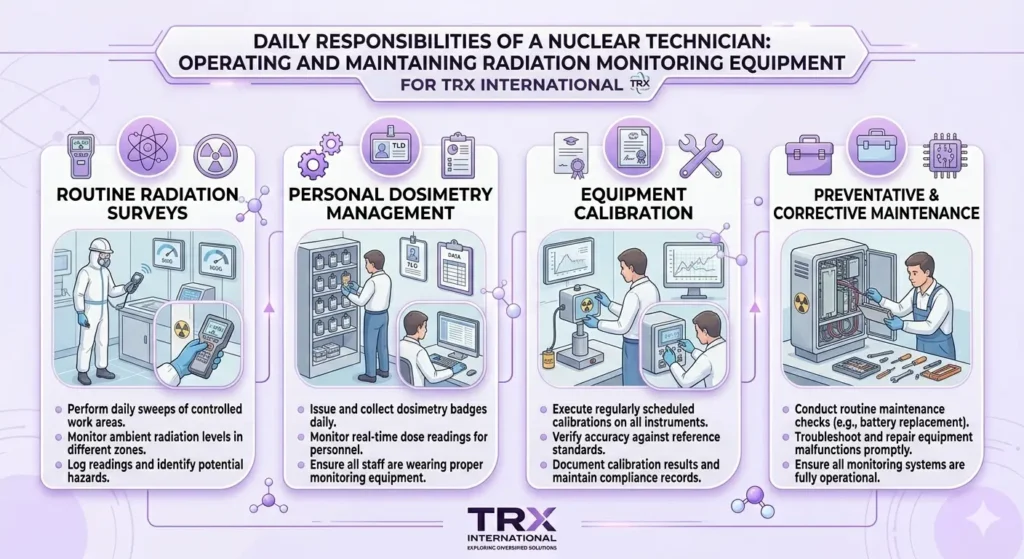
A typical day depends entirely on the type of work and the facility. Some technicians spend most of their shift inside offices and control rooms, monitoring instrumentation. Others spend time on the plant floor, testing equipment, calibrating sensors, running corrective maintenance procedures, and maintaining and operating equipment beyond core reactor components.
In a nuclear power plant, a nuclear technician will often assist a reactor operator by tracking radiation levels onsite, recording readings, and following strict radiation safety procedures. Technicians frequently collect air, water, and soil samples to test for radioactive contamination, operate radiation detection instruments, analyze environmental samples, and enforce safety protocols. The work is repetitive in the best possible way, because every reading matters and every step in a procedure exists for a reason.
In a research environment, the same role looks different. Here, a nuclear technician may operate nuclear testing and research equipment, prepare samples for a scientist or physicist, and document findings from controlled experiments. The pace is slower, but the precision required is just as high.
Where Nuclear Technicians Work? Common Settings Like Nuclear Power Plants?
Nuclear technicians typically work in environments such as nuclear power plants, laboratories, and research facilities. In nuclear power plants, technicians play a crucial role in maintaining safety and efficiency in reactor operations and power generation facilities.
Power plants operate 24 hours a day, requiring rotating shifts, occasional overtime, and a workplace that never really sleeps. That setup is not for everyone, but those who enjoy structured, methodical work often find it suits them well.
Beyond nuclear power plants, technicians typically work in laboratories tied to medical research, universities, defence projects, and waste management facilities. The U.S. Navy nuclear power technology program, often called navy nuclear, is one of the largest training pipelines in the world for this type of skill set, producing workers who later move into civilian roles.
Some technicians also support engineers in fields like nuclear medicine, food irradiation, and applied science in nuclear research. Each of these settings comes with its own equipment, its own protocols, and its own specific training needs.
Connect and Level Up Your Game
If you are interested in roles in nuclear space, reach out to the team at TRX International. We often have insights into upcoming outage needs and permanent staff positions before they hit the general job boards.
The Difference Between Roles in the Industry
It helps to understand where the technician sits compared to other roles. Nuclear engineers design systems and lead improvement projects. Nuclear physicists study the underlying science. A reactor operator runs the reactor itself, often after years of experience and certification.
A nuclear technician supports all of these people, working closely with other scientists such as physicists and engineers. They are the ones running the tests, recording the data, performing the maintenance, and flagging issues before they grow into something serious. The role is sometimes confused with a radiation protection technologist, which is a related but more narrowly focused job centred on radiation protection and health and safety monitoring.
If you imagine a plant as an orchestra, the nuclear engineers wrote the music and the technicians make sure every instrument is tuned, played correctly, and ready for the next performance.
Types of Nuclear Technicians You Might Encounter
There is no single template for this occupation. A few common variations exist depending on the facility and the type of work involved.
A radiation protection technologist focuses on monitoring radiation levels onsite and protecting workers and the public from exposure. An operating technician supports the day-to-day running of the plant alongside a nuclear power reactor operator. A research technician spends more time in a laboratory, often working alongside a nuclear physicist or scientist on testing and research equipment.
Each variation has its own training path, its own skills needed, and its own pre-employment testing requirements. The good news is that the foundational coursework is similar across all of them, so a single starting point can lead to several different doors.
A Quick Look at the Real Working Environment
People sometimes picture a nuclear power plant as something out of a science fiction film. The reality is more grounded. It is an industrial setting with offices, control rooms, equipment bays, and outdoor areas where radiation levels are tightly monitored.
Technicians wear protective gear when needed, follow strict procedures for entering and leaving controlled zones, and keep detailed logs throughout their shift. Health and safety are not afterthoughts here. They are the entire point.
The physical abilities required are moderate. You should be comfortable standing for long periods, climbing ladders, lifting moderate loads, and wearing protective equipment for hours at a time. Pre-employment testing usually checks for these basics, along with vision, hearing, and general fitness.
How to Become a Nuclear Technician and Grow in the Field?
This is the section most readers come for. The path is structured, but it is also more accessible than people assume. You do not need to be a nuclear physicist to enter the field. However, a background in nuclear science or a nuclear power technology program is often necessary for entry as a nuclear technician.
You need the right training, the right attitude, and a willingness to learn. We will walk through education, training, and skills first, then move into salary, job outlook, and long-term career growth so you can see the full picture in one place.
Education and Coursework
Nuclear technicians typically have an educational background in nuclear science or a related field. The most common starting point is an associate’s degree in nuclear technology, engineering technology, nuclear science, or a related applied science in the nuclear field. These two-year programs are widely available through community colleges and technical institutes across the U.S. and other countries with active nuclear industries.
Coursework typically includes nuclear science, mathematics, physics, chemistry, electrical and mechanical fundamentals, radiation protection, radiation safety procedures, instrumentation, and reactor theory. Some programs also include hands-on lab work using simulators and scaled equipment, which gives students a feel for what plant operation looks like before they ever set foot in a real one.
A high school diploma is the minimum entry requirement for most associate degree programs. Strong grades in mathematics and the sciences will help you stand out, especially when training nuclear technicians programs are competitive.
Alternative Routes Into the Field
Not everyone takes the college route. The U.S. Navy nuclear power technology program is one of the most respected alternative paths. Sailors who complete navy nuclear training often transition directly into civilian nuclear technician roles after their service, sometimes earning higher starting salaries than fresh college graduates because of the related on-the-job experience they bring with them.
Some workers enter the field with a background in another technical industry, such as electrical work, instrumentation, or industrial maintenance, and then complete additional training to specialise in nuclear. These career changers often pick up the work quickly because they already understand the rhythm of an industrial setting.
A growing number of utilities also run their own apprenticeship-style training programs, where trainees earn while they learn. These programs are sponsored by groups like the Nuclear Energy Institute, often referred to simply as NEI, which sets standards and pre-employment testing benchmarks across the industry.
Build Your Nuclear Dream Team
Every unfilled role is a missed deadline. Top nuclear talent is scarce and getting scarcer. TRX International sources pre-vetted specialists globally so your projects stay on schedule and fully compliant.
On-the-Job Training and Certification
No matter how you enter the field, on-the-job training is non-negotiable. Every nuclear facility runs its new technicians through extensive site-specific training before they are allowed to work independently. This training ensures that all equipment and reactors are operated safely, meeting strict industry standards. The process usually takes several months and includes shadowing experienced workers, completing written assessments, and demonstrating competency on each piece of equipment.
For roles that involve operating a reactor or working in restricted areas, additional certification is required. A reactor operator licence, for example, is issued only after years of experience, hundreds of hours of training, and a rigorous examination. Most technicians do not need this licence, but those who pursue it open the door to higher pay and senior roles.
Ongoing training is part of the job for life. Procedures change, equipment improves, and regulations evolve. A good nuclear technician treats learning new skills as part of the daily routine rather than something they finished after graduation.
Skills Needed to Succeed
The technical skills are obvious. You need to be comfortable with mathematics, electrical systems, mechanical equipment, and basic chemistry. You also need familiarity with other equipment used in nuclear facilities—beyond just core reactor components, including auxiliary nuclear systems, nuclear materials handling, and specialized machinery. You need to be able to read schematics, interpret data, and follow a written procedure exactly as it is written.
The softer skills matter just as much. Attention to detail is non-negotiable. So is the ability to stay calm under pressure. A nuclear technician who panics during an unexpected reading is a liability. One who works through the procedure step by step, no matter how stressful the moment, is genuinely valuable.
Communication is another skill that gets underestimated. Technicians constantly hand off information to engineers, supervisors, and other technicians across shift changes. A clear, accurate handover can prevent issues that a sloppy one would create.
Comfort with technology is also worth mentioning. Modern nuclear facilities run on a mix of legacy control systems and newer digital instrumentation. A technician who can navigate both, who is not intimidated by older analogue gauges and equally comfortable with newer touchscreen interfaces, becomes valuable quickly. Most facilities provide training on their specific systems, but a baseline curiosity about how things work goes a long way.
Problem-solving is the final piece. Equipment fails. Readings drift. Unusual patterns appear. The technicians who stand out are the ones who notice these things early, ask the right questions, and bring useful information to the engineers who can act on it. Curiosity, paired with discipline, is the combination that separates a good technician from a great one.
Pre-Employment Testing and Background Checks
Before any nuclear facility hires you, expect a thorough pre-employment testing process. This typically includes aptitude tests covering mathematics, mechanical aptitude, and reading comprehension. Many employers use a standardised exam developed in coordination with the Nuclear Energy Institute, particularly for roles in nuclear power generation.
Background checks are extensive because of the security sensitivity of the industry. Drug testing, financial history, criminal record reviews, and reference checks are all standard. For some facilities, especially those with government contracts, security clearances are required and can take months to process.
It sounds intimidating, but most candidates with a clean record and solid coursework pass without issue. The point is to make sure the people working around sensitive nuclear materials and equipment are reliable and trustworthy.
A Realistic Timeline From Start to First Job
Here is what the path usually looks like in practice. You finish high school with a high school diploma. You enrol in a two-year associate’s degree in nuclear technology or engineering technology. During or after the degree, you apply for trainee or entry-level openings at power plants, research facilities, or contractors.
You complete pre-employment testing, pass the background check, and start your on-the-job training. Within six to twelve months, you are working independently in your role. Within a few years, you may move into a senior technician position, or you may pursue further certification to become a reactor operator or specialist.
For navy nuclear graduates, the timeline is often shorter on the civilian side because the training they completed during service satisfies many employer requirements right out of the gate.
Nuclear Technician Salary
Money matters. So does whether the job will still exist in ten years. Both look genuinely promising for a nuclear technician.
Salaries for nuclear technicians sit comfortably above the national average for technical roles. According to Bureau of Labor Statistics data, the median annual wage for nuclear technicians was $104,240 in May 2024. The average salary for a nuclear technician in the United States is about $124,832 per year, with a range from $104,015 to $149,815 depending on experience and location.
Entry-level technicians typically start lower, but salaries climb quickly with experience and certification. A technician with five or more years of experience, especially one who has earned additional licences, can estimate a salary that approaches or exceeds what some bachelor’s degree professionals earn in other industries.
Overtime is common, particularly during refuelling outages and major maintenance windows. Many technicians use these periods to significantly boost their annual income. The hourly structure, combined with regular overtime, makes the role financially attractive even at the start of a career.
The highest paying cities for nuclear technicians include New Brunswick, NJ at $148,146 per year, and Pittsfield, MA at $138,323 per year.
Looking to hire nuclear professionals or explore nuclear career opportunities?
TRX International connects world-class talent with critical roles across the global nuclear industry. Visit trx-international.com or get in touch with the team to start the conversation.
Job Outlook and Number of Jobs
The number of jobs in the nuclear technician occupation has shifted in recent years, and the picture is more nuanced than the headlines suggest. While some traditional power plants have retired, new investment in small modular reactors, nuclear medicine, and research facilities has created fresh demand.
Employment of nuclear technicians is projected to decline 8 percent from 2024 to 2034. Despite this projected decline, about 700 openings for nuclear technicians are expected each year on average over the decade. The need for these openings is primarily due to the replacement of workers who transfer to other occupations or exit the labor force, such as through retirement.
Government agencies, defence projects, and the renewed interest in nuclear energy as part of the global energy transition are all creating new opportunities. For someone entering the field today, the long-term picture looks more stable than it has in years.
Career Progression and Advancement
A nuclear technician role is rarely a dead-end job. With years of experience, technicians can move into supervisory positions, training roles, or specialist tracks like radiation protection, instrumentation, or quality control for nuclear testing.
Some technicians use the role as a stepping stone to become a nuclear engineer, completing a bachelor’s degree while working. Others move into related fields like nuclear medicine technology, industrial radiography, or regulatory compliance. The skills you build are transferable in ways that surprise most people.
Senior technicians often earn well into six figures when overtime, bonuses, and shift differentials are factored in. Combined with strong benefits, pension contributions, and job stability, the long-term financial picture is genuinely strong.
What the Industry Looks Like Today?
The nuclear industry is in a curious moment. Public interest in nuclear energy has shifted, with many countries reconsidering it as a low-carbon source of nuclear power generation. New reactor designs are being approved, older plants are being licensed for extended operation, and the pipeline of work for technicians is growing in places that looked uncertain just a few years ago.
This matters for anyone considering the field. The skills you learn today will not become obsolete. The infrastructure being built and maintained now will need qualified technicians for decades. Few industries can offer that kind of long-term certainty.
A Quick Industry Profile
Here is a snapshot of where nuclear technicians fit in the broader industry profile. The largest employers are nuclear power plant operators, followed by government agencies, defence contractors, and research institutions. Smaller numbers work in medical facilities, university laboratories, and private companies that provide instrumentation, testing, and maintenance services.
The industry rewards people who treat their work seriously, follow procedures, and continually invest in learning new skills. It is not a place for shortcuts, and it is not a place where you can drift through your career. But for those who genuinely enjoy the discipline, the rewards are substantial.
Specialisations Worth Considering
Within the role, several specialisations carry their own pay premiums and career paths. Radiation protection is a common one, focused entirely on monitoring radiation levels onsite and protecting workers. Instrumentation specialists handle the sensors and control systems that keep the plant running. Maintenance technicians focus on corrective and preventive work on critical equipment.
Each specialisation has its own training requirements and its own progression path. Many technicians start as generalists and then specialise once they understand which type of work suits them best. There is no wrong choice, but there are choices that will fit your strengths better than others.
Industry Demand and Recruitment
This is where recruitment partners come in. The nuclear industry has a long-standing skills shortage, particularly for experienced technicians and reactor operators. Specialist nuclear recruitment agencies play a critical role in matching talent with the right openings, especially for roles that require security clearances, specific certifications, or relocation.
Demand is not limited to the U.S. either. The U.K., France, Canada, the UAE, and several Asian countries are all actively expanding their nuclear capacity, which means new openings for trained technicians, often with attractive relocation packages. Statistics from various national bodies suggest the global skills gap will widen over the next decade as older workers retire and new facilities come online.
If you are exploring openings in the nuclear sector, working with a recruitment specialist who understands the industry can save you months of searching. Specialists know which facilities are hiring, which programs offer the best training, and which companies actively support career progression. They also understand the timeline of pre-employment testing and clearances, which can otherwise feel like a black box to candidates.
For employers, the same is true in reverse. A recruitment partner who knows the nuclear industry can fill a critical opening with someone who actually fits the role, rather than someone who simply ticks boxes on paper.
Why a Specialist Nuclear Recruitment Partner Matters?
Generalist recruiters often struggle with nuclear roles. The vocabulary is technical, the certifications are unfamiliar, and the security requirements add layers most agencies are not equipped to handle. A specialist understands what a reactor operator licence actually means, what kind of related on-the-job experience matters, and how to evaluate a navy nuclear background against a traditional academic route.
This is the gap TRX International was built to fill. Operating exclusively within the nuclear sector since 2019, TRX has grown a network of over 5,000 nuclear professionals across all six major industry segments: Large New Build, SMR and MMR, Fusion, Radioactive Waste Management, Decommissioning, and Fuel Handling. That vertical focus means the team genuinely speaks the language of the sector.
Hiring mistakes in nuclear are expensive in ways other industries do not understand. A wrong hire can delay a refuelling outage, miss an inspection window, or compromise health and safety on a site with zero margin for error. With placements across 15 countries and clients including GE-Hitachi, Tractebel, and Jacobs, TRX International is the kind of partner that turns a long search into a fast, confident hire.
Tips for Landing Your First Nuclear Technician Role
A few practical pointers for anyone targeting their first opening. Tailor your resume to the specific facility and role rather than sending the same document everywhere. Highlight any related on-the-job experience, even if it came from a different industry. Mathematics, electrical work, mechanical maintenance, and quality control all transfer better than people realise.
Prepare seriously for pre-employment testing. There are practice exams available online, and many community colleges offer prep courses specifically for the EEI battery and similar assessments. A few weekends of focused practice can make the difference between an offer and a rejection.
Be patient with the timeline. Background checks and clearances take time. The right approach is to apply broadly, prepare thoroughly, and treat the process as a marathon rather than a sprint. The wait is worth it once you are in.
Networking matters too. Attend industry events, connect with current technicians on professional platforms, and reach out to alumni from your training program who already work in the field. A warm introduction often moves your application forward faster than a cold application ever will. Many openings are filled through referrals before they ever appear on a public job board.
Frequently Asked Questions
What does a nuclear technician do on a typical workday?
A nuclear technician monitors radiation levels onsite, operates testing equipment, follows radiation safety procedures, and supports engineers with maintenance, instrumentation checks, and daily plant operations.
How long does it take to become a nuclear technician?
Most candidates complete a two-year associate’s degree, then several months of on-the-job training, putting the full timeline at roughly two to three years.
Do you need a college degree to become a nuclear technician?
An associate’s degree is the most common route, often including coursework in nuclear science or a nuclear power technology program, though navy nuclear training and related on-the-job experience can also qualify candidates for entry-level technician roles.
How much does a nuclear technician earn annually in the U.S.?
According to Bureau of Labor Statistics data, nuclear technicians earn well above average for two-year degree roles, with overtime significantly boosting yearly income.
Is the nuclear technician career still in demand in 2026?
Yes, demand remains strong globally as older workers retire and new reactors, research facilities, and small modular reactor projects come online worldwide.
What skills are most important for a successful nuclear technician?
Attention to detail, strong mathematics, mechanical and electrical fundamentals, calm decision-making under pressure, and clear communication during shift handovers are all essential.
Closing Thoughts on the Career
A nuclear technician career offers something unusual in today’s job market. It pays well without requiring a four-year degree, it is genuinely stable, and it puts you at the centre of an industry that matters for the future of energy and science. The work is technical, the standards are high, and the people who succeed are the ones who take pride in doing things correctly.
If you are someone who likes structure, enjoys solving practical problems, and finds satisfaction in following a procedure exactly the way it should be followed, this could be the right fit. The training nuclear technicians programs are accessible, the entry requirements are reasonable, and the long-term prospects are strong.
For those further along in their career, or for employers looking to recruit experienced technicians, a specialist nuclear recruitment agency is the fastest route to the right match. The nuclear industry is built on trust, expertise, and precision. The same applies to recruitment within it. Choosing a partner who genuinely understands the technical landscape, the regulatory environment, and the specific demands of nuclear roles is what turns a good hire into a great one.
Whether you are taking your first step toward becoming a nuclear technician, looking to move into a more senior position, or building a team for a new facility, the industry rewards those who approach it with the same seriousness it brings to its own work. That is what makes it one of the most genuinely rewarding technical careers available today.