Analytical & Environmental Chemist Jobs in Nuclear: Roles, Pay & Pathways
So You’re a Chemist. Have You Considered Nuclear?
If you’ve been working in a lab environment, running analyses, monitoring environmental samples, or managing quality control, and you’re wondering what’s next, the nuclear industry deserves a closer look. Analytical & Environmental Chemist jobs in nuclear are among the most in-demand, well-paid, and genuinely fascinating roles in the entire energy sector right now.
Whether you’re already nuclear-curious or just starting to explore the space, this guide walks you through everything: what the roles actually involve, what they pay, how to qualify, and how TRX International, a specialist nuclear recruitment agency, can help you take the next step in your nuclear career.
⚗️ Why Chemistry Is at the Heart of Nuclear Energy?
Connect and Level Up Your Game
If you are interested in roles at either Turkey Point or St. Lucie, reach out to the team at TRX International. We often have insights into upcoming outage needs and permanent staff positions before they hit the general job boards.
Analytical & Environmental Chemist Jobs in Nuclear
The nuclear sector relies heavily on analytical and environmental chemists to monitor radiation levels, assess environmental impact, and ensure strict regulatory compliance across facilities. These roles sit at the intersection of chemistry expertise and nuclear safety, making them among the most technically demanding and rewarding positions in the industry.
| Role | Primary Focus |
|---|---|
| Radiochemical Analyst | Analysis of radioactive materials and isotopes |
| Environmental Monitoring Chemist | Site-level radiation and contamination tracking |
| Waste Characterisation Chemist | Classification and disposal of nuclear waste streams |
| Regulatory Compliance Chemist | Ensuring adherence to nuclear safety and environmental standards |
| Laboratory Analytical Chemist | Sample testing and reporting within licensed nuclear facilities |
Opportunities span decommissioning projects, active power stations, research facilities, and government-regulated environmental programmes, offering strong long-term career progression for qualified chemists.
What Does a Nuclear Analytical or Environmental Chemist Actually Do?
Let’s cut through the jargon. If you’ve heard vague references to “nuclear chemistry” without a clear picture of day-to-day work, here’s the reality.
Analytical Chemists in Nuclear
Your core job is to analyse samples, from nuclear fuels, coolant systems, effluents, or site soils, using advanced techniques like ICP-MS, gamma spectrometry, alpha/beta counting, and liquid scintillation counting. You ensure data quality and support regulatory reporting. In short: precision is your superpower.
Environmental Chemists in Nuclear
You’re the eyes of the site beyond the fence line. You monitor air, water, land, and biological samples to ensure the facility isn’t impacting the surrounding environment. You produce reports for regulators, manage environmental management systems, and often lead contamination investigations.
Nuclear Chemistry Roles at a Glance
| Specialisation | Key Responsibilities | Key Qualification |
|---|---|---|
| Radiochemist | Isotope analysis, radioactive waste characterisation | MSc/PhD Chemistry + radiation safety certs |
| Environmental Chemist | Site monitoring, effluent analysis, contamination reports | BSc Environmental Science/Chemistry |
| Analytical Chemist | Sample prep, spectrometry, QA/QC of nuclear materials | BSc Chemistry, analytical lab experience |
| Decommissioning Chemist | Waste streams, decontamination, material clearance | Experience in waste management or decom projects |
| Health Physics Chemist | Radiation dose assessment, contamination control | Radiation Protection Supervisor (RPS) qualification |
Build Your Nuclear Dream Team
Every unfilled role is a missed deadline. Top nuclear talent is scarce and getting scarcer. TRX International sources pre-vetted specialists globally so your projects stay on schedule and fully compliant.
Nuclear vs. Other Industries: Why Chemistry is Different Here?
Chemistry skills transfer across industries, but the context in nuclear is distinct in ways that matter before you make the move.
| Factor | Nuclear | Pharma | Oil & Gas | Environmental Consultancy |
|---|---|---|---|---|
| Regulatory Rigour | Extremely high — ONR, NRC, IAEA oversight with legally binding licence conditions | High — GMP, FDA, MHRA frameworks | Moderate — HSE, EPA, sector-specific | Moderate — EA, EPA, permit-driven |
| Safety Culture | Safety-critical at every level, human factors training embedded | Strong in GMP environments | Strong, particularly offshore | Variable by organisation |
| Key Techniques | Gamma spectrometry, ICP-MS, alpha/beta counting, LSC | HPLC, GC-MS, dissolution testing, titration | GC, ICP-OES, corrosion analysis, water chemistry | ICP-MS, GC-MS, field sampling, ecotoxicology |
| Documentation Standards | Extremely rigorous — every result traceable and legally defensible | Very rigorous under GMP | Moderate to high | Moderate |
| Compensation | Consistently above sector average, especially contract | Competitive, strong at senior level | High, particularly offshore | Below average relative to qualifications |
| Global Mobility | High — nuclear sites on every continent | Moderate | High — offshore and international projects | Low to moderate |
| Career Progression | Clear and structured, strong demand at every level | Structured but competitive at senior level | Strong but cyclical with oil price | Slower, budget-constrained |
The most important difference is consequence. In nuclear, an analytical error or a missed environmental result doesn’t just affect a batch or a report; it can affect a site licence, a regulatory submission, or public confidence in a facility. That weight attracts chemists who want their work to genuinely matter, and it is reflected in both the professional standards expected and the compensation offered.
What Do Nuclear Chemists Actually Get Paid?
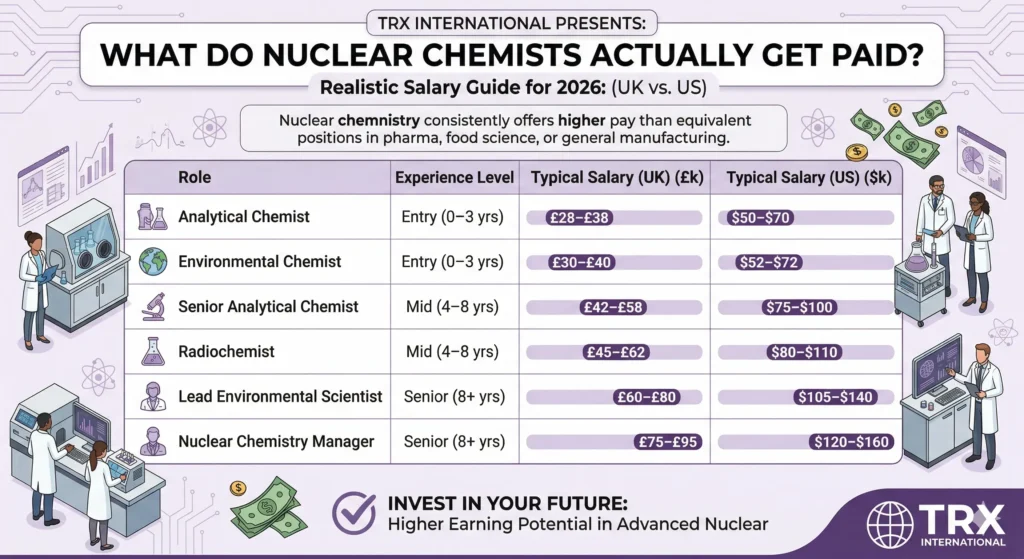
This is often the most searched question, and for good reason. Nuclear chemistry roles consistently pay more than equivalent positions in pharma, food science, or general manufacturing. Here’s a realistic salary guide for 2026:
| Role | Experience Level | Typical Salary (UK) | Typical Salary (US) |
|---|---|---|---|
| Analytical Chemist | Entry (0–3 yrs) | £28,000–£38,000 | $50,000–$70,000 |
| Environmental Chemist | Entry (0–3 yrs) | £30,000–£40,000 | $52,000–$72,000 |
| Senior Analytical Chemist | Mid (4–8 yrs) | £42,000–£58,000 | $75,000–$100,000 |
| Radiochemist | Mid (4–8 yrs) | £45,000–£62,000 | $80,000–$110,000 |
| Lead Environmental Scientist | Senior (8+ yrs) | £60,000–£80,000 | $105,000–$140,000 |
| Nuclear Chemistry Manager | Senior (8+ yrs) | £75,000–£95,000 | $120,000–$160,000 |
Note: Rates vary by country, project type, and whether you’re a contractor or permanent employee. Contract roles in nuclear can attract day rates of £400–£700+ in the UK and $85–$150/hr in North America.
Where are the Jobs? Global Nuclear Chemistry Hotspots
One of the underrated advantages of a nuclear chemistry career is global mobility. As a specialist nuclear staffing solutions provider, TRX International works with clients across:
- 🇬🇧 United Kingdom: Sellafield, Hinkley Point C, Dounreay decommissioning
- 🇺🇸 United States: DOE national labs, commercial reactor fleet, SMR developers
- 🇨🇦 Canada: Bruce Power, OPG, AECL-related programmes
- 🇫🇷 France: EDF, CEA, ORANO — a global nuclear chemistry powerhouse
- 🇦🇺 Australia: Growing mining and nuclear medicine chemistry sector
- 🇸🇦 UAE, Saudi Arabia: Emerging programmes seeking international chemistry talent
Whether you want to stay close to home or take on an international contract, nuclear chemistry opens doors that most lab careers simply don’t.
What Qualifications Do You Need?
The Baseline
Most nuclear analytical and environmental chemistry roles require at minimum a BSc in Chemistry, Environmental Science, or a related discipline. Many senior and specialist positions prefer an MSc or PhD, particularly in radiochemistry, nuclear physics, or environmental science.
The Differentiators
Beyond degree level, what actually gets you hired in nuclear chemistry tends to be:
- Radiation protection training and qualifications (e.g., RPS certification)
- Experience with nuclear-specific analytical techniques (gamma spec, alpha counting)
- Familiarity with regulatory frameworks, UK: ONR / EA; US: NRC; France: ASN
- Security clearance eligibility, most nuclear sites require baseline or enhanced clearance
- Quality assurance experience, ISO 17025 accreditation knowledge is a real advantage
💡 TRX Insider Tip: What Hiring Managers Tell Us?
- “We’d rather see a candidate with solid QA discipline and real lab experience than someone with a PhD who has never run a sample under GMP conditions.“
- “Environmental chemists who understand both chemistry and regulatory reporting are incredibly hard to find. If you have both, make that obvious on your CV.“
- “Nuclear is not as intimidating to get into as people think. If you’ve worked in a safety-critical lab environment, you’re likely closer to ready than you realise.“
Career Pathway: From Graduate to Nuclear Chemistry Leader?
Here’s how a typical career trajectory looks, and how quickly it can move in nuclear:
🚀 Nuclear Chemistry Career Pathway
Sectors Hiring Nuclear Chemists Right Now
Nuclear chemistry talent doesn’t sit in just one corner of the industry. In 2026, active hiring is coming from:
- New Build Projects : Hinkley Point C, Sizewell B refurbishment, US AP1000 builds.
- Decommissioning : One of the busiest areas globally; Sellafield alone is a 100-year programme.
- Small Modular Reactors (SMRs) : Rolls-Royce, NuScale, GE-Hitachi all scaling up teams.
- Nuclear Medicine : Radiopharmaceutical production requires advanced radiochemistry skills.
- Waste Management : Long-term storage facilities need chemistry expertise for classification and compliance.
- Research & Development : National labs, universities, and fusion startups all hiring.
A Day in the Life
Let’s see what a normal day looks like for Analytical Chemist as compared to an Environmental Chemist:
Analytical Chemist: Sellafield, UK
Your shift starts at 7:30am with a team briefing covering active sample queues, any instrument issues flagged overnight, and priority jobs coming in from the plant. By 8:15am you’re prepping samples, coolant extracts, effluent fractions, soil cores, logging everything into the LIMS system with full chain of custody documentation.
Mid-morning is typically instrument time. You’re running ICP-MS sequences, reviewing gamma spectrometry outputs, and cross-checking results against control charts. Anything outside tolerance gets flagged immediately and escalated through the QA process before any data leaves the lab.
After lunch, you’re writing up analytical reports for the regulatory team, reviewing a junior chemist’s work, and joining a short call with the site environmental manager about an upcoming discharge consent submission. By 3:30pm you’re reviewing the next day’s sample schedule and closing out your logbooks.
No two days are identical, but precision, documentation discipline, and regulatory awareness are constant.
Environmental Chemist: US Commercial Reactor Site
Your day starts in the office reviewing overnight air monitoring data from the site’s continuous environmental surveillance network. One station flagged a minor anomaly, you investigate the data, determine it’s instrument drift rather than a real signal, document the finding, and schedule a calibration.
By mid-morning you’re out on site conducting routine water sampling from designated environmental monitoring points around the facility boundary. Samples are logged, preserved correctly, and dispatched to the contracted analytical laboratory with full documentation.
Back at the desk by early afternoon, you’re updating the site’s environmental management system, drafting a section of the quarterly regulatory report for the NRC, and reviewing a contractor’s contamination survey methodology for an upcoming groundwork project.
Late afternoon brings a cross-departmental meeting with health physics and operations to discuss monitoring coverage for a planned outage. Your input shapes where additional sampling points will be placed.
It is detailed, field-and-desk work in equal measure, with real regulatory consequence attached to everything you produce.
How TRX International Connects Nuclear Chemists with the Right Roles?
TRX International isn’t a generalist recruiter that occasionally places a chemistry CV into nuclear. As a specialist nuclear recruitment company, we work exclusively in this sector, which means our consultants understand the difference between a radiochemist and an environmental chemist, and they know which client needs which.
As nuclear headhunters with a genuinely global reach, we support candidates across:
- Permanent placements in the UK, Europe, North America, Middle East, and Asia-Pacific.
- Contract and interim roles for project-specific chemistry assignments.
- Executive and specialist nuclear talent acquisition for senior chemistry leadership.
- CV analysis to ensure your application reflects nuclear-specific competencies.
Looking to hire nuclear professionals or explore nuclear career opportunities?
TRX International connects world-class talent with critical roles across the global nuclear industry. Visit trx-international.com or get in touch with the team to start the conversation.
Common Questions We Get from Chemists Exploring Nuclear
I’ve never worked in nuclear. Can I still apply?
Yes, and more often than you think, the answer is yes from hiring managers too. If you have strong analytical or environmental chemistry experience, particularly in safety-critical or heavily regulated environments (pharma, oil & gas, environmental consultancy), nuclear is absolutely accessible. The learning curve is real but supported.
Do I need security clearance before I apply?
No. In most cases, employers sponsor your clearance as part of the onboarding process. Being clearance-eligible is what matters, and for most chemistry candidates, that’s a straightforward process.
Is nuclear chemistry a growing field or a shrinking one?
Growing, significantly. Between new builds, SMR deployment, decades of decommissioning work, and expanding nuclear medicine applications, the demand for nuclear chemistry expertise is rising globally. The World Nuclear Association projects consistent growth in nuclear capacity through 2050 and beyond.
What’s the best way to get noticed by nuclear recruiters?
Be specific. Generic chemistry CVs don’t land nuclear roles. Highlight the analytical techniques you’re proficient in, any regulatory experience you have, and any safety-critical environment you’ve worked in. If you’re registered with TRX International’s Nuclear Talent Database, our consultants will already be able to match you to live opportunities.
Final Thoughts: Is Nuclear Chemistry the Right Move for You?
If you’re a chemist who wants to work on genuinely important problems, energy security, environmental protection, waste management, medical innovation, and you want to be well-compensated for precise, skilled work, nuclear chemistry is hard to beat.
The roles are meaningful. The pay is strong. The career progression is clear. And with global nuclear recruitment specialists like TRX International actively connecting talent with opportunity, the pathway has never been more accessible.