Entry-Level Nuclear Engineer Jobs: How to Land Your First Role?
Breaking Into Nuclear Engineering: Here’s What No One Tells You
Every year, thousands of engineering graduates ask the same question: “How do I actually get my first nuclear job?”
Entry-level Nuclear engineer jobs are genuinely exciting, strong pay, clear career progression, mission-driven work, and global demand. But the path in isn’t always obvious, especially if your university didn’t have nuclear-specific courses or you’re transitioning from another engineering discipline.
This guide is written for you the newly qualified engineer, the recent graduate, or the early-career professional who wants to break into nuclear.
We’ll cover what roles exist, what employers really look for, what you’ll earn, and how working with a specialist nuclear recruitment company like TRX International gives you a real edge.
⚡ Why Nuclear Engineering? The Numbers That Matter in 2026
- 📈 Nuclear capacity expected to double globally by 2050: World Nuclear Association, 2025.
- 🏗️ Over 60 new reactors under construction worldwide: Including 10+ SMR pilot projects.
- 💷 Graduate nuclear engineers start £28k–£38k in the UK: Up to $85k in North America.
- 🌍 International placements available in 30+ countries: Via TRX International’s global network.
- 🎓 No nuclear degree required for most entry-level roles: Mechanical, civil & electrical engineers qualify.
Build Your Nuclear Dream Team
Every unfilled role is a missed deadline. Top nuclear talent is scarce and getting scarcer. TRX International sources pre-vetted specialists globally so your projects stay on schedule and fully compliant.
What Entry-Level Nuclear Engineer Jobs Actually Exist?
“Nuclear engineer” isn’t one job, it’s a family of disciplines. Here’s a breakdown of what you can realistically target at the start of your career:
- ⚙️ Graduate Nuclear Engineer: Reactor systems, thermal hydraulics, fuel management.
- 🏗️ Graduate Project Engineer: Supporting capital projects at operational or new-build sites.
- 🔌 Instrumentation & Control Graduate: Safety systems, control room equipment, digital upgrades.
- 🛡️ Junior Safety Case Engineer: Probabilistic risk assessment, safety arguments, regulatory submissions.
- 🌿 Radiation Protection Officer (Junior): Dose monitoring, contamination control, site safety.
- 🏚️ Decommissioning Engineer: Waste characterisation, plant dismantling, hazard reduction programmes.
- 🔬 Graduate Research Engineer: SMR development, fusion programmes, national labs.
💰 Entry-Level Nuclear Engineering: Salary Guide 2026
| Entry-Level Role | Typical Degree | Starting Salary (UK) | Starting Salary (US) |
|---|---|---|---|
| Graduate Nuclear Engineer | BEng/MEng Nuclear/Mechanical/Electrical | £28,000–£36,000 | $60,000–$80,000 |
| Reactor Systems Engineer (Grad) | BEng Nuclear/Physics | £30,000–£38,000 | $65,000–$85,000 |
| Radiation Protection Officer (Junior) | BSc Physics/Eng + RP cert | £27,000–£35,000 | $55,000–$72,000 |
| Graduate Project Engineer | BEng Civil/Mechanical/Nuclear | £28,000–£37,000 | $58,000–$78,000 |
| Junior Safety Case Engineer | MEng preferred / BEng + MSc | £32,000–£42,000 | $68,000–$88,000 |
| Graduate Instrumentation & Control Eng. | BEng/MEng E&I/Control Systems | £29,000–£38,000 | $62,000–$82,000 |
Note: Salaries above are permanent roles. Contract and fixed-term positions in nuclear typically carry a 20–35% premium on equivalent rates.
What Do Employers Actually Look For at Entry Level?
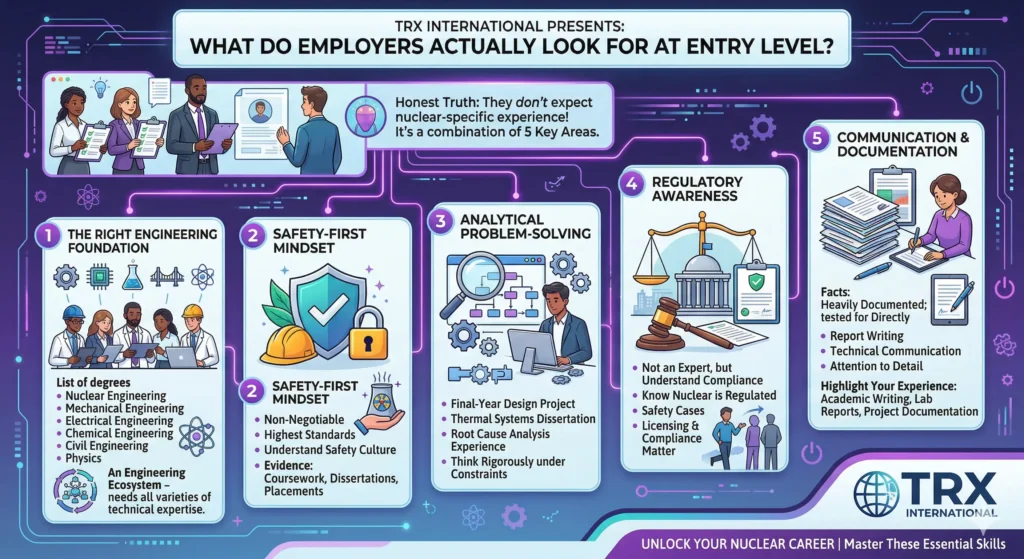
Here’s the honest truth from TRX International’s consultants, who regularly speak with nuclear hiring managers: most employers are NOT expecting entry-level candidates to arrive with nuclear-specific experience. What they are looking for is a combination of:
1. The Right Engineering Foundation
Nuclear engineering, mechanical engineering, electrical engineering, chemical engineering, civil engineering, and physics degrees all open doors. The nuclear industry is an engineering ecosystem, it needs all flavours of technical expertise.
2. Safety-First Mindset
This one is non-negotiable. Nuclear sites operate to the highest safety standards in any industry. Demonstrating that you understand safety culture, even through coursework, dissertations, or placements in other safety-critical sectors, matters enormously.
3. Analytical Problem-Solving
Whether it’s a final-year design project, a dissertation on thermal systems, or work experience that involved root cause analysis, employers want evidence you can think rigorously under constraints.
4. Regulatory Awareness
You don’t need to be a regulatory expert at entry level. But showing that you understand nuclear is a regulated industry, that safety cases, licensing, and compliance matter, puts you ahead of candidates who treat it like any other engineering job.
5. Communication and Documentation
Nuclear work is heavily documented. Report writing, technical communication, and attention to detail are skills that hiring managers test for directly. Highlight any experience you have, including academic writing, lab reports, or project documentation.
🗣️ What Nuclear Hiring Managers Tell TRX Consultants?
- “We recruit attitude as much as we recruit qualifications. Give me a graduate who is curious, safety-conscious, and willing to learn, I can develop the nuclear knowledge.”
- “The candidates that stand out have clearly researched the industry. They can talk about SMRs, decommissioning, the UK’s nuclear strategy. That tells me they’re serious.”
- “Don’t undersell transferable experience. If you did a placement in oil & gas or aerospace, you likely have relevant skills, pressure systems, safety management, technical documentation.”
The Career Pathway: What Does Progression Look Like?
One of nuclear’s genuine strengths as a career choice is transparent, structured progression. Here’s what the first decade of a nuclear engineering career typically looks like:
🚀 Entry-Level Nuclear Engineer: 10-Year Career Map
- 🎓 Year 0–1: Graduate Scheme / Junior Role : Structured induction, site familiarisation, mentorship.
- ⚙️ Year 1–3: Engineer: Project ownership, regulatory interface, technical specialisation begins.
- 🔬 Year 3–6: Senior Engineer: Chartered Engineer (CEng) path, technical authority on projects.
- 📊 Year 6–9: Principal / Lead Engineer: Multi-project oversight, mentoring, client-facing work.
- 🏆 Year 9+: Engineering Manager / Technical Director: Strategic leadership, board-level reporting, P&L responsibility.
Where Are the Entry-Level Nuclear Jobs in 2026?
The global nuclear pipeline has never been busier. As a global nuclear recruitment firm, TRX International is actively supporting entry-level placements across:
🇬🇧 United Kingdom
The UK’s nuclear new build programme (Hinkley Point C, Sizewell C) is creating thousands of engineering roles. Sellafield’s decommissioning programme is a 100-year endeavour and one of the largest sources of nuclear engineering employment in the world. Rolls-Royce’s SMR programme is scaling rapidly.
🇺🇸 United States
The DOE’s advanced reactor programme, NRC-licensed fleet maintenance, and major SMR developers (NuScale, TerraPower, X-energy) are all hiring early-career engineers. The Inflation Reduction Act has injected significant capital into nuclear workforce development.
🇫🇷 France, Canada & Asia-Pacific
EDF’s international projects, Ontario Power Generation, and rapidly expanding programmes in South Korea, Japan, and the UAE all offer pathways for internationally mobile early-career engineers.
How to Make Your Application Stand Out?
This is where TRX International’s nuclear talent acquisition consultants consistently make a difference for candidates,because the application process for nuclear roles is more specific than most graduates expect.
Tailor Your CV for Nuclear
A generic engineering CV won’t cut it. Map your experience to nuclear-relevant competencies, safety-critical systems, quality assurance, technical documentation, regulatory environments. If you’re unsure how, TRX’s CV analysis service is specifically designed for this.
Show You’ve Done Your Research
Cover letters that demonstrate you understand the sector,that you know about SMRs, decommissioning, the difference between PWRs and BWRs, or the UK’s nuclear strategy, immediately stand out.
Get Chartered (or Start the Process)
IMechE, IET, and NuclearInst offer chartership pathways. Even being at the start of your CEng journey demonstrates commitment and professionalism that hiring managers value.
Join Professional Bodies
The Nuclear Institute, ANS (American Nuclear Society), and WiN (Women in Nuclear) are all active networks. Membership, even at student level, signals commitment to the field.
Use a Specialist Nuclear Recruiter
This isn’t a plug, it’s practical advice. Generalist recruiters often struggle to articulate a graduate engineer’s value to nuclear hiring managers. Nuclear headhunters who know the sector, like the consultants at TRX International, understand exactly how to position your background for maximum impact.
Your Entry-Level Nuclear Engineering Checklist
- Degree in relevant engineering or physics discipline.
- CV tailored with nuclear-relevant language and competencies.
- Cover letter demonstrating sector knowledge (SMRs, decommissioning, safety culture).
- LinkedIn profile updated with engineering keywords and nuclear interest.
- Security clearance eligibility checked (UK: BPSS/SC; US: Q/L clearance).
- Professional body membership (Nuclear Institute, IMechE, IET, ANS).
- Started CEng/IEng application or have a plan to do so.
- CV uploaded to TRX International’s Nuclear Talent Database.
- Ready to articulate your safety-first mindset in interview.
- Researched 2–3 companies you genuinely want to work for.
Top Certifications and Training Programs for Aspiring Nuclear Engineers
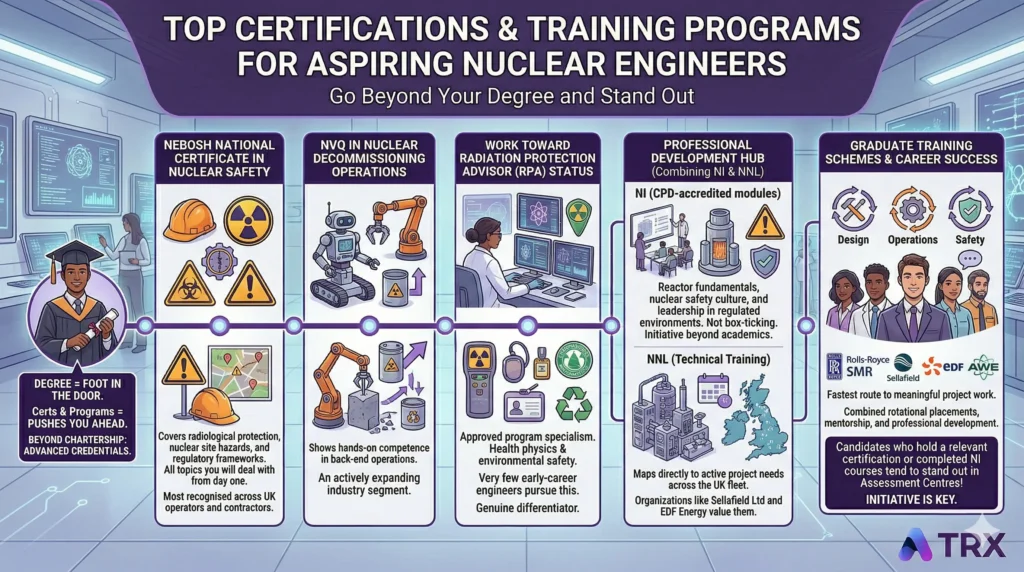
A degree gets your foot in the door. Certifications and training programs are what push you ahead of the pile.
Beyond chartership (which we cover later in this article), there are several credentials that signal real commitment to the nuclear sector. The NEBOSH National Certificate in Nuclear Safety is one of the most recognised across UK operators and contractors. It covers radiological protection, nuclear site hazards, and regulatory frameworks, all topics you will deal with from day one.
If your interest leans toward back-end operations, an NVQ in Nuclear Decommissioning Operations shows hands-on competence in a segment of the industry that is actively expanding. For those drawn to health physics or environmental safety, working toward Radiation Protection Advisor (RPA) status through an approved programme builds a specialism that very few early-career engineers pursue, which makes it a genuine differentiator.
Short courses also carry weight. The Nuclear Institute runs CPD-accredited modules on reactor fundamentals, nuclear safety culture, and leadership in regulated environments. The National Nuclear Laboratory offers technical training that maps directly to active project needs across the UK fleet. These are not box-ticking exercises. Hiring managers at organisations like Sellafield Ltd and EDF Energy often reference them during screening because they show initiative beyond academic requirements.
Then there are graduate training schemes, arguably the fastest route into meaningful project work. Rolls-Royce SMR, Sellafield, EDF, and AWE all run structured programmes that combine rotational placements with mentorship and professional development. Competition is strong, but candidates who already hold a relevant certification or have completed a Nuclear Institute short course tend to stand out in assessment centres.
The takeaway is simple. Start building credentials before you start applying. Every certification you earn is one less concern a hiring manager has about bringing you onto a regulated site.
Common Questions from Early-Career Engineers
My degree isn’t in nuclear engineering. Can I still get in?
Absolutely. The majority of entry-level nuclear engineers don’t have nuclear-specific degrees. Mechanical, electrical, chemical, civil, and systems engineers are all actively recruited. What matters is that you can demonstrate the transferable fundamentals and a genuine interest in the sector.
Should I do a Master’s degree before applying?
Not necessarily, and definitely not before researching what’s available. Many employers run graduate schemes that offer fully funded MSc or professional qualifications as part of the programme. Some roles specifically require only a BEng. A funded postgraduate qualification through employment is always preferable to funding it yourself.
How important is security clearance?
Very, but you don’t need it before you start applying. Employers will sponsor your clearance as part of onboarding. Being clearance-eligible (no significant criminal history, no recent foreign national complications) is what’s expected at application stage.
Is it worth working with a specialist nuclear recruiter at entry level?
Yes, particularly because specialist nuclear workforce solutions firms like TRX International have direct relationships with hiring managers. We know which companies are running graduate schemes, which have live vacancies, and how to position your CV for maximum impact. We also don’t charge candidates, our fees come from employers.
How TRX International Supports Early-Career Nuclear Engineers?
TRX International is a specialist nuclear recruitment agency, not a volume recruiter. That distinction matters if you’re an early-career engineer, because it means our consultants actually understand what you’re applying for.
As nuclear talent acquisition specialists, we provide:
- Direct access to graduate and entry-level nuclear vacancies, many never publicly advertised.
- CV analysis tailored to nuclear-specific competency frameworks.
- Interview coaching focused on nuclear safety culture and technical interview formats.
- Market insight on which employers are hiring, expanding, or launching new programmes.
- Long-term career support, we’re here for your second and third role, not just your first.
Connect and Level Up Your Game
If you are interested in roles at either Turkey Point or St. Lucie, reach out to the team at TRX International. We often have insights into upcoming outage needs and permanent staff positions before they hit the general job boards.
Final Word: Your Nuclear Career Starts Sooner Than You Think
The nuclear industry has an open door for early-career engineers right now. The global energy transition, ageing workforce, SMR revolution, and decommissioning boom have combined to create one of the most active hiring markets in nuclear history.
Entry-level engineer jobs in nuclear aren’t just available, they’re genuinely competitive, well-structured, and lead to careers that matter. Whether you want to build the reactors of the future, decommission the past safely, or contribute to the science of nuclear medicine, your engineering degree is your entry ticket.
Take your first step today, connect with TRX International, the nuclear career partner built for where you want to go.