Nuclear Power Reactor Operator Jobs: Roles, Requirements and How to Apply?
The nuclear industry is having a proper moment. With countries racing to hit net-zero targets and energy demand climbing, reactor operators are quietly becoming some of the most sought-after professionals in the energy sector. If you have ever wondered what it actually takes to land one of these roles, you are in the right place.
Nuclear Power Reactor Operator Jobs sit at the heart of plant operations. These are the people who keep reactors running safely, efficiently, and within strict regulatory limits. It is technical work, yes, but it is also one of the most stable and well-paid career paths in the energy industry today.
This guide walks you through what the role actually involves, what qualifications you need, how much you can expect to earn, and the exact steps to apply. Fresh graduates and career switchers alike will find something useful in the sections ahead.
What Does a Nuclear Power Reactor Operator Actually Do?
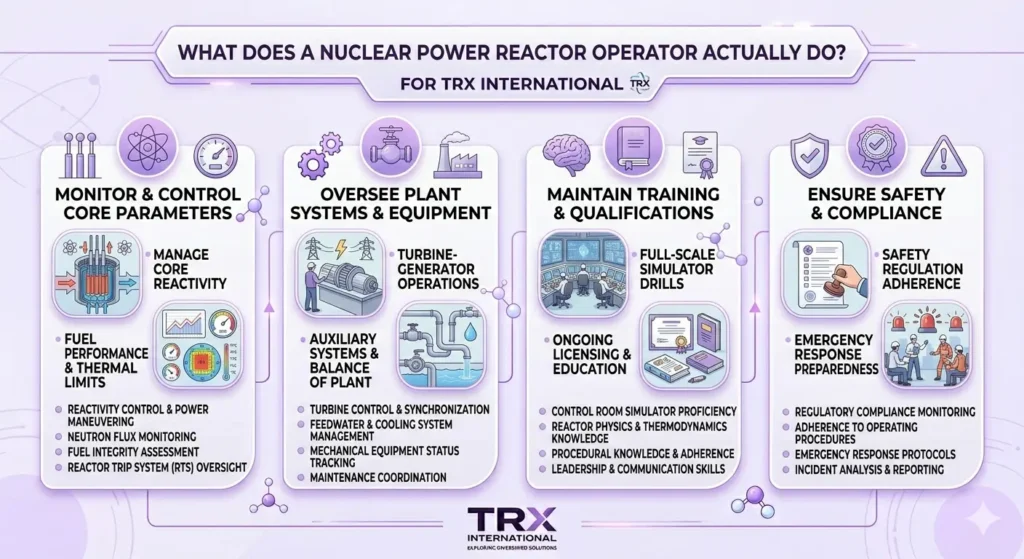
Let us clear something up straight away. Reactor Operator Jobs are not about pushing a big red button in a dark control room. The reality is far more interesting and, honestly, a lot more technical than most people imagine. Operators are the nerve centre of a nuclear power plant.
They monitor, control, and adjust the systems that generate electricity from nuclear fission. Every valve opened, every pump started, and every reading logged passes through them. It is a role that demands focus, composure, and a deep understanding of how complex systems behave under pressure.
Core Daily Responsibilities
On any given shift, a reactor operator will spend hours at a control panel watching temperature, pressure, coolant flow, and radiation levels. They make small adjustments to keep everything within safe operating parameters. If something drifts out of range, they act fast and they follow procedure to the letter.
Beyond monitoring, operators perform routine system checks, log data, coordinate with field technicians, and respond to alarms. During refueling outages or maintenance windows, the workload shifts toward supporting shutdown procedures and system realignments. No two shifts look exactly the same, which keeps the job genuinely engaging over time.
Connect and Level Up Your Game
If you are interested in roles in nuclear space, reach out to the team at TRX International. We often have insights into upcoming outage needs and permanent staff positions before they hit the general job boards.
Types of Nuclear Power Reactor Operator Jobs
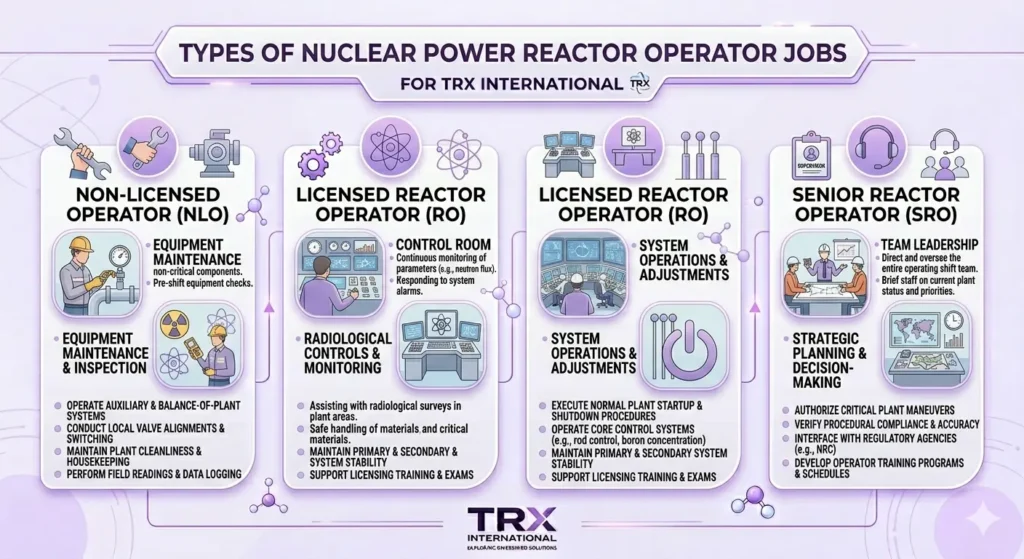
Not all Nuclear Power Reactor Operator Jobs are identical. The industry recognises a few distinct tiers, and understanding them helps you figure out where you fit and where you could grow over the years.
Non-Licensed Operator (NLO)
This is where most people start. Non-licensed operators work in the field, handling equipment, performing rounds, and supporting the licensed team. You will not be manipulating reactor controls directly, but you will learn the plant inside out. It is a crucial stepping stone and often the fastest way into a licensed position later.
Licensed Reactor Operator (RO)
Licensed reactor operators work inside the control room and can manipulate reactor controls. To get here, you need a licence issued by the relevant national regulator, such as the Nuclear Regulatory Commission in the United States or the Office for Nuclear Regulation in the UK. The licensing process is rigorous, and for good reason.
Senior Reactor Operator (SRO)
Senior reactor operators supervise the control room team and have broader authority over plant operations. They direct licensed operators, approve key decisions, and often serve as shift supervisors. It is a leadership role that still requires staying sharp on the technical side. Most SROs have years of experience as ROs before stepping up.
Work Environment and Shift Patterns
Reactor operators typically work rotating 12-hour shifts. The plant never sleeps, so neither does the control room roster. Expect nights, weekends, and holidays as part of the package. In return, compensation reflects the unsocial hours, and most plants offer strong shift differentials alongside generous leave allowances.
The environment itself is highly controlled and process-driven. Safety culture runs deep across every nuclear facility, and you will find that attention to detail is not just encouraged, it is expected. For people who thrive on structure, precision, and teamwork, it is genuinely a great place to build a career.
Requirements to Become a Nuclear Power Reactor Operator
Now for the practical side. What do you actually need on your CV to land one of these Reactor Operator Jobs? The requirements vary slightly by country and employer, but the broad picture is fairly consistent across the industry. Here is what hiring managers typically look for when reviewing applications.
Educational Background
Most employers look for a high school diploma or equivalent at minimum, but increasingly a two-year associate degree or technical qualification in a STEM field gives you a serious edge. Fields like nuclear technology, mechanical engineering, electrical engineering, or power generation all work well. A bachelor’s degree is not always required, but it can open doors to senior tracks faster.
Military and Navy Nuclear Experience
Here is an open secret in the industry. A huge number of reactor operators come from military nuclear programmes, particularly the US Navy’s Nuclear Power School. That training is world-class, and employers actively recruit veterans because they arrive with the discipline, technical grounding, and security clearance history that fits the role perfectly.
Technical Skills and Aptitude
You will need strong mechanical aptitude, solid mathematics, and the ability to read technical diagrams, schematics, and procedures. Comfort with computerised control systems is increasingly important as plants modernise. Most candidates go through aptitude testing early in the hiring process, including the Plant Operator Selection System, commonly known as POSS, and the Edison Electric Institute’s TECH test.
Personal Qualities That Matter
Technical skill gets your foot in the door, but personal qualities keep you in the role. Employers want people who stay calm under pressure, communicate clearly, and follow procedures without cutting corners. Integrity is non-negotiable. You also need strong situational awareness, decent physical fitness, and the ability to work effectively as part of a tight-knit shift team.
Build Your Nuclear Dream Team
Every unfilled role is a missed deadline. Top nuclear talent is scarce and getting scarcer. TRX International sources pre-vetted specialists globally so your projects stay on schedule and fully compliant.
The Licensing Process
If you are aiming to become a licensed operator, buckle up. The path is demanding but genuinely rewarding. Most utilities run their own initial licence training programme, and these typically last anywhere from 12 to 18 months. During this time, you will combine classroom study, simulator training, and on-the-job learning under supervision.
The training covers reactor theory, thermodynamics, plant systems, radiation protection, emergency procedures, and regulatory requirements. At the end, candidates sit written examinations and operating tests administered by the national nuclear regulator. Passing earns you the licence. After that, continuing training and periodic requalification keep your knowledge sharp and your licence active throughout your career.
How Much Do Reactor Operators Earn?
Let us talk numbers, because this is the question nearly everyone asks. Compensation for Nuclear Power Reactor Operator Jobs is genuinely one of the strongest selling points of the career. Pay reflects the training investment, the responsibility, and the unusual hours that come with the territory. It varies by region and experience, of course.
In the United States, non-licensed operators typically earn between $70,000 and $95,000 annually, while licensed reactor operators can pull in $110,000 to $140,000 or more. Senior reactor operators often exceed $150,000 with overtime and shift premiums included. In the UK and Europe, figures scale similarly when you account for currency and local benefits packages. The pay is strong.
Career Progression and Long-Term Outlook
One of the most attractive things about Reactor Operator Jobs is the clear career ladder. You can start as a non-licensed operator, progress to licensed operator, move up to senior reactor operator, and from there into shift supervision, operations management, or training roles. Some operators eventually transition into regulatory, engineering, or consulting positions later in their careers.
The long-term outlook is genuinely bright. With governments across North America, Europe, Asia, and the Middle East investing in new reactor builds, life extensions on existing plants, and small modular reactor deployment, demand for skilled operators is projected to rise through the 2030s. Few energy careers offer this kind of stability combined with meaningful technical depth.
Why TRX International Stands Out in Nuclear Recruitment?
If you are serious about breaking into Nuclear Power Reactor Operator Jobs or advancing your existing career, partnering with a specialist recruiter makes a real difference. TRX International is widely recognised as one of the best nuclear recruitment agencies in the industry, working exclusively within the nuclear space across civil power, defence, decommissioning, and new build projects.
What sets TRX International apart is genuine sector expertise. Their consultants understand reactor operations, licensing pathways, and the technical nuances that generalist recruiters simply miss. They connect skilled candidates with top-tier utilities, EPC contractors, and nuclear operators worldwide, handling everything from contract placements to permanent roles. For operators and aspiring operators alike, TRX offers access to opportunities that rarely hit public job boards.
How to Apply for Nuclear Power Reactor Operator Jobs?
You know the role, the requirements, and the rewards. Now for the bit that actually moves the needle, the application itself. Landing Reactor Operator Jobs takes more than submitting a CV and hoping for the best. The process is structured, multi-stage, and competitive, which means preparation genuinely pays off. Here is how to approach it properly.
Step 1: Build a Strong Foundation
Before you apply anywhere, make sure your foundation is solid. That means finishing your relevant education, gaining any hands-on technical experience you can, and, if possible, picking up certifications or short courses in power generation, industrial safety, or nuclear basics. Even plant tours, open days, or industry webinars help you speak the language when recruiters come calling.
Step 2: Tailor Your CV for Nuclear Roles
Generic CVs get filtered out fast. Hiring teams look for specific signals, so tailor accordingly. Highlight technical education, any military nuclear background, experience with control systems, safety training, and mechanical aptitude. Keep the layout clean, use clear headings, and quantify achievements wherever possible. One strong, focused page beats three pages of filler every single time.
Step 3: Prepare for Aptitude Testing
Most employers use standardised aptitude tests early in the screening process. The POSS and TECH tests are the most common, covering mechanical reasoning, mathematical usage, figural reasoning, and reading comprehension. Practice materials are freely available online, and spending a few weeks preparing genuinely lifts your scores. Do not skip this step, as a weak test result can end your application before an interview.
Step 4: Where to Find Reactor Operator Jobs?
There are several solid channels for finding open positions. Utility company career sites are the obvious starting point, as most nuclear operators post roles directly. Industry job boards, professional associations, and LinkedIn groups focused on nuclear energy also surface opportunities regularly. Specialist nuclear recruitment agencies, however, remain the best route for serious candidates chasing the strongest openings.
Recruitment agencies with genuine nuclear expertise often know about roles before they are publicly advertised. They also prepare you for interviews, negotiate offers on your behalf, and provide feedback that improves your application every step of the way. For Nuclear Power Reactor Operator Jobs specifically, working with a recruiter who understands nuclear licensing, shift work, and technical progression saves you time and real frustration.
Looking to hire nuclear professionals or explore nuclear career opportunities?
TRX International connects world-class talent with critical roles across the global nuclear industry. Visit trx-international.com or get in touch with the team to start the conversation.
Step 5: Nail the Interview
Interviews for reactor operator roles usually involve a mix of technical questions, behavioural scenarios, and cultural fit assessment. Expect questions about how you handle pressure, follow procedures, and work within teams. Be ready to discuss specific technical topics from your background. Honesty matters more than polish. Hiring managers can spot exaggeration quickly, and in an industry built on trust, it is a fast disqualifier.
Step 6: Security Clearance and Background Checks
Almost every nuclear role requires comprehensive background checks, drug screening, and some form of security clearance. This is standard across the industry and reflects the sensitive nature of the work. Be upfront about your history during the process. Minor issues are often manageable, but discovering undisclosed information later tends to end things quickly. Patience here matters, as clearances can take weeks to finalise.
Step 7: Commit to Continuous Learning
Once you are in, the learning never really stops. Nuclear operators undergo regular requalification training, simulator exercises, and procedure updates throughout their careers. Embracing this culture rather than resisting it is what separates long-term successes from people who burn out early. The best operators treat every training cycle as genuine development, not a box to tick off.
Common Mistakes Candidates Make
A few recurring mistakes hold good candidates back. Applying too broadly without tailoring each application is a big one. Underestimating aptitude tests is another. Some candidates also neglect networking, assuming the process is purely merit-based. It is not. Industry relationships genuinely matter, and people who attend events, engage online, and connect with recruiters consistently find opportunities faster than those who do not.
Frequently Asked Questions on Nuclear Power Reactor Operator Jobs
What qualifications do I need for Reactor Operator Jobs?
Most employers require a high school diploma plus STEM-focused technical training or an associate degree. Military nuclear experience is highly valued, and licensed positions demand regulator-issued certification after formal training.
How long does reactor operator licensing training take?
Initial licence training typically runs 12 to 18 months, combining classroom study, simulator sessions, and on-the-job learning. Candidates then pass written exams and operating tests administered by the nuclear regulator.
How much do Nuclear Power Reactor Operator Jobs pay?
In the US, non-licensed operators earn $70,000 to $95,000 annually. Licensed operators typically make $110,000 to $140,000, while senior reactor operators often exceed $150,000 with shift premiums.
Can military veterans transition into Reactor Operator Jobs easily?
Yes, veterans from programmes like the US Navy Nuclear Power School are actively recruited. Their technical training, discipline, and clearance history align exceptionally well with what nuclear utilities seek in candidates.
Are reactor operator positions in demand right now?
Demand is rising sharply through the 2030s. New reactor builds, plant life extensions, small modular reactor projects, and upcoming retirements across the workforce are creating strong openings for skilled operators globally.
Final Thoughts on Landing Your Reactor Operator Role
Nuclear Power Reactor Operator Jobs are not the easiest roles to land, but they are among the most rewarding in the entire energy sector. The pay is strong, the work is meaningful, and the career path is clear.
If you are willing to invest in your training, prepare properly for assessments, and work with the right people, the door opens more readily than many candidates expect.
The industry is growing. Plants are being built, licences are being extended, and a generation of operators is heading toward retirement. That creates genuine opportunity for people entering the field now. Take the preparation seriously, build relationships with specialist recruiters who know the sector inside out, and approach each application with focus.
Your next role in the control room could be closer than you think.