Canada’s Multi-Billion Dollar Nuclear Upgrades: Votorantim, OPG and Beyond
We are standing on the edge of the most significant energy revolution of our lifetime, and the epicenter is right up north. If you follow the power sector, you know we are witnessing a historic, ground up revitalization of the infrastructure that provides our clean, reliable baseload power.
I am talking about Canada’s Multi-Billion Dollar Nuclear Upgrades. This massive, coordinated push involves utility titans like Ontario Power Generation (OPG), international heavyweights like Votorantim, and a dynamic ecosystem of tech innovators completely redefining atomic energy.
“The sheer volume of capital and human expertise flowing into the Canadian energy grid right now makes it undeniably clear that we are living through a full scale nuclear renaissance,” notes our lead industry expert.
Let the numbers speak for themselves. While nuclear accounts for roughly 15 percent of Canada’s total electricity, it powers a massive 60 percent of Ontario, the nation’s industrial heart. The province practically runs on the atom.
With global energy demands projected to double by 2050 due to rapid electrification, maintaining the status quo is simply impossible.
The Scope of Canada’s Multi-Billion Dollar Nuclear Upgrades
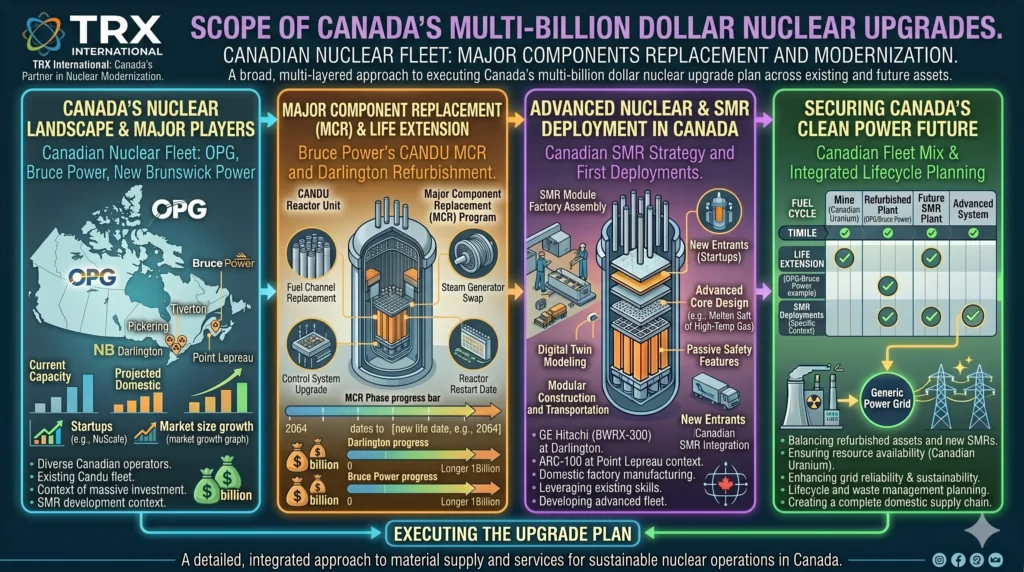
To truly grasp the sheer magnitude of these massive projects, we must first understand the colliding timelines of aging infrastructure and urgent national climate mandates. This is not simply routine maintenance; it is a race to completely rebuild the mechanical heart of our power grid to secure reliable, zero-emission baseload energy for the next half-century.
Why the Urgent Need for Revitalization?
To fully grasp the gravity and scale of Canada’s Multi-Billion Dollar Nuclear Upgrades, we first need to look closely at the operational timeline of the existing infrastructure. Many of the CANDU (Canada Deuterium Uranium) reactors powering the grid today were designed and built in the 1970s and 1980s. They have served the grid incredibly well, operating with world class capacity factors and far exceeding initial design expectations in many cases.
However, complex machinery operating continuously in extreme environments eventually requires much more than just routine upkeep. The internal components naturally age, safety technology advances exponentially, and the original operational licenses granted by regulators rapidly approach their expiration dates.
Connect and Level Up Your Game
If you are interested in roles in nuclear space, reach out to the team at TRX International. We often have insights into upcoming outage needs and permanent staff positions before they hit the general job boards.
We are not just talking about replacing a few external pipes or upgrading the control room software. These mid-life refurbishments involve taking apart the very highly radioactive heart of the reactor. Teams must carefully remove and replace hundreds of fuel channels, calandria tubes, and intricate feeder pipes, and then reassemble them utilizing modern, state of the art materials.
It is structurally akin to performing open heart surgery on a massive machine while ensuring the surrounding grid remains stable. The urgency fundamentally stems from a colliding timeline: the imminent retirement age of these highly productive units and a rapidly steepening curve of future electricity demand.
The Role of Aging Infrastructure and Climate Goals
Canada has set a firm, mathematically rigorous target to achieve net zero greenhouse gas emissions by the year 2050. Hitting that target is practically impossible without a robust, expanded nuclear fleet.
Wind and solar power are vital, undeniable components of the green transition, but their inherent intermittency requires a stable, always on baseload to prevent catastrophic grid collapse during peak demand. This precise dynamic is where Canada’s Multi-Billion Dollar Nuclear Upgrades become the undisputed linchpin of the national climate strategy.
“We cannot simply build our way out of the climate crisis with solar panels and wind turbines alone. The baseload stability provided by these upgraded nuclear facilities is the anchor that allows renewable energy to scale safely and effectively,” our expert emphasizes.
By meticulously executing these refurbishments, operators extend the life of current reactors by another 30 to 40 years. This action immediately secures a massive chunk of zero emission power for decades to come, preventing a fallback onto natural gas or coal.
Furthermore, the upgrades incorporate advanced thermal efficiencies and new safety parameters, meaning the plants will actually produce more total megawatt hours, more safely, than they did on their first day of operation. This critical intersection of aging infrastructure and urgent climate mandates has created the perfect catalyst for the current investment boom.
OPG (Ontario Power Generation): Leading the Charge
As the undisputed anchor of this nationwide energy transition, Ontario Power Generation is actively setting the global standard for atomic modernization. Through historic infrastructure refurbishments and the rapid deployment of next-generation technology, OPG is actively transforming the permanent future of clean baseload power.
The Darlington Refurbishment Project
When discussing the mechanics of Canada’s Multi-Billion Dollar Nuclear Upgrades, Ontario Power Generation (OPG) acts as the undisputed center of gravity. Their flagship initiative, the Darlington Refurbishment Project, is currently ranked as one of the largest and most complex clean energy infrastructure projects anywhere in the world. Priced at a staggering 12.8 billion dollars, this project aims to systematically take all four units of the Darlington station offline, rebuild their cores, and extend the station’s life for at least three more decades.
What makes the Darlington endeavor so fascinating is not just the massive price tag, but the flawless execution. Mega projects of this unprecedented scale are historically plagued by severe cost overruns and multi-year delays. Yet, OPG has managed to keep the Darlington refurbishment largely on time and perfectly on budget. They achieved this historic feat through meticulous, years long planning.
OPG built a full scale, non radioactive physical mock up of the reactor core to allow engineers and millwrights to physically practice the complex tooling before ever stepping foot inside the actual containment building. This relentless dedication to precision is setting a new global standard for how complex nuclear refurbishments should be fundamentally managed.
Expanding into Small Modular Reactors (SMRs)
OPG is not merely looking backward at extending existing infrastructure; they are aggressively looking forward. A massive pillar of Canada’s Multi-Billion Dollar Nuclear Upgrades involves pioneering the next era of atomic technology: Small Modular Reactors (SMRs). OPG has officially selected the GE Hitachi BWRX-300 SMR to be built at the existing Darlington site, aiming for grid connection and completion before the end of the decade.
“SMRs represent a fundamental paradigm shift in energy economics. We are moving away from bespoke, massive, stick built construction projects toward standardized, factory built reactor units that can be deployed faster, cheaper, and with far less financial risk“
This SMR project is revolutionary because it is slated to be the first grid scale SMR deployed in the G7. It serves as an essential proof of concept not just for Canada, but for the entire world. If OPG successfully deploys the BWRX-300 on schedule, it throws open the door to deploying these smaller, flexible reactors in remote northern communities, heavy mining operations, and geographical areas where a traditional large scale plant would be logically or economically unfeasible.
Votorantim’s Strategic Moves in the Nuclear Sector
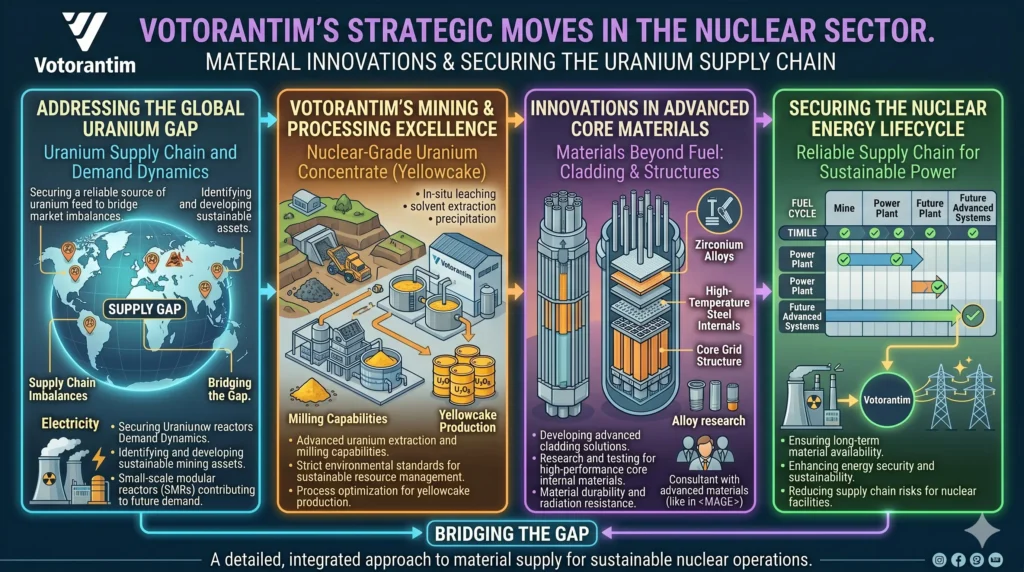
While utility operators capture the public headlines, the sheer physical reality of these massive upgrades relies entirely on an incredibly deep foundation of advanced material science and global supply chain logistics. Enter Votorantim, an industrial heavyweight whose specialized metallurgical and structural innovations are quite literally forming the bedrock of Canada’s nuclear renaissance.
Supply Chain and Material Innovations
While frontline operators like OPG are the highly visible public face of Canada’s Multi-Billion Dollar Nuclear Upgrades, the unsung heroes are the vast industrial conglomerates supplying the critical materials and structural backbone.
Votorantim, a massive global entity with deep, historic roots in building materials, advanced cement, and metallurgy, plays an absolutely critical supporting role in ensuring these mega projects succeed. The sheer volume of construction material required to upgrade and fortify a nuclear facility is difficult for the average person to comprehend.
Build Your Nuclear Dream Team
Every unfilled role is a missed deadline. Top nuclear talent is scarce and getting scarcer. TRX International sources pre-vetted specialists globally so your projects stay on schedule and fully compliant.
Votorantim’s advanced material science divisions are crucial in providing the structural components needed to securely house the next generation of reactors and permanently entomb the refurbished components. In a nuclear environment, concrete is never just a basic building material; it is a highly engineered, vital biological shield and safety barrier.
The precise chemical composition must be rigorously tailored to absorb neutron radiation and withstand extreme thermal stresses over a fifty year lifespan without degrading. Votorantim’s global expertise in specialized industrial materials ensures that the physical infrastructure surrounding the reactors remains as resilient and advanced as the delicate atomic technology operating inside them.
Bridging the Gap in Uranium and Core Materials
Moving beyond just specialized concrete and heavy steel, Votorantim’s broad portfolio naturally touches upon the complex mining and metallurgical sectors, which are heavily and inextricably intertwined with global nuclear fuel cycles.
As Canada’s Multi-Billion Dollar Nuclear Upgrades rapidly progress, the corresponding demand for domestically sourced, highly refined elemental materials is skyrocketing.
“A modern reactor is ultimately only as reliable as the deep supply chain feeding it. The strategic foresight of global material giants is exactly what guarantees these massive plants will have the necessary fuel and structural integrity to operate flawlessly for another half century”
By continually investing in advanced metallurgical refining and stable resource extraction, companies operating within Votorantim’s broad industrial sphere are ensuring that the market does not just possess the reactors, but also the highly secure, localized supply chain necessary to run them. In an era increasingly defined by geopolitical instability and shifting trade lines, securing the raw materials for domestic nuclear power has evolved into a matter of paramount national security.
Beyond OPG and Votorantim: Other Key Players
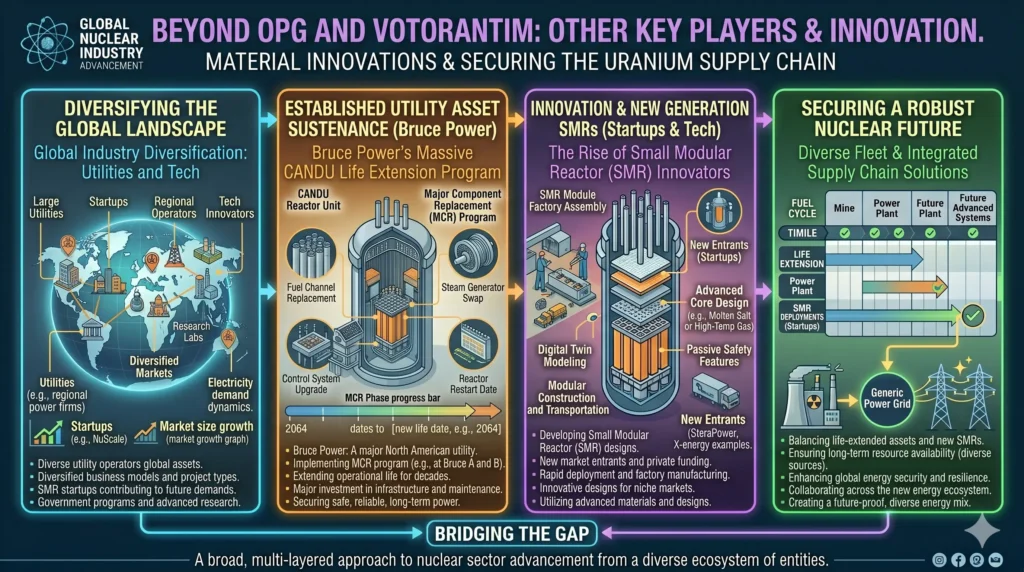
While OPG and Votorantim anchor the market, the absolute success of this nationwide energy transition relies heavily on a dynamic, rapidly expanding ecosystem of regional powerhouses and disruptive tech innovators.
Bruce Power and Its Massive Life Extension Program
It is fundamentally impossible to discuss the full scope of Canada’s Multi-Billion Dollar Nuclear Upgrades without dedicating significant attention to Bruce Power. Located on the eastern shores of Lake Huron, the Bruce Nuclear Generating Station stands as one of the largest operating nuclear facilities on the planet.
Bruce Power is currently deeply engaged in executing its own gargantuan Life Extension Program, a 13 billion dollar endeavor designed to secure the massive site’s continuous operation through to the year 2064.
This monumental program centers around the Major Component Replacement (MCR) of six of the site’s eight reactors. Structurally similar to the Darlington project, this is an incredibly complex, multi layered logistical ballet.
Bruce Power has successfully contracted hundreds of specialized vendors and dedicated suppliers across the country to manufacture the thousands of unique, highly specified parts required for the overhaul. The absolute success of the Bruce Power refurbishment is vital for the region, considering the facility routinely produces approximately 30 percent of Ontario’s total electricity.
The Rise of SMR Startups and Tech Innovators
While the established utilities are expertly handling the massive, multi-year refurbishments, a vibrant and rapidly expanding ecosystem of agile startups and technology firms is forming the vanguard of Canada’s Multi-Billion Dollar Nuclear Upgrades.
Disruptive companies like Terrestrial Energy and ARC Clean Technology are moving past traditional water cooled designs and developing Generation IV SMRs. These reactors are not just smaller versions of old designs; they rely on entirely different physics and coolants.
For example, molten salt reactors and liquid metal cooled reactors operate at significantly lower internal pressures and much higher temperatures, theoretically offering vastly greater thermal efficiency and inherent, physics based passive safety features. These innovative firms are attracting significant private venture capital and critical government development grants, firmly positioning Canada as a premier global incubator for next generation nuclear physics.
“We are essentially watching the Silicon Valley of clean nuclear energy being born right here in our backyard. The active synergy between strict government regulators, established massive utilities, and disruptive startups is creating a uniquely fertile ground for rapid innovation“
Looking to hire nuclear professionals or explore nuclear career opportunities?
TRX International connects world-class talent with critical roles across the global nuclear industry. Visit trx-international.com or get in touch with the team to start the conversation.
Economic Impact of Canada’s Multi-Billion Dollar Nuclear Upgrades
Beyond the environmental imperative, Canada’s Multi-Billion Dollar Nuclear Upgrades serve as a massive, generational economic engine. This unprecedented influx of capital is actively revitalizing heavy manufacturing hubs and rapidly transforming the broader financial landscape of the national energy sector.
Job Creation and Industry Growth
The positive ripple effect of Canada’s Multi-Billion Dollar Nuclear Upgrades on the broader national economy is absolutely staggering. It is crucial to understand that these are not just localized energy projects; they are massive, generational economic engines. The Darlington and Bruce refurbishments alone are currently supporting tens of thousands of highly skilled, incredibly well paying jobs across the entire country.
We are actively seeing a massive, sustained surge in demand for precision trades, including specialized boilermakers, nuclear millwrights, radiation protection specialists, and mechanical engineers. The inherently highly specialized nature of nuclear work means these positions offer long term, exceptionally stable careers.
Furthermore, the massive influx of capital is actively revitalizing heavy manufacturing hubs, as traditional factories retool and upskill to produce certified nuclear grade valves, massive coolant pumps, and delicate digital instrumentation.
Exporting Canadian Nuclear Expertise
As the domestic industry perfects the complex art of the mid-life nuclear refurbishment and aggressively leads the global charge on SMR deployment, it is inadvertently creating a highly lucrative, highly exportable commodity: applied expertise.
Countries around the world, particularly in Eastern and Western Europe, are rapidly waking up to the mathematical necessity of nuclear power for both energy security and strict climate compliance. They are increasingly looking to the Canadian market as the ultimate blueprint for success.
“Canada’s greatest and most profitable export over the next twenty years will not just be raw natural resources, it will be the advanced intellectual property and elite project management expertise we are actively developing right now in our domestic nuclear sector“
By successfully and flawlessly executing Canada’s Multi-Billion Dollar Nuclear Upgrades on time and on budget, Canadian engineering firms, elite project managers, and advanced technology vendors are perfectly positioning themselves to win massive, lucrative contracts on the international stage.
This surging global demand for proven, reliable nuclear capabilities could completely transform the national economy, shifting the country from a domestic energy producer into a dominant global force in clean energy consulting and international deployment.
The Human Element: Staffing Canada’s Nuclear Boom
Behind the billions of dollars in infrastructure investment lies the most critical factor in this entire energy renaissance. That factor is human capital. Canada’s Multi-Billion Dollar Nuclear Upgrades are fundamentally driving a massive, unprecedented talent bottleneck. The industry is currently facing a perfect demographic storm, creating a golden opportunity for ambitious professionals and skilled tradespeople alike.
The Looming Skills Gap
We are actively witnessing a profound demographic shift often referred to as the “silver tsunami.” A massive generation of highly experienced legacy workers is reaching retirement age just as a tidal wave of new refurbishment projects and SMR developments hits the market. This intersection creates a severe shortage of specialized talent. For individuals researching how to get into the nuclear industry, there has absolutely never been a more opportune moment.
Utilities and major contractors are actively scrambling to transfer decades of complex institutional knowledge to a brand new generation of workers before those senior experts leave the workforce entirely. The sheer volume of heavily funded, government approved projects guarantees that the demand for skilled labor will continuously outpace the available supply for at least the next two decades.
Targeted Roles and Unprecedented Demand
This significant talent shortage translates directly into highly lucrative, long term career paths. The massive projects fueling Canada’s Multi-Billion Dollar Nuclear Upgrades require a vast array of specialized disciplines.
On the technical and mechanical side, the market is completely starved for elite boilermakers and precision nuclear millwrights. Because of the rigorous safety standards and specialized training required to operate in these environments, these positions consistently rank among the highest paying trades in Ontario.
However, the explosive demand extends far beyond the physical construction and maintenance phases. There is a massive, immediate need for specialized safety analysts, sophisticated project managers, and regulatory compliance experts who can expertly navigate complex licensing frameworks.
If you are actively searching for nuclear energy jobs Canada, you will quickly find that utility operators and major vendors are not just hiring for short term contracts.
They are aggressively recruiting for entire career lifecycles. This booming sector offers unparalleled job security, elite compensation, and the unique chance to physically build the permanent foundation of our clean energy future.
Future of Energy: Sustaining Canada’s Multi-Billion Dollar Nuclear Upgrades
As we look beyond the immediate construction phases, the true measure of Canada’s Multi-Billion Dollar Nuclear Upgrades lies in their long-term sustainability. Securing this historic clean energy legacy requires a seamless blend of evolving regulatory frameworks and relentless technological innovation. The next decade will not just be about finishing these massive projects, but rather about laying the permanent foundation for a grid that powers generations to come.
Regulatory Frameworks
For the true potential of Canada’s Multi-Billion Dollar Nuclear Upgrades to be fully realized, the complex regulatory landscape must rapidly and safely evolve alongside the underlying technology. The Canadian Nuclear Safety Commission (CNSC) is highly respected on the global stage, widely known for its stringent, uncompromising, and deeply science based approach to public safety.
However, the rapid rise of SMRs and novel Generation IV reactor designs strictly requires a thoughtful shift from traditional prescriptive regulation toward more dynamic, performance based regulation.
Regulators are currently working incredibly hard to systematically establish modern frameworks that guarantee absolute public and environmental safety while still allowing for rapid technological innovation and commercial deployment. The ultimate success of the nationwide SMR rollout inherently depends on the CNSC’s ability to create efficient, predictable licensing pathways that absolutely do not compromise the rigorous safety culture that the Canadian nuclear industry is famous for globally.
It is a highly delicate balance, but one that is being actively and successfully managed through continuous, transparent dialogue between private industry and federal government bodies.
Long-Term Outlook for the Next Decade
As we confidently look ahead, the overall trajectory of Canada’s Multi-Billion Dollar Nuclear Upgrades is clear and undeniable: massive acceleration. The 2020s will be historically remembered as the critical decade of refurbishment and SMR physical demonstration.
The 2030s, however, are poised to be the pivotal decade of widespread, fleet wide SMR deployment and the highly anticipated potential for new, large scale reactor builds.
The provincial government in Ontario has already formally announced preliminary exploratory work to evaluate building the first entirely new large scale nuclear plant in a generation, likely to be situated at the sprawling Bruce site. This bold announcement signals a monumental, generational shift in both public policy and broader public perception.
Nuclear power is clearly no longer viewed merely as a legacy technology to be quietly maintained; it is universally recognized as the absolute, essential foundation of the future clean energy economy. The multi-billion dollar investments we are actively seeing today are merely the first wave of a much larger industrial movement.
Queries Related to Canada’s Multi Bilion Dollar Nuclear Upgrades
What is the primary goal of Canada’s Multi-Billion Dollar Nuclear Upgrades project?
The main objective is to revitalize aging infrastructure while securing a reliable, zero emission baseload of power to meet the country’s rapidly growing electricity demands by 2050.
How does Ontario Power Generation contribute to the national nuclear refurbishment efforts?
OPG leads the charge through the Darlington refurbishment project and pioneering the first grid scale small modular reactor to ensure long term stability for the provincial energy grid.
What role does Votorantim play in supporting Canada’s massive nuclear infrastructure projects?
Votorantim provides critical industrial materials and advanced metallurgical expertise required to build the highly resilient structural foundations and safety barriers for next generation Canadian reactor sites.
Why are small modular reactors considered essential for Canada’s future energy security?
Small modular reactors offer a flexible, cost effective solution for providing clean energy to remote regions and heavy industrial operations where traditional large scale plants are logically unfeasible.
How do these massive nuclear upgrades impact the job market for skilled professionals?
These projects create thousands of high paying positions for specialized trades and engineers, offering long term career stability and a chance to build sustainable national energy infrastructure.
Conclusion
In summary, Canada’s Multi-Billion Dollar Nuclear Upgrades are actively writing the definitive modern playbook for the global clean energy transition.
Through the massive, highly disciplined, and carefully managed refurbishments led by OPG and Bruce Power, the critical logistical and material support from industrial giants like Votorantim, and the agile, brilliant innovation of the SMR tech sector, the market is decisively securing a clean, reliable energy future.
The environmental and economic stakes are incredibly high, but the flawless execution witnessed thus far proves beyond a doubt that the industry is more than capable of meeting the monumental challenge. This ongoing effort is not merely about keeping the lights on; it is fundamentally about actively powering a truly sustainable, economically prosperous future for generations to come.