Nuclear Energy in Daily Life: 12+ Real-World Uses You Didn’t Know
When most people hear the words “nuclear energy,” their minds jump straight to massive cooling towers, power plants, or scenes from old sci-fi movies. But here’s something that might surprise you. Nuclear energy is probably closer to your daily routine than you think.
From the food sitting in your fridge to the smoke detector on your ceiling, nuclear science quietly shapes how we live, eat, work, and stay healthy.
The truth is, nuclear energy in daily life is not some distant industrial concept. It’s woven into the background of modern living in ways that rarely get credit. Most people simply don’t notice it because it doesn’t come with flashing lights or loud announcements. It just works.
In this article, we’ll walk through the real-world applications of nuclear energy you probably encounter every week, and maybe even every single day.
By the end, you’ll likely look at a few everyday objects a little differently.
How Nuclear Energy Quietly Powers Everyday Living?
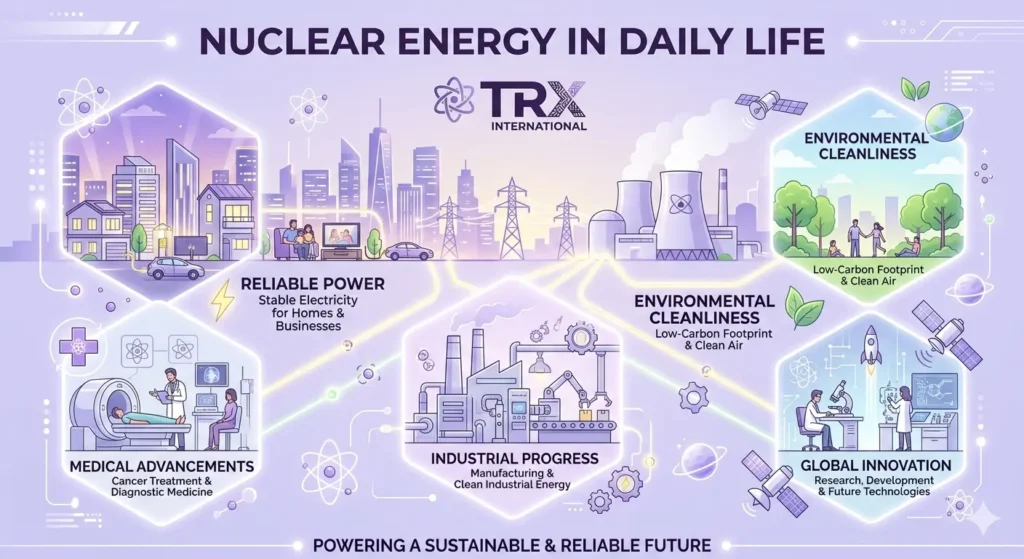
Nuclear energy isn’t limited to electricity generation, although that alone is a huge contribution. It extends into medicine, agriculture, industry, security, and even space exploration. The reason it shows up in so many places comes down to one thing.
Nuclear processes produce energy, radiation, and isotopes that can be used for incredibly precise tasks, whether that’s killing harmful bacteria, diagnosing a disease, or powering a spacecraft millions of miles from Earth.
Let’s break down the most common and genuinely fascinating examples.
| Use Case | How Nuclear Energy Is Applied | Real-World Impact |
|---|---|---|
| 1. Electricity That Lights Up Your Home | Nuclear reactors split uranium atoms to generate heat, which produces steam to spin turbines and create electricity | Powers around 10% of global electricity with near-zero carbon emissions, running 24/7 regardless of weather |
| 2. Smoke Detectors on Your Ceiling | A tiny sealed amount of americium-241 emits alpha particles that ionize air inside the detector | Triggers alarms when smoke disrupts the ionized air, saving countless lives in homes and offices worldwide |
| 3. Medical Imaging and Cancer Treatment | Radioactive isotopes like technetium-99m are used in scans; targeted radiation destroys cancer cells | Over 40 million medical procedures globally each year, supporting cancer care, cardiology, and diagnostics |
| 4. Food Safety and Longer Shelf Life | Controlled radiation kills bacteria, parasites, and insects on spices, fruits, grains, and meats | Reduces foodborne illnesses like salmonella and E. coli, extends shelf life, and cuts food spoilage |
| 5. Water Purification and Desalination | Nuclear reactors power desalination plants; isotope hydrology tracks groundwater and pollution | Turns seawater into drinkable freshwater and improves water resource management in drought-prone regions |
| 6. Industrial Inspection and Quality Control | Gamma rays and X-rays scan metals, welds, and structures without damaging them | Detects cracks and defects in aircraft, pipelines, bridges, and oil rigs to prevent dangerous failures |
| 7. Space Exploration and Deep Space Missions | Radioisotope thermoelectric generators (RTGs) use heat from plutonium-238 decay to generate electricity | Powers Voyager 1 and 2, Mars rovers, and Cassini where solar panels fail due to weak sunlight |
| 8. Archaeology and Dating Ancient Artifacts | Carbon-14 decay rates are measured to calculate the age of organic materials | Enables accurate dating of fossils, cave paintings, mummies, and artifacts going back tens of thousands of years |
| 9. Security at Airports and Borders | X-ray and gamma-ray scanners inspect luggage, cargo, and shipping containers | Detects contraband, weapons, and smuggled nuclear materials at airports, ports, and border checkpoints |
| 10. Agriculture and Crop Improvement | Radiation induces genetic variations in seeds through mutation breeding; sterile insect technique controls pests | Over 3,400 crop varieties developed for drought, pest, and disease resistance, reducing chemical pesticide use |
| 11. Consumer Products You Didn’t Expect | Trace radioactive materials used in camera lenses, exit signs, anti-static brushes, and some ceramics | Enables glow-in-the-dark safety signs, sharper camera optics, and static-free photography equipment |
| 12. The Clean Energy Transition and Future Cities | Small Modular Reactors (SMRs) and high-temperature reactors produce clean electricity and hydrogen fuel | Supports net-zero goals, powers remote communities, and fuels future transport with clean hydrogen |
Electricity That Lights Up Your Home
This one might seem obvious, but it’s worth starting here because the scale of it is enormous. Nuclear power plants generate around 10% of the world’s electricity, and in countries like France, that figure climbs to nearly 70%. If you live in parts of the United States, Canada, the UK, South Korea, or the UAE, there’s a strong chance that some of the electricity running your fridge, charging your phone, or powering your Wi-Fi router came from a nuclear reactor.
What makes it impressive is how little fuel is needed. One kilogram of uranium can produce roughly the same energy as 2.7 million kilograms of coal. That’s why nuclear is often described as dense, low-carbon, and reliable energy. It runs 24/7, rain or shine, which makes it different from solar or wind.
The environmental side of this matters too. Nuclear plants produce electricity with virtually zero carbon emissions during operation, making them a serious player in the clean energy conversation. As countries push toward net-zero targets, nuclear is increasingly seen as part of the solution rather than just the old-school villain it was once made out to be.
Smoke Detectors on Your Ceiling
Here’s a fun one. That small white disc on your ceiling, the one that beeps when you burn toast, likely contains a tiny amount of a radioactive element called americium-241. Before you panic, it’s completely safe. The amount is microscopic and sealed inside the detector.
How does it work? The americium-241 emits alpha particles that ionize the air inside a small chamber. When smoke enters, it disrupts this ionized air, and the detector triggers the alarm. It’s a brilliantly simple use of nuclear science that has saved countless lives in homes, offices, and schools around the world.
So the next time your smoke alarm beeps, you can thank a bit of radioactive material for watching over you.
Connect and Level Up Your Game
If you are interested in roles in nuclear space, reach out to the team at TRX International. We often have insights into upcoming outage needs and permanent staff positions before they hit the general job boards.
Medical Imaging and Cancer Treatment
If you or anyone you know has ever had an X-ray, CT scan, PET scan, or radiation therapy, you’ve directly benefited from nuclear technology. Hospitals use radioactive isotopes every single day for diagnostics and treatment. Technetium-99m, for instance, is used in over 40 million medical procedures each year worldwide.
Cancer treatment relies heavily on radiation therapy, which uses carefully targeted radiation to destroy cancer cells. This is one of the most important applications of nuclear energy in daily life, especially for millions of patients who depend on these treatments to survive and recover.
Nuclear medicine also plays a role in diagnosing heart disease, bone disorders, thyroid issues, and neurological conditions. Without nuclear science, modern healthcare would look very, very different.
Food Safety and Longer Shelf Life
Most people have no idea that a lot of the food they eat has been treated using nuclear technology. It’s called food irradiation, and it’s used to kill bacteria, parasites, and insects in everything from spices to fruits, grains, and meats. This process is approved by the World Health Organization and used in more than 60 countries.
Food irradiation helps reduce foodborne illnesses like salmonella and E. coli, extends shelf life, and reduces spoilage. It doesn’t make the food radioactive, just like an airport scanner doesn’t make your luggage radioactive. It’s just a quick, controlled exposure that keeps your food safer.
Farmers also benefit. Radiation is used to sterilize insects in a technique called the sterile insect technique (SIT), which helps control pests without chemical pesticides. It’s a cleaner, more sustainable way of protecting crops.
Build Your Nuclear Dream Team
Every unfilled role is a missed deadline. Top nuclear talent is scarce and getting scarcer. TRX International sources pre-vetted specialists globally so your projects stay on schedule and fully compliant.
Water Purification and Desalination
Access to clean water is one of the biggest global challenges today. Nuclear technology plays a surprisingly important role here too. Some countries use nuclear reactors to power desalination plants, which convert seawater into drinkable freshwater. Kazakhstan, India, and Japan have all experimented with nuclear-powered desalination at commercial scale.
Beyond that, isotope hydrology is used to study groundwater sources, track pollution, and manage water resources more effectively. Scientists use tiny amounts of isotopes to trace how water moves through soil, rivers, and underground aquifers. This helps cities and governments manage droughts, floods, and water shortages with much better accuracy.
Industrial Inspection and Quality Control
You’ve probably driven across a bridge, boarded a plane, or used a gas pipeline without realizing that nuclear technology helped inspect them. Industrial radiography uses gamma rays or X-rays to detect cracks, weaknesses, or defects in metals, welds, and structures. It’s non-destructive, meaning it doesn’t damage the object being tested.
This is a huge deal in industries like oil and gas, aerospace, construction, and manufacturing. Without nuclear-based inspection tools, ensuring the safety and longevity of critical infrastructure would be far more expensive and less accurate. From aircraft engines to massive oil rigs, radiography keeps things running safely.
Space Exploration and Deep Space Missions
Here’s where things get really cool.
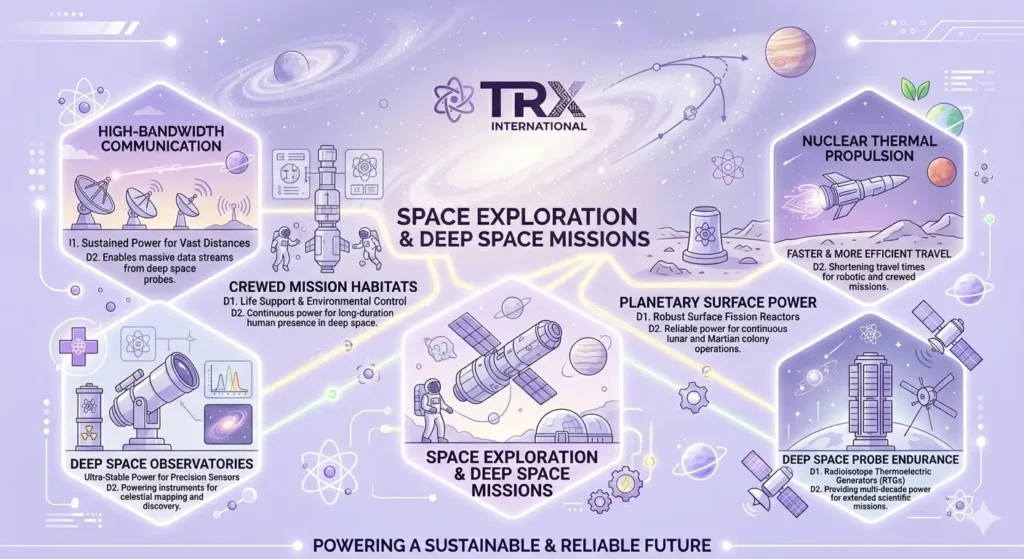
NASA and other space agencies have been using nuclear energy in daily life, or rather, in spacecraft life, for decades. Radioisotope thermoelectric generators (RTGs) use the heat from decaying plutonium-238 to generate electricity. These RTGs power spacecraft like Voyager 1, Voyager 2, Cassini, and the Mars rovers Curiosity and Perseverance.
Solar panels don’t work well in deep space where sunlight is weak. Nuclear power steps in and keeps instruments running for decades. Voyager 1, launched in 1977, is still communicating with Earth from interstellar space thanks to its nuclear generator. That’s nearly 50 years of continuous operation. Impressive, right?
Archaeology and Dating Ancient Artifacts
Ever wondered how scientists know a dinosaur fossil is 65 million years old or that a cave painting is 40,000 years old? The answer is radiocarbon dating, which uses the radioactive isotope carbon-14 to determine the age of organic materials. This technique has transformed archaeology, paleontology, and historical research.
Without nuclear science, much of what we know about human history, ancient civilizations, and Earth’s timeline would still be guesswork. Every museum exhibit that tells you when something existed owes a quiet thanks to nuclear physics.
Looking to hire nuclear professionals or explore nuclear career opportunities?
TRX International connects world-class talent with critical roles across the global nuclear industry. Visit trx-international.com or get in touch with the team to start the conversation.
Security at Airports and Borders
Those big scanners at airports?
Many of them use X-ray or gamma-ray technology derived from nuclear science to scan luggage and cargo. Customs agencies also use radiation detectors to catch smuggled nuclear materials at ports and borders. It’s one of those things you interact with almost every time you travel without giving it much thought.
Agriculture and Crop Improvement
Farmers around the world have used nuclear techniques to develop better crops. Through a process called mutation breeding, scientists use radiation to create genetic variations in seeds, some of which result in crops that are more resistant to drought, pests, or disease. Over 3,400 crop varieties have been developed this way, including certain types of rice, wheat, barley, and peppers.
This isn’t genetic modification in the GMO sense. It’s simply an accelerated version of the natural mutations that happen in nature, helping farmers feed more people with fewer resources.
Consumer Products You Didn’t Expect
Some everyday items contain small amounts of radioactive materials or rely on nuclear-derived processes. Examples include certain camera lenses, watch dials (older ones), exit signs that glow without electricity, and anti-static brushes used in photography.
Even some ceramics and tiles have trace amounts of uranium for color. These are all perfectly safe and tightly regulated, but they show how deeply nuclear science is embedded in manufacturing.
The Clean Energy Transition and Future Cities
As the world shifts toward greener energy, nuclear is making a big comeback. Small Modular Reactors (SMRs) are being designed to power remote communities, industrial sites, and even future lunar bases. Countries like the UK, US, Canada, and China are heavily investing in SMR development.
Nuclear energy also supports hydrogen production, a fuel that could soon power cars, trucks, ships, and airplanes. High-temperature reactors can split water into hydrogen efficiently, offering a cleaner alternative to fossil fuels. In short, nuclear is quietly becoming a backbone of the future energy mix.
Why So Many Industries Rely on Nuclear Expertise?
The more you look, the clearer it becomes. Nuclear energy isn’t just about giant power plants. It’s a web of science, engineering, medicine, and innovation that touches almost every sector. This is also why the demand for skilled nuclear professionals continues to grow year after year.
From reactor engineers and radiation specialists to regulatory experts and nuclear medicine technologists, the industry needs talent across dozens of disciplines.
And that’s exactly where specialist recruitment partners come in.
Finding the Right Nuclear Talent With TRX International
The nuclear industry isn’t a space where generalist recruiters thrive. It requires deep technical understanding, regulatory awareness, and a strong network of qualified professionals. That’s where TRX International stands out. As one of the leading specialist nuclear recruitment agencies, TRX International connects world-class nuclear talent with projects that power modern life, from nuclear power plants and decommissioning sites to SMR development, nuclear medicine facilities, and research reactors.
Whether you’re an employer looking to fill critical roles in reactor engineering, radiation protection, nuclear safety, or project management, or a professional searching for your next big opportunity in the nuclear sector, TRX International offers tailored recruitment solutions backed by industry expertise. The team understands the nuances of the nuclear industry, the regulations, and the pace of innovation happening globally, making them a trusted partner for both candidates and clients.
FAQs
Is nuclear energy really used in everyday life?
Yes. Nuclear energy and nuclear science are used in electricity generation, medical imaging, cancer treatment, food preservation, smoke detectors, water desalination, industrial inspection, and many other areas most people interact with regularly.
Are smoke detectors really radioactive?
Most ionization smoke detectors contain a tiny, sealed amount of americium-241. It’s safe, tightly regulated, and poses no risk during normal use.
Does food irradiation make food radioactive?
No. Food irradiation exposes food to controlled radiation to kill bacteria and pests. The food itself does not become radioactive and remains completely safe to eat.
How does nuclear energy help in medicine?
Nuclear medicine uses radioactive isotopes for diagnosing and treating conditions like cancer, heart disease, and thyroid disorders. Techniques include PET scans, CT scans, and radiation therapy.
Why is the nuclear industry hiring so many professionals today?
Global interest in clean energy, SMRs, nuclear medicine, and decommissioning projects is driving demand for skilled engineers, scientists, and technicians. Specialist recruitment agencies like TRX International play a key role in connecting talent with these opportunities.
Final Thoughts
Nuclear energy in daily life is one of those quiet giants. It powers homes, saves lives in hospitals, protects food supplies, explores distant planets, and even helps uncover ancient history. The more you look around, the more you realize how deeply nuclear science is woven into the modern world.
It’s not just about reactors and cooling towers. It’s about a field of science and engineering that continues to push humanity forward in countless practical, often invisible, ways. And as the world leans further into clean energy and advanced technology, nuclear will only become more important.
So next time you hear someone mention nuclear energy, you’ll know it’s not just about power plants. It’s about the smoke detector in your home, the CT scan at your hospital, the strawberries in your fridge, and the rover exploring Mars. It’s everywhere, helping in quiet but powerful ways.